



Published by TrenBuzz.com | April 24, 2026
Key Points at a Glance
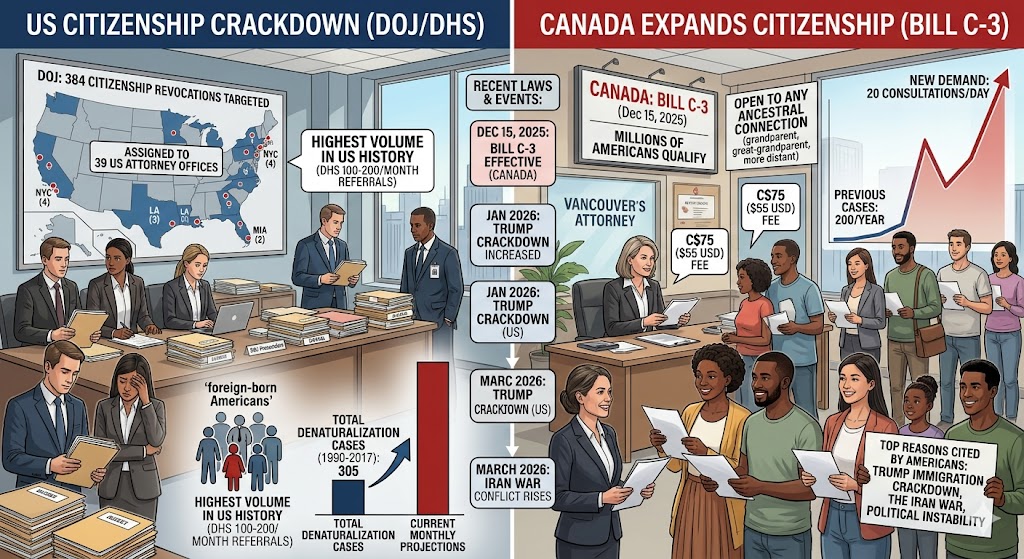
- The DOJ has identified 384 foreign-born Americans whose citizenship it wants to revoke — assigning cases to prosecutors in 39 US attorney offices nationwide.
- This is the highest volume of denaturalization referrals in US history, with DHS directed to refer 100–200 cases per month.
- Between 1990 and 2017, the US filed just 305 denaturalization cases total — an average of 11 per year.
- Simultaneously, Canada’s new Bill C-3 — effective December 15, 2025 — opens Canadian citizenship to anyone with a grandparent, great-grandparent, or more distant Canadian ancestor.
- Immigration attorneys say millions of Americans already qualify and may not know it.
- One Vancouver attorney went from 200 citizenship cases per year to 20 consultations per day since the law took effect.
- The Canadian citizenship application fee is just C$75 ($55 USD) for those with documentation ready.
- Americans cite Trump’s immigration crackdown, the Iran war, and political instability as their top reasons for applying.
On the exact same day — April 23, 2026 — two headlines landed side by side that together tell the story of a country at a crossroads with itself.
The United States Department of Justice announced it is moving to strip citizenship from hundreds of naturalized Americans. Meanwhile, Canada quietly opened its doors to potentially millions of Americans who may have never even realized they already belong there.
Part 1: The DOJ’s Historic Denaturalization Push
The Justice Department has identified 384 foreign-born Americans whose citizenship it wants to revoke, part of a push to increase the pace of denaturalizations by assigning the cases to prosecutors in dozens of US attorney’s offices across the country. Senior Justice Department officials told colleagues that civil litigators in 39 regional offices would soon be assigned to file denaturalization cases against these individuals.
Matthew Tragesser, DOJ’s deputy director for communications, said the department is “pursuing the highest volume of denaturalization referrals in history” and is “moving at warp speed to ensure fraudsters are held accountable and prosecuted to the fullest extent.”
Between 1990 and 2017, the US filed 305 denaturalization cases — an average of just 11 per year. The Trump administration directed DHS to present 100 to 200 denaturalization cases per month in fiscal year 2026.

Who Is Being Targeted — And How?
Under federal law, the government can ask a court to strip citizenship from people who obtained it fraudulently, including through a sham marriage or by hiding information that would have made them ineligible. The government must present evidence to a federal judge in a civil or criminal proceeding.
The Justice Department has widened the pool of denaturalization candidates. Now, federal prosecutors are pursuing violent criminals, gun offenders, human traffickers, and fraudsters — including those who hid criminal histories during their naturalization process.
Amanda Frost, a law professor at the University of Virginia, warned: “The message it sends is that naturalized citizens don’t have the same rights and stability as native-born citizens.” She added that the government has previously used this power to target those it views as political opponents.
Part 2: Canada’s “Little Gift” — Millions of Americans Already Qualify
While Washington strips citizenship from some, Ottawa is quietly recognizing it for millions more — and Americans are rushing to find out if they qualify.
Potentially millions of Americans suddenly have a much easier path to Canadian citizenship. A change in Canada’s laws has prompted a rush of people to explore their ancestry and file paperwork seeking dual citizenship. Since the new law took effect December 15, immigration lawyers in the United States and Canada say they have been overwhelmed by clients seeking help submitting proof of citizenship applications.
Previously, Canadian citizenship by descent could only be passed down one generation — from parent to child. But Canadian Bill C-3 opened citizenship to anyone born before December 15 who could prove a direct Canadian ancestor — a grandparent, great-grandparent, or even more distant relative.
Immigration attorney Amandeep Hayer, who advocated for the new law in Parliament, explained: “You are Canadian, and you’re considered to be one your whole life. That’s really what you’re applying for — the recognition of a right you already have vested.”
Americans Are Flooding Canadian Immigration Offices
Immigration attorney Amandeep Hayer said his Vancouver-area practice went from about 200 citizenship cases a year to more than 20 consultations per day. Attorney Nicholas Berning in Bellingham, Washington said his practice is “pretty much flooded with this” and has shifted other work away to push these cases through.
Maureen Sullivan of Naples, Florida, whose grandmother was Canadian, said she sees citizenship in Canada as an option if things in the US “really go south.” She described it as “this little gift that fell in my lap,” adding: “There was kind of this collective excitement among the family who just felt like we wanted to feel like we were doing something to take care of our security in the future.”
For those with documentation ready, the proof of citizenship application fee is just C$75 ($55 USD). Costs rise for those needing attorney or genealogist help to locate birth, death, and marriage certificates establishing Canadian lineage.
The Defining Contrast of 2026
Two nations. Two citizenship stories. One pulling the welcome mat from under naturalized Americans — the other rolling one out to millions who never knew they needed it.
Hafiz, a civil liberties attorney, warned the DOJ’s denaturalization push could be carried out in a “very broad and expansive way,” noting: “We’ve seen in so many of the tactics that the Trump administration is using what a slippery slope it is — how they say this policy is to target one set of individuals, and how that set of individuals just becomes broader as it’s applied.”
America Is Stripping Citizenship: Whether you’re worried about your existing citizenship — or quietly hoping a Canadian grandparent just handed you a lifeline — April 23, 2026 may be a date worth remembering.
Disclaimer: This article is for general informational and news reporting purposes only. All quotes, legal details, and policy information are based on publicly available and credible news sources as of April 24, 2026. TrenBuzz.com does not provide immigration or legal advice. Readers considering denaturalization defenses or Canadian citizenship applications should consult a qualified immigration attorney. Information is subject to change — please verify with official government sources.