


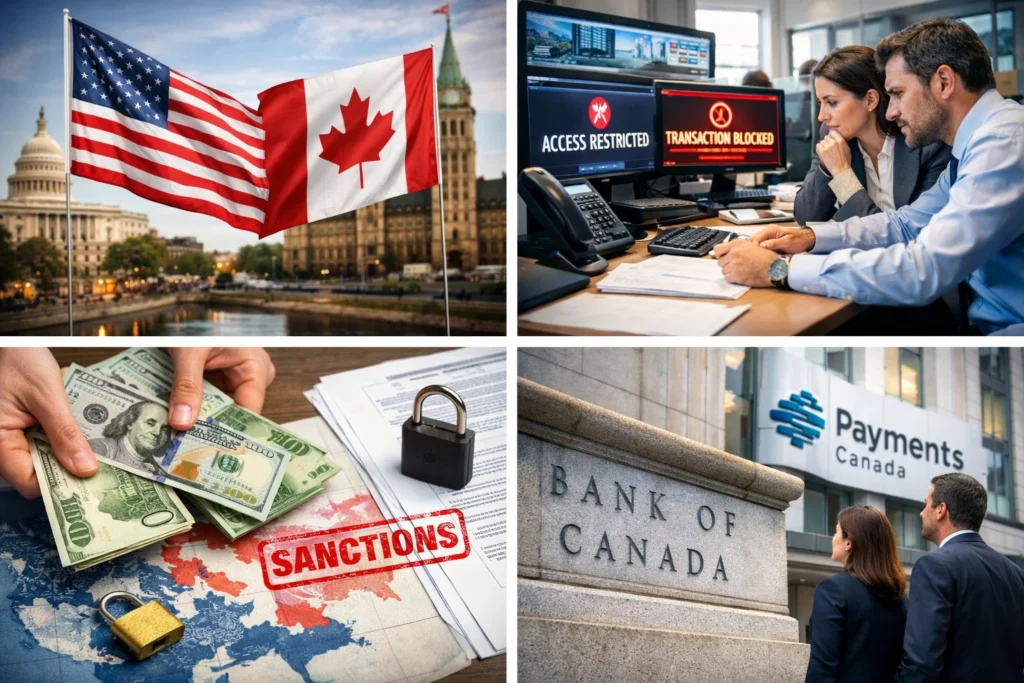
Key points
- There is no public evidence that Canada has issued a blanket legal ban blocking all U.S. banks from operating in Canada — claims to that effect have circulated and been disputed.
- Political rhetoric and tariff disputes have stoked headlines suggesting a financial “freeze-out,” but in practice Canada’s actions so far are limited to trade measures, regulatory controls and targeted sanctions tools — not an across-the-board ban.
- Canada can cut specific payment channels, restrict dollar clearing access for named institutions, or use sanctions/market rules in retaliation — steps that would be costly and legally complex and that would reverberate through North American markets. (See examples of prior multilateral measures.)
- Financial markets, corporate treasuries and cross-border business should watch three practical signals: changes in correspondent-bank arrangements, Canada’s sanctions/OFAC-style guidance, and payments-system rules from the Bank of Canada and Payments Canada.
Headline answer — did Canada “block” U.S. banks?
Short answer: no, not in any routine, public legal sense. Sensational headlines like “Canada blocks U.S. banks” have been driven by political statements, trade tensions and speculation about what could be done — not by a single, authoritative government order halting all U.S. banks’ operations in Canada. Recent fact-checks and reporting find plenty of U.S. bank presence in Canada and regulatory complexity, but not a blanket exclusion.
Where the idea came from (quick background)
Two drivers created the headline risk:
- Political claims and rhetoric. Public figures have framed tariff rows and financial friction as if U.S. banks were being “frozen out.” Reuters covered a notable moment where a U.S. leader claimed U.S. banks were barred — a claim that prompted pushback and fact checks.
- Real levers that could be pulled. Canada has legal tools — trade measures, sanctions authorities, regulatory supervision, and payment-system rules — that can be used selectively against institutions or services. Those tools exist; deploying them wholesale would be exceptional and economically disruptive.
What “blocking” a bank would mean in practice
If Ottawa wanted to effectively block one or more U.S. banks (or services they provide) it would likely use a combination of mechanisms rather than a single blunt legal switch:
- Sanctions or designation: Canada can place named institutions or counterparties under restrictive measures that limit correspondent access or freeze assets. (Targeted designations are far more common than blanket bans.)
- Payment-rail limits / correspondent-bank restrictions: Governments can pressure clearing banks or payment infrastructures; rerouting or closing correspondent accounts can choke a bank’s ability to clear U.S.-dollar payments. Historical precedent: coordinated moves to cut Russia’s access to SWIFT illustrate how financial chokepoints can be used multilaterally.
- Regulatory barriers / licensing: Domestic regulators and supervisors can limit branches, block particular foreign acquisitions, or tighten licensing for cross-border activity — steps that raise compliance costs and slow business expansion.
- Market-level responses: Insurers, custodians and foreign correspondents can pre-emptively restrict services if political risk spikes — meaning market actors often do the “blocking” before a legal order arrives. (Think risk-off cycles in correspondent banking.)

Why Ottawa would be cautious — the costs of escalation
A true, wide “blocking” of U.S. banks would carry immediate costs for Canada and for global finance:
- Trade & investment pain: Cross-border banking lubricates trade, corporate treasury, and foreign direct investment between the two economies. Interrupting those channels would raise costs for Canadian importers/exporters and multinational companies.
- Reciprocal measures risk: The United States could respond with financial counter-measures, regulatory pushback or tariff-related steps — raising geopolitical risk and market volatility.
- Market contagion: Disruption to dollar clearing or correspondent lines would ripple through commodity markets, pension funds and corporate liquidity — and would likely trigger emergency steps by central banks (including the Bank of Canada).
What has happened so far (facts you can cite)
- Reporting shows sharp political tensions and retaliatory trade measures between the two countries in recent months; that context fuels claims about banking restrictions. Journalists and fact-checkers have pushed back on claims that U.S. banks are legally barred across Canada.
- Canadian authorities and the Bank of Canada have been publicly active on payment modernization, financial-stability guidance and contingency planning — steps that improve resilience but are not the same as “blocking” foreign banks.
Scenario planning — 3 plausible “what ifs”
Targeted designations against specific entities. Ottawa names a bank or network as subject to measures that restrict certain transactions. Impact: targeted but manageable; counterparties can be re-routed. (Most likely short of full escalation.)
Correspondent-bank disruption (indirect blocking). Commercial banks and custodians, fearing regulatory or reputational risk, close correspondent accounts with certain U.S. institutions. Impact: sudden payment frictions; corporates scramble for alternatives. (Plausible and market-driven.)
Formal multilateral financial exclusion. Canada helps coordinate an allied restriction on access to a key global message/clearing system. Impact: severe, rapid market shock. Historically rare and used only in extreme geopolitical cases.
What businesses and individuals should watch this week
- Correspondent-bank notices: treasury teams should ask banks whether correspondent lines are at risk and request contingency plans.
- Regulatory guidance: read updates from the Bank of Canada, Payments Canada, and Finance Canada for emergency measures.
- Sanctions lists & OFSI/OFAC-style advisories: legal/compliance teams should monitor Canada’s sanctions releases and related guidance for named entities.
- FX & clearing liquidity: CFOs should evaluate dollar liquidity buffers and alternative clearing paths (e.g., other correspondent banks, local currency netting).