


By TrenBuzz — Special report
Key points
- Canada’s Prime Minister Mark Carney publicly urged the U.S. to respect Canadian sovereignty after reports that U.S. officials held private meetings with the Alberta Prosperity Project, an Alberta separatist group.
- The meetings — reported to have taken place several times since April 2025 — reportedly included discussion of a large credit facility proposal from the separatists and triggered uproar in Ottawa and some provincial capitals.
- Provincial leaders voiced a range of reactions: Alberta’s premier stressed local frustrations with federal policy but stopped short of endorsing secession; British Columbia’s premier called the contacts “treasonous.”
- Washington says its contacts were routine engagement with civil-society groups; Ottawa sees the talks as a red line unless the U.S. clarifies its posture. The row has raised larger questions about foreign interference and alliance trust.
Carney says he expects Trump to— the short version
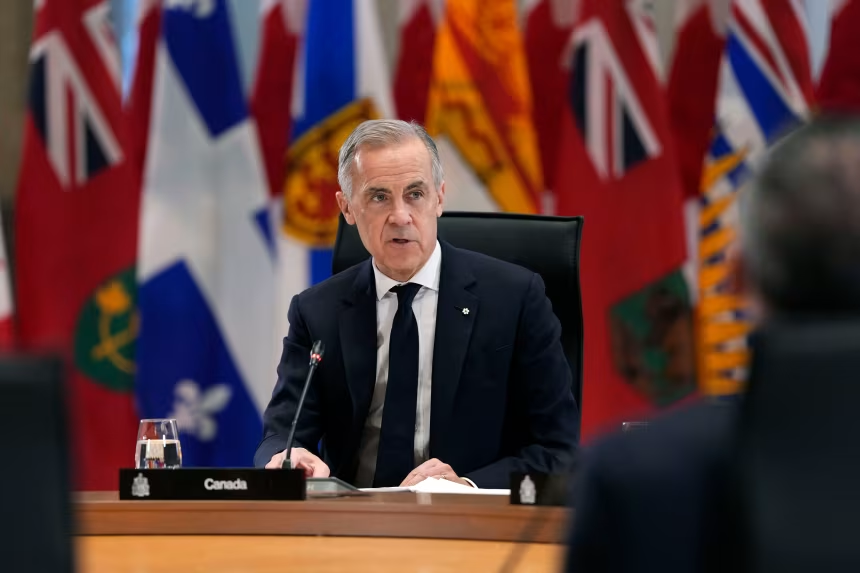
Prime Minister Mark Carney told reporters he expects the U.S. administration to respect Canadian sovereignty after revelations that members of the Trump administration met privately with an Alberta separatist group. The disclosures have provoked a diplomatic and domestic political backlash in Canada, exposing tensions over energy policy, federal–provincial relations and the limits of U.S. engagement with domestic Canadian actors.
What happened (facts)
- Multiple news outlets reported that officials from the U.S. State Department and Treasury held meetings with representatives of the Alberta Prosperity Project (APP) on several occasions between April 2025 and January 2026. The APP has pushed for Alberta independence and discussed bold funding proposals with U.S. interlocutors.
- Ottawa learned of the contacts and publicly demanded clarity; Carney’s response was to reiterate that Canada’s sovereignty must be respected and that internal Canadian matters should be decided by Canadians.
- U.S. spokespeople have characterized such contacts as routine engagement with civil-society groups, not an endorsement of separatism. Washington says no official U.S. policy supports Alberta breaking away from Canada.


Why Ottawa is alarmed
- Foreign interference risk. Contacts by a powerful ally with a group seeking to break up a sovereign state raise classic foreign-interference concerns and risk inflaming domestic tensions.
- Energy and geopolitics: Alberta is Canada’s energy heartland; any foreign encouragement of separatism could be motivated by commercial or strategic interest in resources—raising the stakes for Ottawa.
- Alliance trust: The U.S.–Canada security relationship depends on predictable, respectful behavior; secretive outreach to separatists strains that foundation and demands a clear U.S. public posture.
Reactions across Canada and Washington
- Mark Carney (Prime Minister): Called for respect for sovereignty and said he has made Canada’s position “clear” in conversations with President Trump.
- Alberta Premier Danielle Smith: Emphasized Albertans’ frustrations with federal policy but reiterated that decisions about Alberta’s future should be made by Albertans, not foreign governments.
- B.C. Premier David Eby: Strongly condemned the contacts and used the word “treason” to describe the separatists’ appeal to U.S. officials.
- U.S. officials: Characterized meetings as routine engagement with civil-society actors; some U.S. comments (from senior officials) describing Albertans as “very independent” have nonetheless been seized on politically in Canada.
Practical implications
- Diplomatic: Ottawa will likely demand formal clarification from Washington and may seek written assurances that the U.S. does not support any attempt to undermine Canadian territorial integrity.
- Domestic politics: The episode strengthens voices in Ottawa calling for unity measures, and gives provinces ammunition both to press federal government policy (e.g., on pipelines) and to decry external meddling.
- Security and intelligence: Canadian security services may heighten monitoring of foreign influence campaigns and of the funding channels that could back separatist activity.
Quick interactive checklist — what Canadians and observers should track
- Does Washington issue a public clarification or apology? — If yes, that will reduce diplomatic heat; if not, expect Ottawa to escalate requests for formal assurances.
- Will any U.S. official statements be backed by documents or meeting notes? — If yes, transparency may defuse mistrust; if no, suspicion will linger.
- Are federal or provincial leaders calling for an independent inquiry? — If yes, a formal probe could reveal more about the scope and purpose of the contacts.
What to watch next
- Formal U.S. clarification: A White House or State Department statement explicitly denying support for secession would be the fastest de-escalator.
- Ottawa’s diplomatic moves: Note whether Carney raises the issue at G7/NATO meetings or requests a bilateral diplomatic demarche.
- Parliamentary action in Canada: Look for committee hearings, emergency debates, or requests for intelligence briefings.
Bottom line
Revelations that U.S. officials met privately with Alberta separatists have forced a sharp Canadian response. Mark Carney’s public demand that the U.S. “respect Canadian sovereignty” seeks to reassert that international norm and to push Washington to clarify that it will not meddle in Canada’s internal affairs. How the U.S. answers — and whether Ottawa pursues formal diplomatic or parliamentary remedies — will determine whether this becomes a short diplomatic spat or a lasting rupture in bilateral trust.