


Table of contents
- Quick takeaway
- Market reaction: Chevron (CVX), Exxon (XOM), ConocoPhillips (COP) and energy shares
- Oil prices and futures: immediate moves and medium-term outlook
- Venezuela’s oil reserves — scale, quality and why it matters
- Why markets moved: the capture of Maduro and political fallout
- What this means for Chevron and other oil majors (fundamentals & risks)
- Investment checklist: watchlist items for energy investors
- Celebrity and public reaction (Mark Ruffalo and others) — why it matters for perception
- Reader poll — are you bullish on oil stocks now? (results visible only to you)
- Bottom line & disclaimer
1 — Quick takeaway (Chevron Stock, Oil Prices and Venezuela’s Reserves)
Energy markets spiked on early-January 2026 geopolitical shocks, lifting major U.S. oil stocks while analysts warned the supply picture may still keep prices capped through 2026.
Chevron (CVX) and peers saw sharp intraday gains on headlines; traders balanced short-term supply uncertainty against longer-term forecasts that expect ample global oil output.
2 — Market reaction: Chevron (CVX), Exxon (XOM), ConocoPhillips (COP) and energy shares
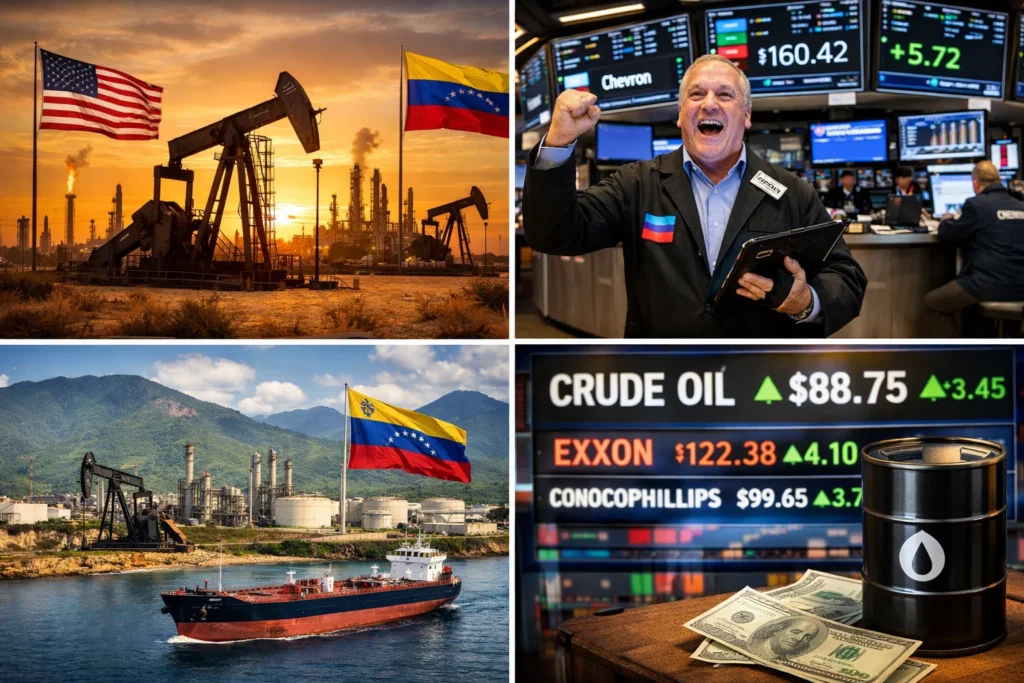
Chevron’s shares jumped sharply in pre-market trade after announcements suggesting U.S. firms could re-enter Venezuelan oil, reflecting investor bets on eventual upstream opportunities.
Official closing prices for early January show Chevron around $155–$165 per share depending on the source and exact day; Exxon closed near $122–$123 in the same window.
ConocoPhillips (COP), a major U.S. independent, also rallied alongside integrated majors as traders priced the prospect of larger Western investment in Venezuelan heavy-oil projects.
Those moves were strongest on the first trading sessions after the geopolitical event; analysts cautioned that market moves reflect expectations, not immediate production changes.
3 — Oil prices and futures: immediate moves and medium-term outlook
Brent and WTI rose modestly on the news — Brent traded near the low $60s per barrel and WTI near the high $50s to low $60s in early January 2026.
However, surveyed analysts expect 2026 price pressure from ample supply and sluggish demand, with Reuters’ survey placing average Brent in the low $60s for the year; futures traders remain divided.
4 — Venezuela’s oil reserves — scale, quality and why it matters
Venezuela holds the world’s largest proven crude reserves — roughly 300–303 billion barrels — concentrated in heavy Orinoco Belt crude that requires special handling and investment to process.
Scale alone doesn’t translate into immediate crude flows: underinvestment, sanctions and degraded infrastructure have constrained Venezuelan output to a fraction of its potential.
Restoring meaningful volumes would take years and large capital expenditures; meanwhile, political and legal hurdles add uncertainty for Western oil firms.
5 — Why markets moved: the capture of Maduro and political fallout
The capture of President Nicolás Maduro and subsequent U.S. statements about opening Venezuela’s oil sector to Western companies triggered hopes among investors that Venezuelan crude could eventually increase global supply.
Short-term market reaction lifted energy equities, but credit and commodity markets remain focused on practical limitations to rapidly restoring Venezuelan output.

6 — What this means for Chevron and other oil majors (fundamentals & risks)
Upside case: access to massive heavy-oil resources could expand long-term reserves and provide advantaged feedstock for refineries capable of processing heavy crude.
Downside and practical risks: legal claims, asset disputes (including CITGO and other foreign holdings), sanctions remnants, and the technical cost of retooling operations mean any commercial upside is multi-year and uncertain. (
Chevrons’ fundamentals—cash flow, dividends, and capital allocation—are central to investor sentiment; a potential Venezuelan reopening is a strategic tailwind but not a near-term earnings driver.
Exxon and ConocoPhillips share the same profile: potential reserve upside balanced against reputational, legal and operational complexity.
7 — Investment checklist: watchlist items for energy investors
• Monitor official statements from Chevron, Exxon, and ConocoPhillips about Venezuela engagement.
• Track oil futures curve, spare capacity reports, and OPEC+ meeting outcomes for supply signals.
• Watch commodity and shipping lanes for logistical bottlenecks that could temporarily lift physical crude spreads.
• Follow legal developments around Venezuelan assets and any sanctions relief or reinstatement — these determine real access.
8 — Celebrity and public reaction (Mark Ruffalo and others) — why it matters for perception
High-profile figures and Hollywood personalities reacted strongly to the U.S. action in Venezuela; social posts attributed comments to actors such as Mark Ruffalo circulated widely.
Celebrity reactions can shape public perception and political pressure, which in turn can influence regulatory scrutiny and reputational risk for companies considering re-entry into politically sensitive markets.
After the Venezuela developments and market moves, are you bullish on oil stocks?
10 — Bottom line & disclaimer
Short-term: geopolitical shocks can lift oil prices and energy stocks quickly, and Chevron’s CVX rallied on the Venezuela headlines.
Medium-term: most forecasters still see 2026 prices facing downward pressure from ample supply and ongoing demand weakness; Venezuelan reserves are enormous, but turning them into seaborne barrels is costly and time-consuming. Investors should balance headline-driven momentum with longer-term fundamentals and legal/political risk.
Disclaimer: This article synthesizes market data, reporting and analyst surveys current as of early January 2026. It is informational and not investment advice. Investors should consult licensed financial advisors and company filings before making investment decisions.