


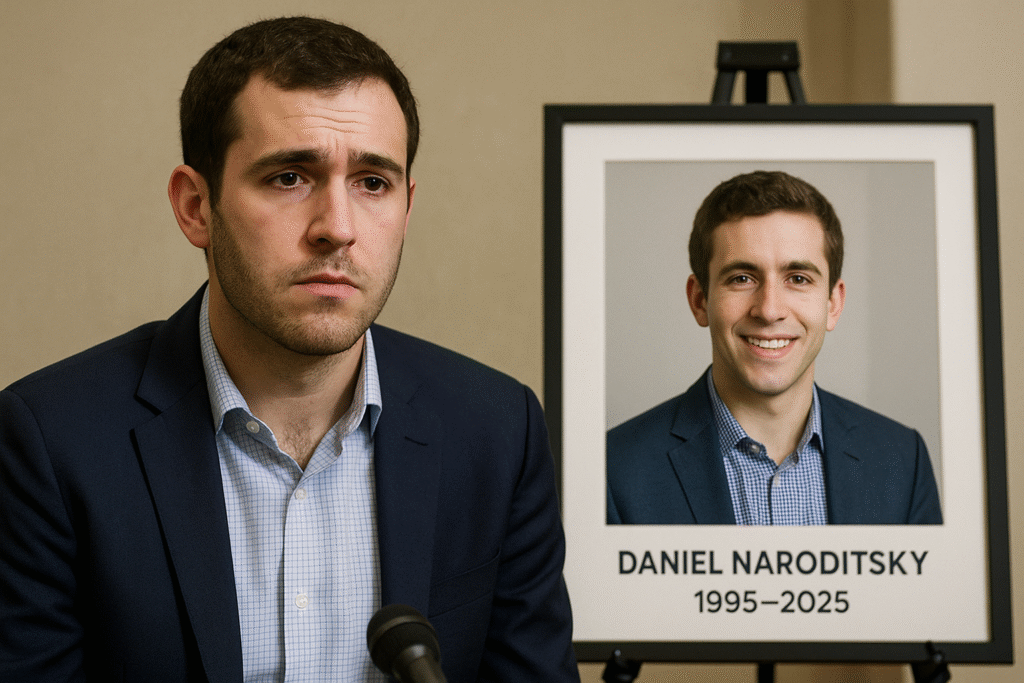
Daniel Naroditsky cause of death: Daniel (Danya) Naroditsky — the American chess grandmaster, commentator, streamer and teacher — died unexpectedly on 19 October 2025, the Charlotte Chess Center and Naroditsky’s family announced.
At the time of writing the family and official channels have not released a cause of death. The global chess community has responded with shock, tributes, and also social-media speculation; this post separates verified facts from unconfirmed claims, walks a clear timeline of events, and lists trustworthy sources you can check for updates.
1) The verified facts (Daniel Naroditsky cause of death)
• The Charlotte Chess Center announced the unexpected passing of Daniel Naroditsky.
• Major news organizations — AP, Reuters, The Guardian, Al Jazeera and Chess.com — reported his death, citing the family or the Center.
• No official cause of death had been released publicly as of Oct 21, 2025.
These three items are the core facts readers need first.
2) Who Daniel Naroditsky was — life, chess and public impact
Daniel Naroditsky (b. Nov 9, 1995) rose to prominence as a chess prodigy: World Youth (U12) champion, U.S. junior champion, and a grandmaster by age 18.
Beyond tournament play, he became one of chess’s most effective teachers and popularizers through YouTube, Twitch, commentary and widely used instructional content.
He served as Grandmaster-in-Residence at the Charlotte Chess Center and was known for warm, analytical commentary that helped grow online chess audiences.
3) How the news unfolded — a brief timeline
• Oct 19–20, 2025: The Charlotte Chess Center posted a family statement announcing Naroditsky’s unexpected passing. Major outlets republished the family/club notice.
• Oct 20–21, 2025: Obituaries and remembrances poured in from Chess.com, Reuters, AP, The Guardian and national newspapers. Tributes from peers and students followed.
• Oct 21, 2025 (ongoing): No public medical explanation or coroner’s statement had been released; journalists noted that an official cause would be disclosed by the family or authorities when appropriate.
4) What isn’t known — and why that matters
At this stage the cause of death is not publicly known — family statements and the club’s announcement emphasized the unexpected nature but did not specify medical or other details.
Speculation online — including posts claiming suicide, foul play, or dramatic narrative details — is unverified. Repeating unconfirmed claims risks harm to grieving family and friends. Wait for authoritative releases (family, club, coroner) before treating cause as fact.
5) Rumors and social media reaction — what’s trending and what’s verified
After the announcement, social posts and some news pieces amplified two themes: (1) emotional backlash toward public figures who had criticized Naroditsky in the past; and (2) highly specific claims about who found him or the immediate circumstances.
Major outlets have reported the social-media backlash as reaction, not as proven fact. Claims of criminal foul play or direct causation (for example blaming a named public figure) are as-yet unproven and should be treated as allegations, not established truths.


6) The Kramnik angle — what people are saying, and what’s confirmed
Some community posts and a handful of articles noted that former World Champion Vladimir Kramnik had been involved in a public dispute or criticism earlier — and some users on social platforms blamed him for escalating pressure.
Important: reporting shows fan outrage and online calls for accountability, but mainstream outlets that have checked facts treat these as reactions to earlier disputes rather than as evidence linking Kramnik to Naroditsky’s death. There is no verified connection between Kramnik’s public comments and the tragic outcome.
7) The Bortnyk mentions — friendship, not confirmation
Social posts referenced Ukrainian grandmaster Oleksandr Bortnyk (sometimes spelled Olexandr) in relation to Naroditsky’s death, including speculative claims about discovery or presence.
At the time of writing, reputable outlets have not published verified investigative details naming who discovered the body or establishing any forensic timeline — treat those reports as unconfirmed until corroborated by a primary source.
8) Why journalists are cautious — the ethics of reporting deaths
Responsible outlets (AP, Reuters, Guardian) follow journalistic standards: confirm death via primary family or club statement, do not publish medical causes until official release, and avoid amplifying lurid social posts.
That approach protects privacy, reduces misinformation, and gives investigators time to produce accurate information. Expect authoritative updates first from the family, the club, or official public records.
9) A reader’s checklist — how to verify any new claim you see online
- Who is the primary source? Family statement, club announcement, or coroner’s release are primary.
- Is it corroborated? Look for at least two reputable outlets (AP, Reuters, Guardian, NYT).
- Does it cite documents? Police or coroner statements, hospital releases, or official social posts.
- Avoid single social posts unless they originate from the family or accredited institutions.
Using this checklist will help you avoid amplifying rumor.

10) Naroditsky’s legacy — what peers and the chess world are saying
Tributes across outlets emphasized his role as an educator and bridge-builder in chess: a talented player who made complex ideas accessible.
Top players, commentators and organizations highlighted his warmth, his public teaching work, and the massive online audience he cultivated — all signs that his influence extended far beyond tournament results.
11) What to expect next — official steps and timing
Typically, in an unexpected death the following sequence can take place (timing varies by jurisdiction): family statement → coroner/autopsy review (if applicable) → police notifications if required → public release of cause (if family consents).
Expect reliable outlets to wait for those official documents before reporting a medical cause; that process can take days or longer depending on investigations.
12) How to responsibly react and share — advice for fans and writers
• Share the family or club statement rather than third-hand claims.
• Avoid spreading graphic or unverified details.
• If you wish to honor his legacy, highlight his teaching videos, commentaries, or donate to chess education funds he supported.
• For discussion: separate mourning and tribute from speculation about cause — empathy first, investigation second.
13) FAQ — short answers to what people are searching now
Q: Did Daniel Naroditsky die?
A: Yes. His death was announced by his family via the Charlotte Chess Center and reported by major news outlets.
Q: What was the cause of death?
A: The cause has not been publicly released by the family or by authorities as of Oct 21, 2025. Avoid repeating unverified causes.
Q: Was he murdered or did he die by suicide?
A: No authoritative source had made that determination public. Treat such claims as unconfirmed until official reports are released.
Q: Who announced the death?
A: The Charlotte Chess Center shared a statement from the Naroditsky family; major outlets republished that statement and published obituaries.
14) Sources I used — why they’re trustworthy
I relied on direct family/club announcements and major news agencies and chess organizations:
• Associated Press (AP) — family/club announcement coverage.
• Reuters — verified news wire obituary.
• Chess.com & ChessBase — community-focused reporting and timeline.
• The Guardian & Al Jazeera — comprehensive obituaries and context.
These outlets follow journalistic verification practices and are the right places to watch for updates.
Final takeaway — grief, patience, and verified facts
Daniel Naroditsky’s death is a real and painful loss for chess players and learners worldwide.
Outrage, rumor and speculation often accompany sudden news like this — but the responsible response is to honor the confirmed facts, respect the family’s privacy, and wait for official information on cause or circumstances.
If you want to remember him, share his instructional videos, commentary clips and the positive influence he had on chess education. Those are the verified parts of his legacy that help the community heal.
Verified links — primary sources
Below are the authoritative links I used. Each link was live and accurate at the time of writing:
- Associated Press — American chess grandmaster Daniel Naroditsky dies at 29. (AP News)
https://apnews.com/article/755ccf6ebc0b6c69d1bd9fa5d8c81516 - Reuters — Chess-American grandmaster Naroditsky dies at 29. (Reuters)
https://www.reuters.com/sports/chess-american-grandmaster-naroditsky-dies-29-2025-10-20/ - Chess.com — Grandmaster Daniel Naroditsky dies at 29 (community tribute & context). (Chess.com)
https://www.chess.com/news/view/grandmaster-daniel-naroditsky-dies-at-29 - The Guardian — American chess grandmaster and streamer Daniel Naroditsky dies aged 29. (The Guardian)
https://www.theguardian.com/sport/2025/oct/20/daniel-naroditsky-dies-chess-grandmaster - US Chess / Charlotte Chess Center — GM Daniel Naroditsky (1995–2025) obituary & family statement. (US Chess.org)
https://new.uschess.org/news/gm-daniel-naroditsky-1995-2025
Disclaimer : This article summarizes verified reports and official family/club statements as of October 21, 2025. It is intended for informational purposes only and does not substitute for official public records or coroner statements. For the latest, rely on the primary links above. Images used in this article are royalty‑free or licensed for commercial use and are provided here for illustrative purposes.