


By TrenBuzz — Updated Oct 28, 2025. Sources and live pages checked the morning of publication.
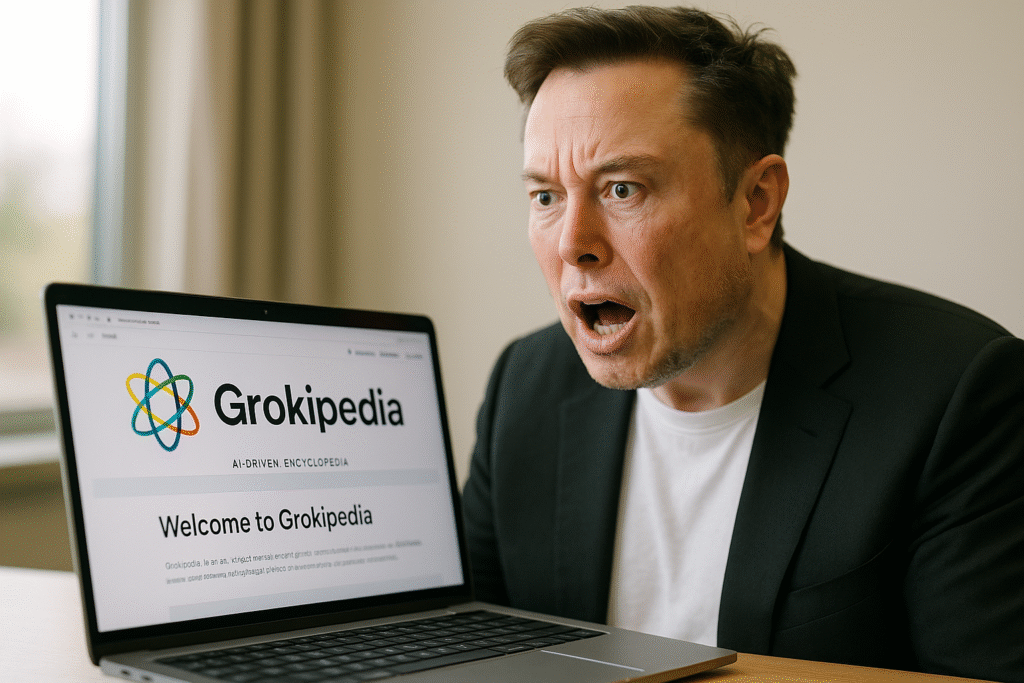
Grokipedia Launched: Elon Musk’s xAI quietly pushed Grokipedia (grokipedia.com) live in late October 2025 and the internet immediately reacted. The new site bills itself as an AI-first, “truth-seeking” alternative to Wikipedia, but its launch raised at least as many questions as it answered.
Below I break down what Grokipedia is, how it works (as far as is public), the immediate controversies, what Wikipedia’s community and outside reporters are saying, and a step-by-step guide for readers, researchers, and publishers who want to understand whether — and when — to use it. All claims that needed verification are sourced to reputable reporting and primary pages.
1) Grokipedia Launched: what happened and when
xAI — Elon Musk’s artificial-intelligence company — launched Grokipedia (version 0.1) in late October 2025 as an “AI-driven encyclopedia” aimed at competing with Wikipedia. The site went public Oct. 27–28, 2025 and immediately drew attention for its design, for being powered by Musk’s Grok chatbot technology, and for the speed of its rollout.
2) How big is Grokipedia today (and how does it compare to Wikipedia)?
At launch Grokipedia published roughly 885,000 entries — a substantial corpus but far smaller than English Wikipedia’s ~7+ million articles. That gap matters: breadth, depth, and long-tail coverage are where Wikipedia still dominates. Grokipedia’s team says version 1.0 will be “10x better,” but right now the site is best described as an alpha/beta offering rather than a drop-in replacement.
3) Where does Grokipedia get its content — AI, humans, or both?
xAI says Grokipedia is built with its Grok AI as primary authoring and checking engine. Early reporting and analyses, however, show that many Grokipedia entries appear to have been adapted from existing public sources — including Wikipedia itself — sometimes with minimal edits or rewording. Some pages include explicit Creative Commons attributions while others do not, prompting questions about sourcing and licensing. Expect deeper forensic analysis of content provenance in the coming days.
4) Accuracy & bias — the launch day controversies
Within hours of the launch, reporters and fact-checkers identified multiple inaccuracies and editorial choices in Grokipedia articles — ranging from minor wording errors to disputed claims about historical events and public figures. Critics pointed out that deploying generative AI across millions of articles can reliably produce fluent prose that still contains factual errors. Wired and other outlets warned that Grokipedia already showed signs of repeating fringe or ideologically slanted narratives in some entries. That’s a core problem for any encyclopedia: style alone doesn’t equal accuracy.

5) Is Grokipedia copying Wikipedia?
Multiple outlets reported that some Grokipedia entries were extremely similar to Wikipedia pages, and in at least a few cases the new site included disclaimers that content was adapted under Creative Commons licenses. This raised two issues: 1) whether Grokipedia is relying on Wikipedia content (permitted under CC BY-SA if attribution rules are respected), and 2) whether mass-AI paraphrasing of community work undermines the volunteer process that powers Wikipedia. The Wikimedia Foundation reiterated the value of volunteer, source-based editing while questioning the claim that AI can instantly solve editorial reliability.
6) What makes Grokipedia different — product and policy features
Grokipedia is pitched as:
• AI-first: articles are generated and updated with Grok AI assistance.
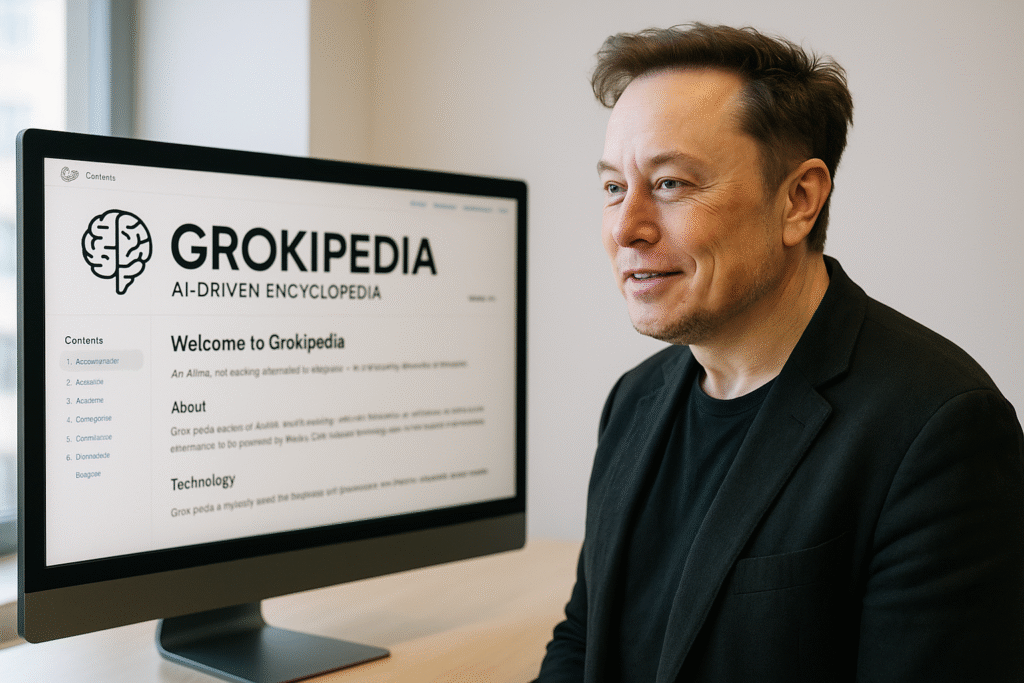
• Searchable and minimalist: the UX is designed for fast lookups and a dark theme.
• Flagging, not direct editing: at launch users can flag inaccuracies but not perform wiki-style edits.
That flagging model is a major departure from Wikipedia’s community editing — it centralizes editorial control and shifts from a distributed volunteer model to an AI + moderation model. Whether that model scales without bias or systematic errors is the big open question.
7) Legal and licensing considerations
Because Wikipedia content is CC BY-SA licensed, anyone can reuse it provided attribution and share-alike rules are followed. If Grokipedia copied or adapted content without proper attribution, that raises legal and ethical concerns. Early coverage indicates xAI included some CC attributions on entries, but the provenance of many articles remains unclear and will be the focus of review by editors and legal scholars. Transparent sourcing will be essential for Grokipedia’s credibility.
8) How reliable is Grok (the AI) at fact-checking large reference content?
Current large language models (including those behind Grok) are excellent at fluent synthesis but known to hallucinate factual details, misattribute sources, or reproduce biased framings unless rigorously constrained and linked to verifiable citations. Journalists found several examples where Grokipedia repeated questionable claims without adequate sourcing — a predictable risk when AI is asked to summarize complex history or controversial topics. Any serious encyclopedia needs transparent citations for verifiability; Grokipedia’s approach to citation and provenance will determine whether it matures into a trustworthy resource.
9) What Wikipedia’s founders and the Wikimedia Foundation said
Key figures in the free-knowledge community publicly reacted. Wikipedia’s volunteer ecosystem and the Wikimedia Foundation emphasized community-based sourcing, transparency, and that crowd-sourced editing remains the gold standard for checking facts at scale. Cofounders and prominent editors expressed skepticism about AI-first models replacing long-running community checks, while calling for stronger attribution and safeguards in any reuse of Wikipedia material. Expect public statements and more detailed responses in the coming 48–72 hours.

10) Practical guide for readers — when to use Grokipedia and when to double-check
If you’re curious: use Grokipedia as a quick, conversational starting point — but treat it the same way you would an AI chat: useful for orientation, not authoritative for citation.
Checklist before you rely on a Grokipedia claim:
- Look for explicit citations and original-source links inside the article.
- Cross-check with primary sources (academic journals, government pages, established news archives) or the corresponding Wikipedia page.
- If the topic is live or controversial, prefer peer-reviewed or primary documents for decisions that affect health, law, or finances.
- Use Grokipedia’s flagging tool to report any clear mistakes you find; keep screenshots as records of what changed.
11) What publishers, librarians and educators should watch
• Publishers should evaluate whether Grokipedia’s licensing and attribution practices fit editorial standards before republishing.
• Librarians should test Grokipedia for reference-service workflows and add caveats to students about provenance.
• Teachers should encourage students to compare Grokipedia entries with Wikipedia and primary sources to teach critical media literacy. Grokipedia’s arrival is a teachable moment about AI generation vs. source-based scholarship.
12) What to expect next — roadmap and red flags
Expect rapid iteration. xAI says Grokipedia will improve across versions; early versions often contain bugs, UX gaps and sourcing lapses. Useful signals that show the project is maturing:
• Transparent provenance for every article (source links and edit histories).
• A clear copyright and attribution policy (how CC BY-SA content is reused).
• A moderation and appeals process that lets subject-matter experts correct factual errors quickly.
Red flags to watch: persistent ideological slant across batches of entries, refusal to disclose sources, and refusal to maintain a public edit history. The press and academia will track these closely.