



Is Nursing a Professional Degree:
By TrenBuzz — a practical, step-by-step explainer for students, nurses, educators and policymakers.
Updated November 2025 — facts verified from Department of Education rulemaking and leading higher-education and nursing organizations.
Quick answer in plain English
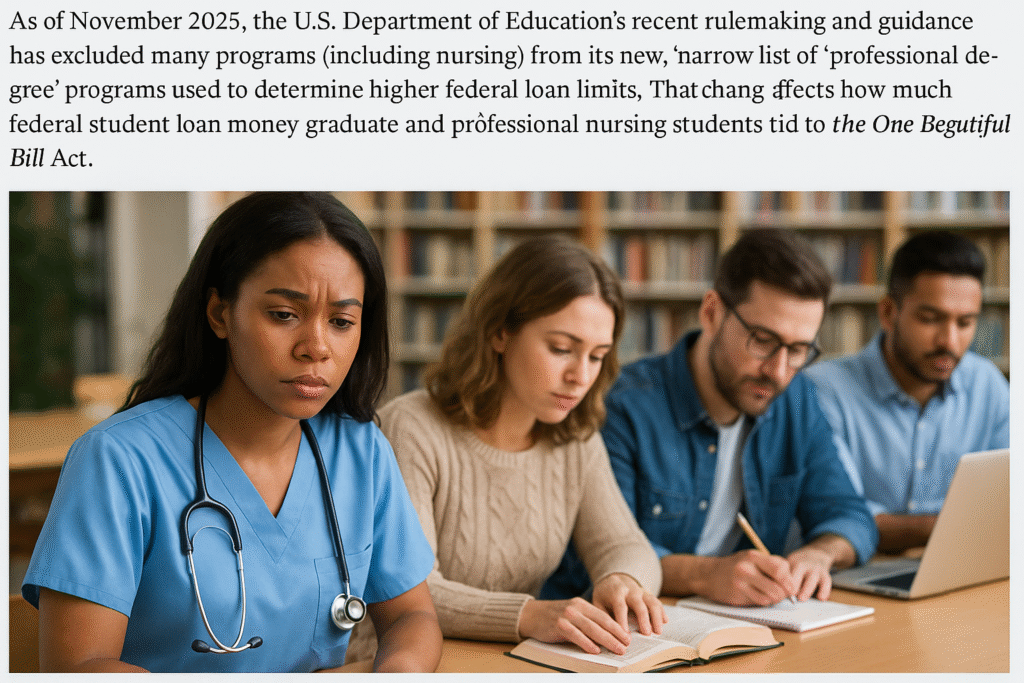
As of November 2025, the U.S. Department of Education’s recent rulemaking and guidance has excluded many programs (including nursing) from its new, narrow list of “professional degree” programs used to determine higher federal loan limits.
That change affects how much federal student loan money graduate and professional nursing students can borrow under rules tied to the One Big Beautiful Bill Act.
This article walks through what a “professional degree” is, why the Department reclassified some fields, which degrees are still on the list, how nursing was affected, and what students and schools should watch next.
1) What the Department of Education now means by “professional degree”
Historically, federal rules have treated a “professional degree” as one that prepares a person to begin practice in a regulated profession and typically leads to licensure.
Under the negotiated rulemaking to implement the One Big Beautiful Bill Act, the Department produced a much narrower list of programs eligible for the higher “professional” federal loan caps.
That narrower definition is the reason some fields that long considered professional — such as many nursing programs — were removed from the Department’s updated category.
2) Which degrees the Department currently lists as “professional”
In the Department’s negotiated rules, the set of degrees explicitly treated as professional includes medicine, dentistry, pharmacy, optometry, law, veterinary medicine, osteopathic medicine, podiatry, chiropractic, theology, and clinical psychology.
Other fields that many educators expected to be included — nursing, physician assistant, social work and public health among them — were left off the narrow list adopted in the rulemaking.
That list determines access to the higher borrowing caps ($50,000 per professional year; $200,000 aggregate for professional students) that take effect under the law’s timeline.


3) Why the change matters — practical consequences for students
If a program is not classed as a “professional” program under ED rules, graduate students in that program will be subject to the lower graduate borrowing caps ($20,500 per year; $100,000 aggregate).
For nursing graduate students — especially those in costly MSN or DNP tracks — that lower cap could force students to find private loans or pay out of pocket, raising affordability and access concerns.
The change also interacts with the elimination of Grad PLUS loans in the bill, which means fewer federal backstops for students who rely on those loans to cover tuition gaps.
4) Was nursing ever widely considered a professional degree? (short history)
Yes — for decades nursing files and graduate nursing degrees have been discussed and regulated as professional programs because many lead directly to licensure and clinical practice.
State boards of nursing and national accreditors oversee licensing and clinical standards for RN, NP and advanced practice roles, which is the classic hallmark of a “professional” program.
But federal loan-rule definitions are administrative constructs that can diverge from professional practice definitions; the November 2025 rulemaking is an instance where that divergence became policy.
5) Who is pushing back — major organizations and their arguments
Leading nursing groups and academic organizations quickly criticized the Department’s proposal and the negotiated consensus list, saying exclusion risks the health workforce and contradicts the realities of clinical practice.
The American Association of Colleges of Nursing (AACN), public-health schools, social-work organizations and many university associations warned the caps and restrictive list will reduce access to essential graduate programs.
Those groups argue the Department’s approach ignores the decades-long streamlining of advanced nursing into direct clinical roles — nurse practitioners, nurse anesthetists and others — that require rigorous graduate training.
6) What the rule change means for different nursing programs (BSN, MSN, DNP)
Under the new DOE classification the practical hit will fall hardest on post-baccalaureate graduate nursing (MSN, DNP, NP tracks) that routinely relied on higher federal loan caps or Grad PLUS loans.
Bachelor of Science in Nursing (BSN) programs are undergraduate awards and so are not directly part of the graduate/professional loan-cap discussion; their federal aid rules remain separate.
For students planning advanced practice nursing careers, the policy shift means tighter borrowing limits, which could reduce enrollment or force reliance on alternative financing strategies.
7) Are other fields affected — the broader higher-education ripple
Yes — social work, public health, physician assistant, physical therapy and some education programs were also flagged in the Department’s process as excluded or in a gray area.
Universities that run multidisciplinary professional schools now face uncertainty about tuition pricing, enrollment projections and how to advise current students about finances.
Financial-aid officers and legal counsel at many institutions will need to update counseling, promissory-note language and costestimates for prospective graduate students.

8) What students and applicants should do now — an action checklist
- Check your program’s official status with the school’s financial-aid office — ask whether your program is classified as “professional” under the Department’s negotiated rule.
- Request cost and borrowing scenarios that assume the lower $20,500/year cap so you can plan for worst-case affordability.
- Explore scholarships, employer tuition assistance and state loan programs; nursing employers often offer tuition support for practicing nurses advancing to NP or DNP roles.
- Follow the negotiated-rule docket — the Department’s negotiated rulemaking process and final rule text can still change during implementation; stay informed.
9) Longer term — policy outlook and what to watch
The Department’s negotiated rule is part of a process that includes public comment and final regulatory text; Congress or courts might still affect implementation timelines.
Advocacy groups and many university consortia are mobilizing to ask the Department to reconsider or Congress to amend loan rules if the exclusions cause workforce harm. Expect follow-up legal and legislative activity.
Watch for final rule publication, implementation dates (the law’s loans changes phase in by July 1, 2026) and any negotiated exceptions or legacy protections for currently enrolled students.
FAQ — short answers to the most-searched questions
Q: Is nursing a professional degree now?
A: Under the Department of Education’s updated regulatory list (Nov 2025), many nursing graduate programs were excluded from the narrowly defined “professional” list used for higher loan limits.
Q: Will this stop people from becoming nurses?
A: It could make advanced nursing degrees harder to finance for some students, but employers, states and philanthropic organizations may expand support to fill gaps. The long-term effect depends on policy responses.
Q: Where can I find the official Department of Education text?
A: The ED press releases and negotiated-rule documents published on ed.gov and the Federal Register contain the official definitions and timelines. Monitor the Department’s negotiated-rule web pages.
Which outcome worries you most about the DoE reclassification?
How TrenBuzz verified these facts (short note for readers)
Key factual claims in this piece come from the U.S. Department of Education’s negotiated-rule announcements and the federal student-aid guidance implementing the One Big Beautiful Bill Act.
We also cross-checked reactions and analyses from major higher-education groups (AACN, AAU, NASFAA, ASPPH) and news outlets covering the implementation and its timelines.
Final takeaway — practical and policy reality
Is nursing a professional degree? — Technically, under the Department of Education’s November 2025 negotiated rule used to set higher federal borrowing caps, most nursing graduate programs were excluded from the narrow “professional” list.
That administrative reclassification matters financially and politically: it changes who can access larger federal loans, pressures schools and students to find other funding sources, and has already prompted strong pushback from nursing and higher-education communities.
If you’re a nursing student, applicant or program leader, start planning now: check your program’s ED status, revise borrowing scenarios, and talk to your school about scholarships and employer support.
Disclaimer
This TrenBuzz article is for informational purposes only and reflects reporting and the Department of Education guidance available as of November 2025. It is not legal, financial, or tax advice. Readers should consult official Department of Education publications, university financial-aid officers, or qualified advisors for definitive guidance on individual circumstances.