


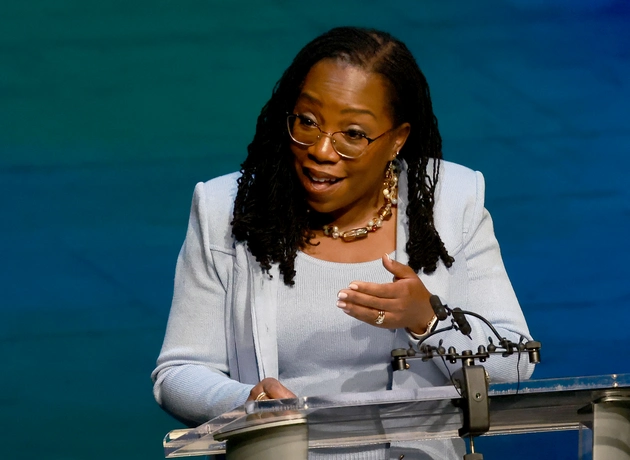
In a rare and striking public address at Yale Law School, Justice Ketanji Brown Jackson chided her conservative colleagues for using the court’s emergency docket to greenlight Trump’s agenda — calling the practice “potentially corrosive” to the rule of law.
By TrenBuzz Staff | Washington, D.C. | April 15, 2026 | 5 min read
Key Points
- Justice Ketanji Brown Jackson delivered a sweeping public critique of the Supreme Court’s emergency docket at Yale Law School on April 13, 2026.
- Jackson called emergency orders “scratch-paper musings” and “back-of-the-envelope, first-blush impressions” that are being misused.
- She reviewed roughly two dozen emergency orders from the past year that allowed Trump’s policies on immigration and federal funding to move forward despite lower courts blocking them.
- Jackson warned the practice is having “an enormously disruptive and potentially corrosive effect” on the justice system.
- The speech was the most extended public attack by a sitting justice on the court’s own internal practices in recent memory.
- Justice Sonia Sotomayor made similar remarks just one week earlier at the University of Alabama.
- Jackson said she went public to be “a catalyst for change” and called for reform of the emergency docket process.
Justice Ketanji Brown Jackson Slams the Supreme Court: In one of the most remarkable public speeches delivered by a sitting U.S. Supreme Court justice in modern history, Justice Ketanji Brown Jackson stood before a packed audience at Yale Law School on April 13 and delivered a pointed, hour-long rebuke of how the nation’s highest court has been handling its emergency docket.
Jackson, the court’s newest justice, did not name her colleagues directly. But her target was unmistakable: the conservative supermajority that has repeatedly issued emergency orders allowing the Trump administration to implement sweeping immigration, funding, and policy changes — even after lower courts ruled those policies were likely unlawful.
The speech, titled “Equity and Exigency: A First-Principles Solution for the Supreme Court’s Emergency Docket,” was recorded by Yale Law School and posted publicly on Wednesday, instantly igniting a national legal debate.
What Is the Supreme Court’s Emergency Docket — and Why Does It Matter?
The Supreme Court’s emergency docket — sometimes called the “shadow docket” by critics — is a process that allows parties to seek urgent, short-term relief from the court outside of the normal full-briefing and oral-argument process. Historically, it was used mainly in capital punishment cases where a prisoner faced imminent execution.
In recent years, the court has dramatically expanded its use of this tool. The current conservative majority has granted emergency orders allowing major Trump administration policies to take effect immediately — even while those policies remain actively challenged in lower courts.
These orders are typically issued with little or no written explanation, meaning the public and lower court judges receive almost no reasoning for why the Supreme Court intervened.

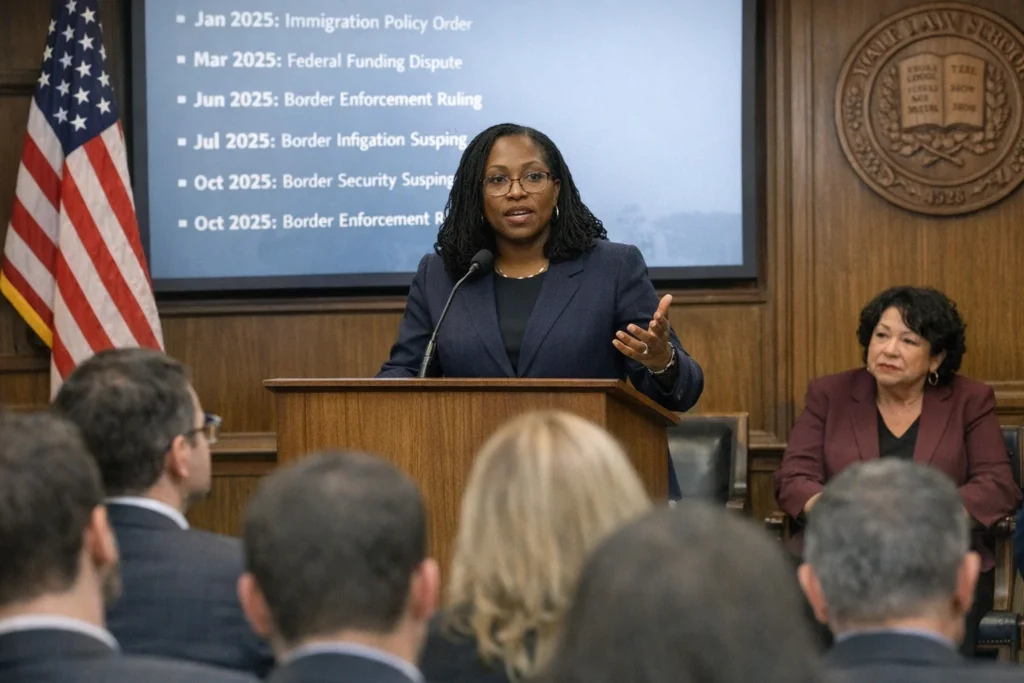
Justice Jackson Chides Colleagues: The Full Weight of Her Words
Justice Jackson chides her fellow justices not out of emotion, she made clear, but out of institutional alarm. She described the emergency orders as “back-of-the-envelope, first-blush impressions of the merits of the legal issue” — short-cuts that are then being used as binding legal precedent by lower courts nationwide.
Even more troubling, she argued, is that these orders fail to acknowledge the real human beings on the other side of each case — real families affected by immigration enforcement, real communities cut off from federal funding — making them “seem oblivious and thus ring hollow.”
She also challenged the court’s reasoning that preventing a president from implementing a policy counts as a legal “harm” that often outweighs the harm to those challenging it. “The president of the United States, though he may be harmed in an abstract way, he certainly isn’t harmed if what he wants to do is illegal,” Jackson said pointedly.
“There is a serious concern that the Supreme Court’s modern stay practices are having an enormously disruptive and potentially corrosive effect.”— Justice Ketanji Brown Jackson, Yale Law School, April 13, 2026
From the Clerk’s Desk to the Dissenter’s Bench: Jackson’s Journey to This Moment
Jackson’s critique carries personal weight. As a young law clerk for Justice Stephen Breyer — the justice she would eventually succeed on the court — Jackson said the Supreme Court’s emergency docket consisted almost entirely of death penalty cases. The dramatic expansion into routine policy disputes is a shift she described as both recent and deeply concerning.
This was not her first warning. She has issued stinging dissents in several emergency order cases over the past year and made pointed remarks about the practice during a joint appearance with Justice Brett Kavanaugh last month. But speaking at Yale to a public audience marked a clear escalation in her willingness to call out the pattern openly.
Justice Sonia Sotomayor made similar remarks at the University of Alabama just one week prior, suggesting a coordinated effort by the court’s liberal bloc to push back publicly against what they see as an alarming institutional drift. The Supreme Court’s liberal justices have grown increasingly vocal about the court’s use of emergency orders to advance the Trump administration’s policy agenda.
Justice Jackson’s Call for Reform — and What Happens Next
Jackson closed her speech not with despair but with a challenge. She called on legal scholars, students, and lawmakers to examine the Supreme Court’s emergency docket critically and to propose meaningful reforms. “My hope is that this speech opens up a conversation,” she said, “with an eye toward ensuring equal justice under the law.”
Legal reform advocates have long argued the shadow docket lacks the transparency and deliberation that Supreme Court decisions demand. Jackson’s public endorsement of reform talk gives the movement fresh momentum and an unusual ally from inside the court itself.
Whether her colleagues listen — or whether this becomes simply one more dissent, just delivered from a podium rather than a printed opinion — is a question that may define the court’s legacy in the Trump era.
Disclaimer: This article is published for informational and news reporting purposes only. All content is based on publicly available sources and verified reports as of April 15, 2026. TrenBuzz.com does not express any legal or judicial opinion on the matters discussed. Readers are encouraged to consult official court documents and legal experts for detailed analysis.