


Stellar Meanings and Mythic Connections: This guide explains the origins and meanings behind a dozen sky-words you searched for — Big Bear (Ursa Major), Lyre (Lyra), Centaur (Centaurus), Capri / Capricornus, the folklore word bugbear, and short entries for related queries like lyre constellation, uni meaning, and the mythic hunter (Orion).
You’ll get clear definitions, myth notes, visual tips for spotting them, and how these names connect across cultures — all verified with authoritative sources .
Why these names matter — language, myth and the sky
Stellar Meanings and Mythic Connections: Constellation names are living fossils: they preserve ancient languages, myths and navigation tricks.
Words like Lyra (lyre), Ursa Major (Great Bear) and Centaurus (Centaur) come from Greek and Latin astronomy, then spread worldwide through trade and scholarship.
Other words on your list — bugbear, Capri, uni — sit beside them because language and myth often cross paths: islands, beasts, instruments and single-horned creatures turn up both on maps and in stories.
1) Big Bear — Ursa Major (what “Big Bear” means)
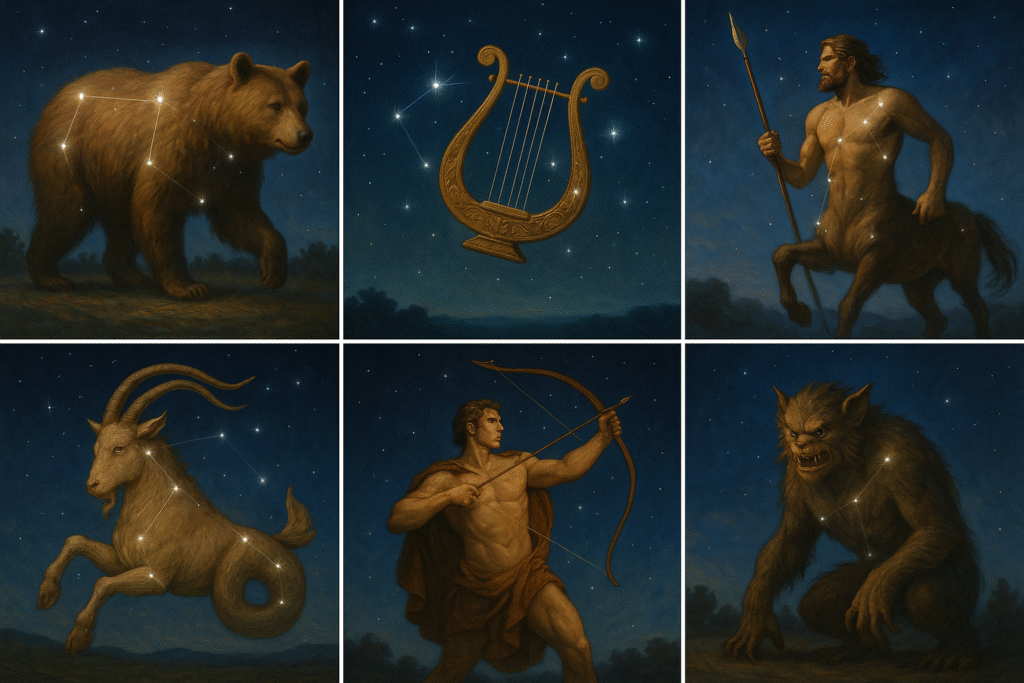
Ursa Major literally means “greater bear” in Latin and is one of the most recognisable constellations in the northern sky.
Its best-known asterism is the Big Dipper (or Plough), a seven-star pattern that has been used for navigation and seasonal lore for millennia.
The constellation’s mythology — from Greek tales of Callisto to widespread “cosmic hunt” stories — often frames the stars as a mother bear or part of a hunt myth shared by many cultures.
2) Lyre — Lyra (what “lyre” means in the sky)
Lyra is a small but bright constellation associated with the musical lyre of Orpheus in Greek myth.
Its brightest star is Vega, one of the sky’s most prominent beacons, and Lyra also holds the famous Ring Nebula (a colourful planetary nebula) visible in amateur telescopes.
The name Lyra recalls music and culture — a reminder that people long ago placed instruments in the heavens alongside animals and heroes.
3) Centaur — Centaurus (who the centaur was and why he’s in the sky)
Centaurus is a southern-hemisphere constellation named for the centaur, the half-man, half-horse creature of Greek myth.
It contains bright stars such as Alpha Centauri (our nearest stellar neighbor system) and showcases how ancient observers associated striking stellar groupings with well-known mythic figures.
As a concept, “centaur” also links to other sky-figures like Sagittarius (the archer centaur) — a family of myths built around hybrid creatures and teachers of heroes.
4) Capri / Capricornus — capra, sea-goats and the zodiac
When searches say “capri” they sometimes mean the island, and sometimes Capricornus, the zodiac constellation (the sea-goat).
Capri the island likely gets its name from Latin capra (“goat”) or Greek kapros (“boar”), while Capricornus is traditionally depicted as a goat with a fish tail and is one of Ptolemy’s ancient constellations.
Capricornus sits along the ecliptic (the Sun’s path) and therefore became part of Western astrology and seasonal calendars.
5) Bugbear — from frightened child to modern meaning
Unlike Lyra or Ursa Major, bugbear is not a constellation — it’s an English folkloric term.
Originally a mythical creature used to frighten children (a goblin or bogey), bugbear later evolved to mean “a persistent worry” or “an annoyance.” The definition shows up in dictionaries such as Merriam-Webster.
Because language migrates, you’ll sometimes see old folklore names used as nicknames for strange beasts or even fictional “constellations” in modern stories — but bugbear has no official place among the 88 IAU constellations.
6) Lyre constellation — spotting Lyra in the night sky
Lyra is small but easy to locate during northern summer because Vega (α Lyrae) is bright and forms the Summer Triangle with Deneb (in Cygnus) and Altair (in Aquila).
Look for Vega and then a compact parallelogram of stars that make the lyre’s body; the Ring Nebula (M57) sits between two of those stars and makes a great binocular target.
This is why Lyra is a favourite of backyard astronomers: small, bright and full of interesting targets.

7) Big Bear definition & why cultures saw a bear
Ursa Major’s shape — the dipper plus handle — was interpreted differently across regions: bears, wagons, three hunters, or even a plough.
Archaeological and comparative studies suggest a common “cosmic hunt” narrative underlies many of these images, a myth that likely predates written history.
That shared tale helps explain why the “Big Bear” appears in European, Native American and Siberian lore with similar story elements.
8) Centaur and the hunter connection — Orion and friends
Constellations carry relationships: Orion the hunter, nearby Taurus the bull, and Canis Major and Canis Minor as hunting dogs form a dramatic celestial scene.
Centaurus occupies the southern sky and joins the tapestry of heroes, hunters and hybrid creatures — a visual storytelling map of mythic roles.
These groupings are not random: ancient observers used bright stars to imagine narratives and seasons, linking the “hunter” archetype across the heavens.
9) Connections between the Lyre, Centaur, and Big Bear — mythic cross-pollination
On star maps you’ll find lyres beside hunters and bears near hunters because myths overlap: music soothes, hunters chase, animals flee — all useful for mnemonic sky stories.
For example, Orpheus’ lyre (Lyra) and the hunter (Orion) belong to different but adjoining sky neighborhoods; Centaurus sits in the southern storytelling ground where hybrid tutors and heroes reside.
Astronomers and folklorists agree that cultural contact (trade, migration) spread these images and sometimes merged local traditions into the names we still use.
10) “Uni” — short note on the prefix and its place here
You also searched “uni meaning.” The prefix uni- means “one” and comes from Latin (as in universe, unicorn).
That small root shows up everywhere: a unicorn (one horn) and universe (one turned whole) both connect to star myths — unicorns appear in medieval bestiaries and the Universe is literally the combined sky.
When reading old constellation names, spotting prefixes and roots like uni-, ursa- (bear), capri- (goat) helps you decode meaning quickly.
11) “Bugbear constellation” and why you won’t find it on star charts
No official astronomical catalogue lists a “Bugbear” constellation. The 88 modern constellations are standardized by the IAU and do not include folkloric bogey-creatures.
Fiction and fantasy routinely invent star-names (including bugbears), but in practical stargazing you’ll use the classical names (Lyra, Ursa Major, Centaurus, Capricornus) that history and science preserve.
12) Practical skywatching tips — find these constellations tonight
• Ursa Major (Big Bear): Visible year-round across much of the Northern Hemisphere; find the Big Dipper and follow the “pointer” stars to Polaris.
• Lyra (Lyre): Look for Vega in summer; it’s the brightest vertex of the Summer Triangle.
• Centaurus: Best seen from the Southern Hemisphere; use Alpha/Proxima Centauri as markers if your view allows.
• Capricornus: A faint zodiacal figure best located by pattern recognition in late summer nights.
13) Why etymology helps — decode future searches quickly
Knowing roots — ursa = bear, capri = goat, lyra = lyre — makes the sky less mysterious.
When you see a new name like Centaurus or Perseus you can often guess its story: a hybrid creature, a hero, or a tool. That linguistic map is how astronomers, sailors and farmers remembered seasonal cues before modern calendars.
Final takeaway — the sky as a layered storybook
The constellations you asked about are a mix of animals (Ursa Major), instruments (Lyra), hybrid beings (Centaurus), and zodiac creatures (Capricornus), with a folklore word (bugbear) thrown in for flavor.
Together they show how humans have used language, myth and observation to make sense of the night — and why those old names still help us navigate both sky and story.
If you want, I can make a printable star map that highlights Ursa Major, Lyra, Centaurus and Capricornus for your latitude — or a short infographic explaining the “cosmic hunt” myth linking many of these constellations. Which would you prefer?
Sources & Verified External Links (checked Oct 2025)
Below are the authoritative, live links used to compile this guide:
- Merriam-Webster — bugbear definition and usage. (Merriam-Webster)
https://www.merriam-webster.com/dictionary/bugbear - Wikipedia — Ursa Major (Great Bear) constellation (overview, myths). (Wikipedia)
https://en.wikipedia.org/wiki/Ursa_Major - Britannica — Lyra (Lyre) constellation (Orpheus myth, Vega, Ring Nebula). (Encyclopedia Britannica)
https://www.britannica.com/place/Lyra-constellation - Britannica Kids / Students — Centaurus (Centaur) constellation overview. (Britannica Kids)
https://kids.britannica.com/students/article/Centaurus/310617 - Britannica / The Guardian — Capricornus (Capricorn) constellation and mythology. (Encyclopedia Britannica)
https://www.britannica.com/place/Capricorn - Etymonline / Capri — island name origin (if your search meant Capri the island). (etymonline.com)
https://www.etymonline.com/word/Capri
https://en.wikipedia.org/wiki/Capri - Membean — prefix uni- (meaning “one”). (Membean)
https://membean.com/roots/uni-one
Disclaimer : This article summarizes widely accepted astronomical names, etymologies and mythic associations as of October 2025, and uses authoritative reference sources. It is for educational and informational purposes only. For observational planning, consult local planetarium schedules or the International Astronomical Union’s resources.