


Published by TrenBuzz.com | April 29, 2026 | BREAKING — LIVE UPDATE
Key Points at a Glance – Supreme Court Just Gutted the Voting Rights Act
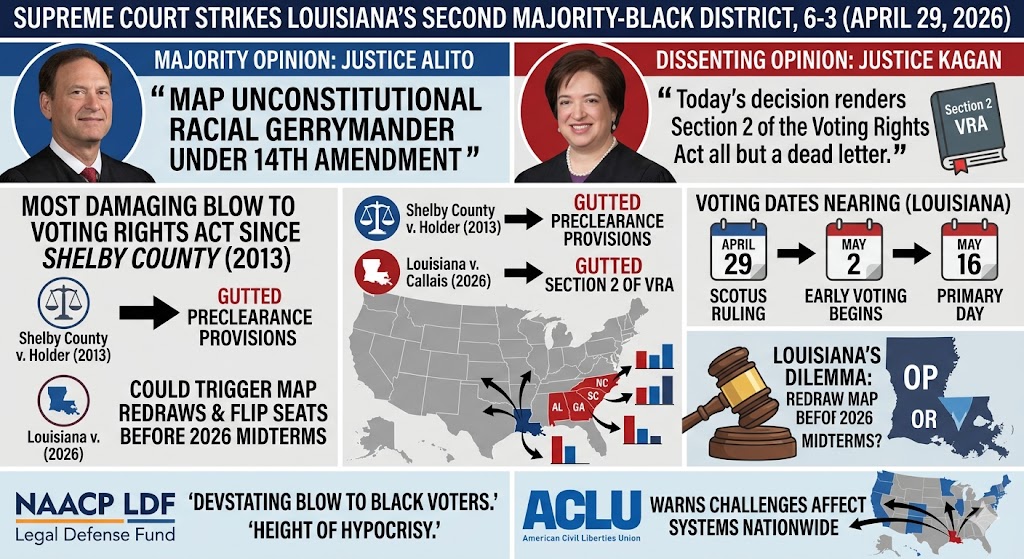
- The US Supreme Court ruled 6-3 on April 29, 2026 in Louisiana v. Callais — striking down Louisiana’s congressional map that created a second majority-Black district.
- Justice Samuel Alito wrote the majority opinion — ruling the map was an unconstitutional racial gerrymander under the 14th Amendment.
- In her dissent, Justice Elena Kagan declared: “Today’s decision renders Section 2 of the Voting Rights Act all but a dead letter.”
- This is widely seen as the most damaging blow to the Voting Rights Act of 1965 (VRA) since Shelby County v. Holder gutted its preclearance provisions in 2013.
- The ruling could trigger congressional map redraws in multiple states — potentially flipping multiple House seats before the 2026 midterms.
- Louisiana’s May 16 primary is just weeks away — early voting begins May 2.
- The NAACP Legal Defense Fund called it “the height of hypocrisy” and “a devastating blow to Black voters.”
- The ACLU warned the ruling affects not just Louisiana — but challenges to state legislative and local election systems across the country.
- Louisiana now must decide whether to redraw its map before or after the 2026 midterms.
In one of the most consequential civil rights decisions in more than a decade, the Supreme Court on Wednesday fundamentally reshaped American voting law — and the reverberations are already being felt from Baton Rouge to Washington.
The Supreme Court on Wednesday, in the case of Louisiana v. Callais, struck down a Louisiana congressional map that a group of voters who describe themselves as “non-African American” had challenged as the product of unconstitutional racial gerrymandering. By a vote of 6-3, the justices left in place a ruling by a federal court that barred the state from using the map, which had created a second majority-Black district, in future elections.
The Case Background — How We Got Here
For years, Louisianans have organized, legislated, and litigated for the promise of a fair and representative congressional map. In 2022, Louisiana’s Republican-controlled legislature drew a map with only one majority-Black district — despite Black voters making up one-third of the state’s population. Federal courts ruled that map likely violated the Voting Rights Act, and in 2024, Louisiana was required to redraw it to include two districts where Black voters had an opportunity to elect candidates of their choice.
A group of “non-African American” voters then challenged the 2024 map, arguing that the map’s creation of a second majority-Black district was itself an unconstitutional racial gerrymander — that it wrongly sorted voters based primarily on race in violation of the 14th Amendment.
What Alito Said — The Majority’s Reasoning
Justice Samuel Alito said in his opinion for the six-justice majority that the Voting Rights Act didn’t require Louisiana to create an additional majority-minority district, so there was no compelling interest justifying the state’s use of race in creating the map, making it an unconstitutional racial gerrymander.
Alito wrote: “Section 2 of the Voting Rights Act of 1965 was designed to enforce the Constitution — not collide with it. Unfortunately, lower courts have sometimes applied this Court’s §2 precedents in a way that forces States to engage in the very race-based discrimination that the Constitution prohibits.”

Kagan’s Dissent — The Phrase That Defines the Day
Although the ruling did not strike down Section 2 of the Voting Rights Act outright, as Louisiana and some challengers had asked, Justice Elena Kagan — joined by Justices Sotomayor and Jackson — suggested in dissent that the majority opinion had rendered the provision “all but a dead letter,” calling it “the latest chapter in the majority’s now-completed demolition” of the Act.
During earlier oral arguments, Justice Brett Kavanaugh pushed the notion that race-based remedies in the law should end. Janai Nelson of the NAACP Legal Defense Fund had warned the court then that curbing Section 2 would be “pretty catastrophic” and would “resurrect the 15th Amendment as a mere parchment promise.”
The Immediate Fallout — Civil Rights Groups React
“The Supreme Court has reversed decades of progress toward a multiracial democracy in the name of partisan politics,” said Janai Nelson, President and Director-Counsel of the Legal Defense Fund. “The ruling is devastating for Black Louisiana voters and for fair representation for all voters of color. It also undermines the legitimacy of institutions that rely on fair maps to represent the American people.”
The ACLU warned the ruling has immediate consequences for communities engaged in redistricting litigation and for voters seeking relief from discriminatory practices — including vote dilution, restrictive registration requirements, and changes to election administration that disproportionately burden communities of color.
The NAACP LDF stated: “Partisan gerrymandering has time and again been used as a cover for racial discrimination. The Supreme Court’s decision in Louisiana v. Callais could open the floodgates for more underhanded manipulation and voter dilution in Black communities and other communities of color.”
What Happens to Louisiana Now — The Midterm Crunch
The ruling comes just weeks before Louisiana’s May 16 primary, with early voting beginning May 2. Louisiana Gov. Jeff Landry, a Republican, said it’s too early to say whether they would try to race to redraw the map. Rep. Cleo Fields, whose district was invalidated by the ruling, said: “The final court has spoken. Louisiana now must make its decision. I think the wise decision is if they’re gonna redraw lines, they need to redraw them for the next election.”
The National Stakes — A Redistricting Earthquake
The ruling narrows the Voting Rights Act precedent on race-based redistricting and could prompt challenges in other states that could flip multiple congressional seats. Elections analyst Kyle Kondik said: “2025-2026 redistricting has taught us that things that don’t seem possible can become possible. The redistricting battle could stretch into 2027 and 2028 with this ruling.”
With a severely narrowed Section 2, voters challenging racially discriminatory maps and voting laws will face higher legal barriers and fewer statutory protections. The decision affects not only congressional redistricting but challenges to state legislative and local election systems across the country.
The Voting Rights Act of 1965 was born from the bloodshed of Selma. Today, the Supreme Court didn’t repeal it — but critics say they’ve done something close to the same thing with a pen, six votes, and 36 pages.
Disclaimer: This is a breaking news article based on publicly available reporting from SCOTUSblog, ACLU, NAACP Legal Defense Fund, NBC News, Deseret News, and the Supreme Court’s own published opinion as of April 29, 2026. TrenBuzz.com does not provide legal advice and makes no independent legal assessments of the ruling’s implications. Readers are encouraged to consult credible legal and news sources for full details of the Louisiana v. Callais decision and its ongoing impact.