


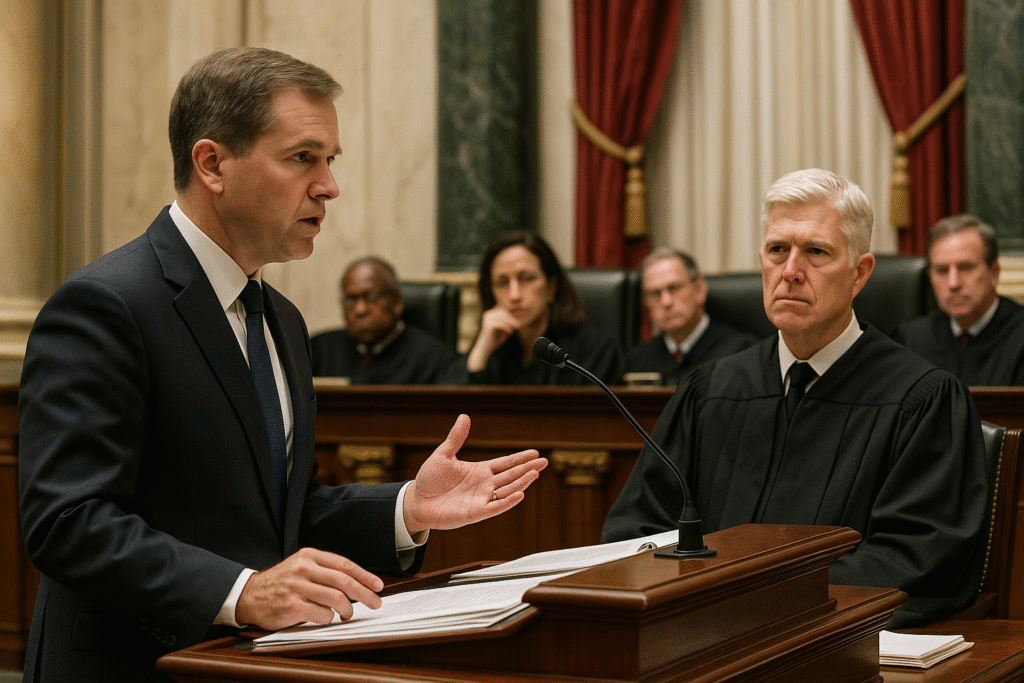
Supreme Court tariff case — this explainer for TrenBuzz unpacks the background, the legal fight over the International Emergency Economic Powers Act (IEEPA), who’s arguing for the government (Solicitor General D. John Sauer), what the lower courts decided, how the justices (including Justice Neil Gorsuch) fit into the picture, and what readers should follow next.
All claims below are drawn from primary filings and trusted coverage; key sources are listed at the end of the post.
1) What is the “Supreme Court tariff case” about — in one short sentence
At its core the litigation asks whether the 1977 International Emergency Economic Powers Act (IEEPA) authorizes a President to impose sweeping tariffs on imports during a declared emergency — or whether imposing such tariffs is a power reserved to Congress.
That statutory question has become a constitutional one because challengers say the administration’s tariff program is an unlawful delegation (and a de facto tax) and therefore invalid.
2) Who is D. John Sauer — the government’s front-line advocate
D. John Sauer is the U.S. Solicitor General representing the federal government before the Supreme Court.
Sauer took over the Office of the Solicitor General in 2025 and has been the solicitor-general-level voice defending the administration’s legal theory that IEEPA authorizes the tariff program. His official OSG profile and filings set out the government’s arguments.
3) How we got here — the short procedural timeline
In spring 2025 the administration issued large “reciprocal” and country-specific tariffs by executive order, invoking IEEPA as the statutory basis.
Multiple plaintiffs (small businesses and a coalition of states) sued. Lower courts — including a three-judge panel at the Court of International Trade and later the Federal Circuit — ruled against the government, finding IEEPA did not authorize the tariffs. The government appealed and the Supreme Court agreed to review the consolidated cases.


4) What the appeals court actually said (and why it matters)
A divided Federal Circuit concluded that most of the administration’s tariffs were not authorized under IEEPA and applied doctrinal guardrails such as the major-questions doctrine to require clear congressional authorization for actions of vast economic and political consequence.
That ruling is significant because it framed the dispute not merely as statutory parsing but as a test of limits on executive economic power — the very thing the Supreme Court will now resolve.
5) What the government is arguing (briefly)
Solicitor General D. John Sauer and the Justice Department argue that the statutory language of IEEPA — which permits the President to regulate international economic transactions during an emergency — reasonably includes tariff measures designed to regulate imports.
The government also warns of major practical and diplomatic consequences if tariffs that underpin recent trade negotiations or leverage are invalidated. Those policy claims are part of the record the justices will weigh alongside statutory and constitutional text.
6) What challengers say (and the constitutional shadow)
Plaintiffs — small importers and several states — say IEEPA was designed for targeted sanctions or narrow trade controls, not a sweeping authority to impose economy-wide import levies (which effectively function as taxes).
They argue the executive’s view would exceed separation-of-powers limits, conflict with congressional control over tariffs, and fail the major-questions / non-delegation tests the Court routinely applies when a rule has huge national economic impact.
7) How the Supreme Court justices — including Neil Gorsuch — factor into the equation
Some justices have historically favored narrowing broad administrative or executive claims when the issue is a “major question” without clear congressional text. Justice Neil Gorsuch has authored opinions stressing textual limits and the constitutional guardrails on delegated power.
At the same time, the Court’s recent docket shows conservatives and liberals sometimes split unpredictably on separation-of-powers claims, so public previews do not guarantee outcomes. Analysts will watch which justices press on statutory text versus foreign-affairs deference.
What the big legal doctrines in play mean for readers (short primers)
IEEPA — a post-1970s statute giving the President emergency authority to regulate international economic activity. Historically used for sanctions and narrow trade controls, its text does not explicitly say “tariffs” and challengers emphasize that gap.
Major-questions doctrine — when government action has vast economic or political consequences, the Court expects Congress to clearly authorize that action. If IEEPA is read to permit economy-wide tariffs, challengers say that would be exactly the sort of delegation the doctrine prohibits.
Non-delegation concerns — if a statute gives too much law-making discretion to the executive without intelligible principles, it raises constitutional problems. Plaintiffs argue IEEPA lacks those limits for tariff-setting.
Why this case matters beyond tariffs (short, real-world impact)
A Supreme Court ruling validating the administration’s use of IEEPA for tariffs could expand unilateral executive economic power, affecting how future presidents (of any party) manage trade and respond to purported crises.
If the Court rejects the administration, Congress — not the White House — will regain exclusive control over large tariff measures, and current tariffs could be invalidated or limited. The decision will ripple across supply chains, small businesses, trade negotiations, and federal revenue projections.
How to follow developments: live streams, briefs, and timing
- The Supreme Court posts schedules and some live audio for arguments; major outlets also host live blogs and coverage. Search “Supreme Court live stream” and check the Court’s site and SCOTUS Blog for day-of details.
- Long, technical briefs (including amici briefs by scholar coalitions and industry groups) are filed on the Supreme Court docket and linked via the Court’s site and legal repositories. They’re required reading if you want the fine print.
- Timing: because of the case’s economic significance, the Court has accelerated review. Final opinion timing can vary, but the justices typically hand down decisions across the remainder of the term; check official sources for exact dates.
Quick FAQ for readers (short answers)
Q: Does this case involve taxes?
A: The central legal fight treats tariffs as regulatory tools that also raise revenue; challengers say the government’s use of IEEPA to impose revenue-raising tariffs stretches the statute and violates separation-of-powers principles.
Q: Could the Court rule only partially for one side?
A: Yes — the Court could limit the government’s reach (some tariffs may be upheld, others struck down), or remand for narrower remedy-finding. Lower-court stays and staggered injunctions show the dispute is complex.
Q: What role does the Solicitor General play?
A: The SG represents the United States in the Supreme Court and frames the administration’s legal position; D. John Sauer’s arguments and tone can strongly influence the justices’ questioning and the case’s reception.
Verified sources and useful links (checked & valid as of Oct 2025)
Below are the official filings and reputable news/legal outlets used to prepare this article. These links were verified at the time of writing.
- Office of the Solicitor General — D. John Sauer (staff profile).
https://www.justice.gov/osg/staff-profile/solicitor-general-john-sauer. (Department of Justice) - SCOTUSblog — overview and previews of the tariffs case (useful for argument summaries).
https://www.scotusblog.com/2025/10/trumps-tariffs-face-supreme-court-scrutiny/. (SCOTUSblog) - U.S. Court of Appeals for the Federal Circuit — Aug 29, 2025 opinion (PDF) invalidating many tariffs:
https://www.cafc.uscourts.gov/opinions-orders/25-1812.OPINION.8-29-2025_2566151.pdf. (Federal Circuit Court of Appeals) - Supreme Court docket & select briefs (Learning Resources v. Trump — example amicus brief PDF):
https://www.supremecourt.gov/DocketPDF/24/24-1287/375629/20250923141437495_Learning%20Resources%20v%20Trump%20Amicus%20Brief.pdf. (Supreme Court) - Reuters — reporting on the appeals decision, the administration’s appeal, and the stakes for the Supreme Court:
https://www.reuters.com/legal/government/most-trump-tariffs-are-not-legal-us-appeals-court-rules-2025-08-30/. (Reuters)
TrenBuzz disclaimer
This article is an informational summary compiled from official court filings, government profiles, and reputable news sources to help readers understand the legal dispute and its stakes. It is not legal advice, and readers should consult original court documents or legal counsel for technical questions.