


Key points
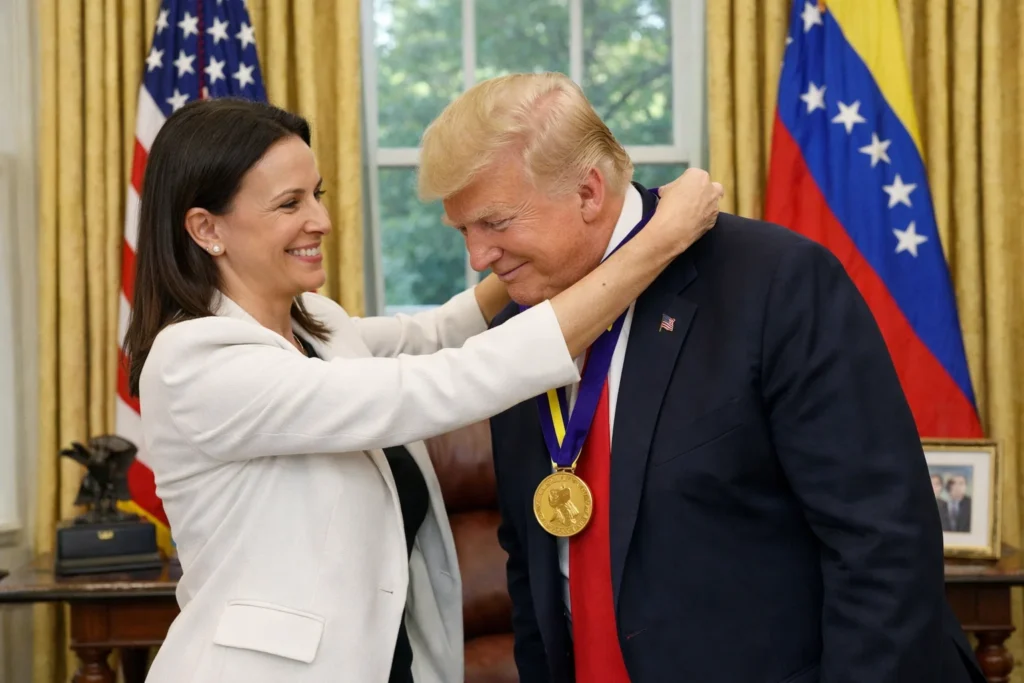
- Venezuelan opposition leader María Corina Machado presented her 2025 Nobel Peace Prize medal to U.S. President Donald Trump during a White House meeting; Trump accepted the medal as a symbolic gift.
- The Norwegian Nobel Institute and prize officials have made clear that Nobel prizes are non-transferable; gifting the physical medal does not transfer laureateship or alter the official record.
- The meeting—and Machado’s gesture—adds a new twist to U.S.–Venezuela diplomacy and to Machado’s political effort to solidify international backing amid Venezuela’s deep instability.
- The move sparked immediate debate: supporters see it as symbolic recognition of U.S. support for Venezuelan democracy; critics call it a performative stunt that raises questions about politicizing awards and about U.S. motives in Venezuela.
Trump accepts Nobel medal — what happened and why it matters
On January 15, 2026, María Corina Machado—winner of the 2025 Nobel Peace Prize for her pro-democracy advocacy in Venezuela—presented her Nobel medal to President Donald Trump during a private White House meeting. The act was framed by Machado as a gesture of thanks for U.S. support for Venezuelan freedom; the White House released images and a short readout of the meeting. Nobel officials quickly emphasized that while the medal was gifted, the formal recognition and laureateship remain Machado’s and cannot be transferred.
The facts, plainly stated
- What happened: Machado met the president and handed over the Nobel Peace Prize medal (the gold medallion laureates receive). The two discussed Venezuela’s political future and Machado’s visions for democratic transition. The White House described the meeting as cordial.
- What Nobel officials say: The Norwegian Nobel Institute reiterated that Nobel prizes and laureateship are non-transferable; a physical medal can be gifted, but the prize’s legal and symbolic ownership remains with the laureate and the Nobel Committee’s record.
- Who Machado is: Machado was awarded the 2025 Nobel Peace Prize for her prominent role in advocating democracy and civil resistance against Nicolás Maduro’s government. The Nobel Foundation’s official page lists her laureateship and justification.
Why Machado gave the medal — and why Trump accepted it
From Machado’s perspective, the act is meant to cement a political alliance: she has sought stronger U.S. backing in the wake of recent upheaval in Venezuela and sees public displays of support as a means to regain momentum within Venezuelan opposition circles. From the U.S. side, accepting the medal publicly signals recognition—symbolic, not institutional—of Machado’s role and keeps Washington visibly engaged in Venezuela’s trajectory. But the optics are complicated: accepting a laureate’s medal is rare and elevates the meeting’s political profile, inviting scrutiny about the lines between diplomacy, symbolism and domestic politics.

Political and diplomatic implications
- For U.S.–Venezuela relations: The meeting strengthens Washington’s visible ties to one opposition figure but does not change legal or diplomatic recognition. It may complicate relations with other Venezuelan actors, who could perceive the move as favoritism.
- For the Nobel institution: The Nobel Committee’s swift clarification preserved institutional norms: laureateship rests with the awardee and the committee’s judgment, not with post-award gifts. Still, the episode raises questions about how laureates use the prize in political advocacy.
- For Machado’s political strategy: Presenting the medal is a high-profile gambit to bolster international legitimacy and to boost her standing among exile communities, foreign governments, and donors—especially after months of uncertainty about Venezuela’s interim political arrangements.
Legal, ethical and protocol notes
- No transfer of the Nobel title: According to Nobel rules and commentary from prize officials, a physical medal can be gifted, but a Nobel Peace Prize title and its legal status are not transferrable. Media outlets and the Nobel page confirm this.
- Gifting versus institutional endorsement: Accepting a medal as a personal gift is different from the Nobel Committee formally endorsing a political action or candidate. Observers caution against conflating symbolic gestures with institutional endorsement.
What opponents and supporters are saying
- Supporters argue the meeting spotlights Venezuelan democracy struggles and keeps international attention on human rights and political transition. They say symbolic acts can matter in galvanizing diplomatic backing.
- Critics call it politicization of a moral award and warn that the White House’s acceptance of the medal risks mixing U.S. foreign policy with partisan theater—especially given domestic political dynamics in Washington and Machado’s contested standing inside Venezuela.
Bottom line
María Corina Machado’s presentation of her Nobel Peace Prize medal to President Trump is a striking symbolic episode at the intersection of international awards, public diplomacy and high-stakes politics. The medal’s physical transfer does not change Nobel laureateship or institutional standing; nevertheless, the gesture amplifies Machado’s bid for influence and puts new diplomatic spotlight on Venezuela—one that policymakers and the public should watch closely for substantive follow-through or policy shifts.