


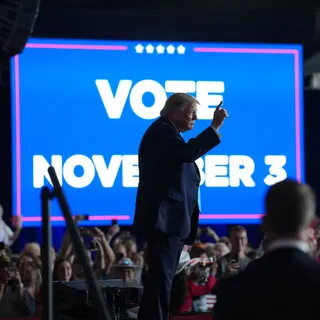
Key Points: Trump in Grand Island
- Trump in Grand Island Monday marked his latest stop on what CNN described as a “red-state October blitz” through deep conservative territory ahead of the midterms.
- The visit supported Gov. Jim Pillen and Sen. Pete Ricketts in a county Trump himself won by 37 points back in 2024.
- The last sitting president to visit Grand Island was George W. Bush in 2006, just two days before Republicans lost both chambers of Congress.
- Needing to rally supporters in one of the reddest corners of one of the reddest states carries its own unspoken message about this cycle.
Trump In Grand Island Is About More Than One Campaign Stop
Trump in Grand Island Monday night drew a packed crowd to the Nebraska State Fairgrounds, but the choice of location itself tells a more interesting story than the rally speech alone.
Trump headlined the event at Fonner Park’s Pinnacle Bank Expo Center, supporting Gov. Jim Pillen and Sen. Pete Ricketts ahead of November, part of what CNN specifically labeled a “red-state October blitz” taking him through some of the most reliably conservative territory in the country.
Why A Deep Red Stop Deserves A Second Look
Here is the detail that deserves more attention than typical rally coverage usually gives it. Trump won Nebraska by 20 points in 2024. He won Hall County, which includes Grand Island itself, by an even larger 37 points. He carried the surrounding 3rd Congressional District with a striking 76 percent of the vote.
Presidents generally don’t need to campaign hard in places they already win this decisively. Choosing to spend time and political capital rallying supporters in exactly this kind of overwhelmingly friendly territory, rather than in a genuinely contested battleground, signals something worth examining rather than dismissing as routine midterm scheduling.
The 2006 Parallel Nobody Else Connected
Here is the angle that gives this visit real historical weight. The last time a sitting president visited Grand Island, it was George W. Bush in November 2006, arriving just two days before that year’s midterm elections.
Bush used that stop to warn Republicans against slipping into what he called a gloom and doom mindset heading into the vote. Days later, Republicans lost control of both the House and Senate in one of the most decisive midterm wave elections in recent memory.
That historical echo doesn’t guarantee a repeat outcome this cycle, but it does offer a striking parallel worth understanding, a sitting Republican president making a late push through safe territory immediately before voters delivered a significant rebuke to his party.
What This Fits Into Nationally
This visit lands directly within the broader approval rating picture shaping this entire midterm cycle. Trump’s numbers have sat underwater in several genuine battleground states throughout the summer, a dynamic that makes shoring up turnout in safe territory a meaningfully different strategic priority than expanding into competitive terrain.
Rallying the base hard in places already won decisively often signals a campaign more focused on turnout mechanics than persuasion, a sign that enthusiasm, not conversion, has become the central concern heading into November.
How Democrats Are Framing The Visit
Nebraska Democratic Party Chair Jane Kleeb used the visit as an opportunity to directly criticize Trump’s broader standing, arguing his tour through deep red towns actually reflects weak polling numbers rather than political strength.
That framing fits a now familiar pattern this cycle, Democrats pointing to the frequency and location of Trump’s campaign stops as evidence of base anxiety rather than confident momentum heading into the final stretch before voters decide.
What Happened At The Rally Itself
Beyond the political symbolism, Trump used the Grand Island stage to sign his red dye diesel executive order live during the event, directly tying the rally to a concrete policy announcement aimed at a state hit hard by this year’s diesel price spike.
That pairing, a major policy signing combined with base mobilization messaging, reflects a broader strategy of using rally stops themselves as vehicles for news generating moments rather than purely symbolic campaign appearances.
What Comes Next
Expect this red-state blitz to continue through additional safely Republican states in the coming weeks, with each stop likely drawing similar scrutiny over what the strategy signals about confidence levels heading into competitive races elsewhere on the map.
The Bottom Line
Trump in Grand Island carries real symbolic weight well beyond Monday night’s crowd size, a historical echo of a visit that once preceded a major political wave, landing at a moment when similar warning signs are already shaping this year’s midterm landscape.
Trenbuzz will continue tracking Trump’s continued campaign stops as the midterms approach in November.