


Key points
- President Trump told European leaders he “no longer feels an obligation to think purely of peace” after being passed over for the 2025 Nobel Peace Prize, linking that grievance to his aggressive push to acquire Greenland.
- Trump threatened new U.S. tariffs on goods from multiple European countries and tied tariff relief to a U.S. purchase of Greenland; the move has prompted urgent EU consultations on countermeasures.
- EU officials are preparing a menu of retaliation options — from targeted tariffs to invoking the Anti-Coercion Instrument — amounting to as much as roughly €93–€108 billion in potential measures.
- Diplomats aim to defuse the dispute at multilateral settings such as Davos, but European leaders are also preparing an emergency summit to coordinate response.
What triggered the row — Trump Links Greenland Threat to Nobel Snub
In a letter and private messages to European leaders, Trump framed his Greenland campaign not only as a strategic imperative but as a personal rebuke after the Nobel Committee chose another candidate for 2025.
He followed that message with explicit tariff threats — saying he would slap an extra 10% on goods from several NATO and EU countries beginning in February, rising later if his demands weren’t met.
Why Greenland suddenly matters (beyond headlines)
Greenland sits astride critical Arctic sea lanes and mineral-rich territory that has strategic value in a Sino-Russian era of Arctic competition.
Control of the island would reshape Arctic basing, surveillance and resource access; that is why Denmark, NATO partners and Greenlanders themselves reacted strongly.
The EU’s options — from words to a shopping list of retaliation
European diplomats have signalled both a preference for de-escalation and readiness to act if tariffs are imposed.
Measures discussed include targeted tariffs, suspension of trade concessions, and use of the EU’s Anti-Coercion Instrument to block or limit market access.

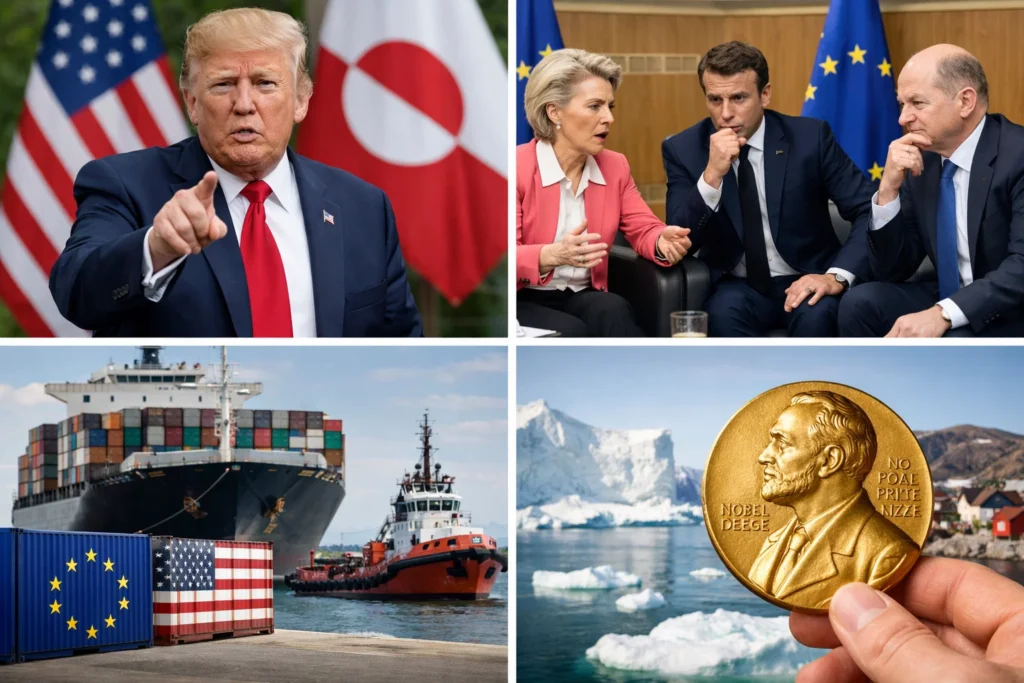
Political and alliance fallout at a glance
The dispute strains NATO cohesion: allies see an American demand to buy territory from a fellow NATO member as a destabilising escalation.
European leaders plan intensive bilateral talks at Davos and an extraordinary EU summit to coordinate policy if Trump follows through.
Markets and companies — immediate ripple effects
News of tariff threats sent jitters through European markets and weakened some stocks tied to cross-Atlantic trade; firms that rely on integrated supply chains are watching closely.
Industries likely to feel the earliest pain include autos, food and machinery — sectors where transatlantic imports and exports are sizeable.
What the U.S. says (and doesn’t) — White House posture
The White House framed the Greenland push as strategic and tied tariffs to leverage in negotiation, while insisting diplomacy remains an avenue.
Officials insist any move would be aimed at protecting American strategic interests — a phrasing that unsettles allies who view it as coercive.
What diplomats will try next — the immediate playbook
- Quiet diplomacy at Davos — leaders hope to calm rhetoric face-to-face.
- Emergency EU coordination — officials prepare legal and economic contingency options before any tariffs land.
- Public pressure — allied capitals will rally public and parliamentary support to constrain any unilateral U.S. land-grab.
Quick FAQ — short answers readers want
Is the U.S. actually going to buy Greenland?
No formal purchase process exists; the notion of buying Greenland from Denmark is legally and politically fraught and contradicts Greenlandic self-determination.
Could the EU successfully retaliate with tariffs?
Yes — the EU has tools, including a ready list of measures and the Anti-Coercion Instrument, but leaders prefer engagement first to avoid a damaging trade war.
What about Greenland’s own stance?
Greenlanders and Copenhagen have loudly opposed any forced transfer; demonstrations and diplomatic protests across the region reflect deep local resistance.
Should the EU respond with tariffs if the US imposes Greenland-linked tariffs?
Final take — balance and risk
What began as a personal grievance linked to a Nobel Prize decision now confronts NATO, European unity, and global trade norms.
Even if the U.S. never purchases Greenland, threats tied to that demand have already injected a new diplomatic and economic risk into transatlantic relations.
Disclaimer: This article synthesizes contemporaneous reporting and official statements available as of January 19, 2026. Sources include Reuters, AP and other major outlets summarizing EU and U.S. reactions; readers should consult official government releases and live diplomatic statements for evolving details.