


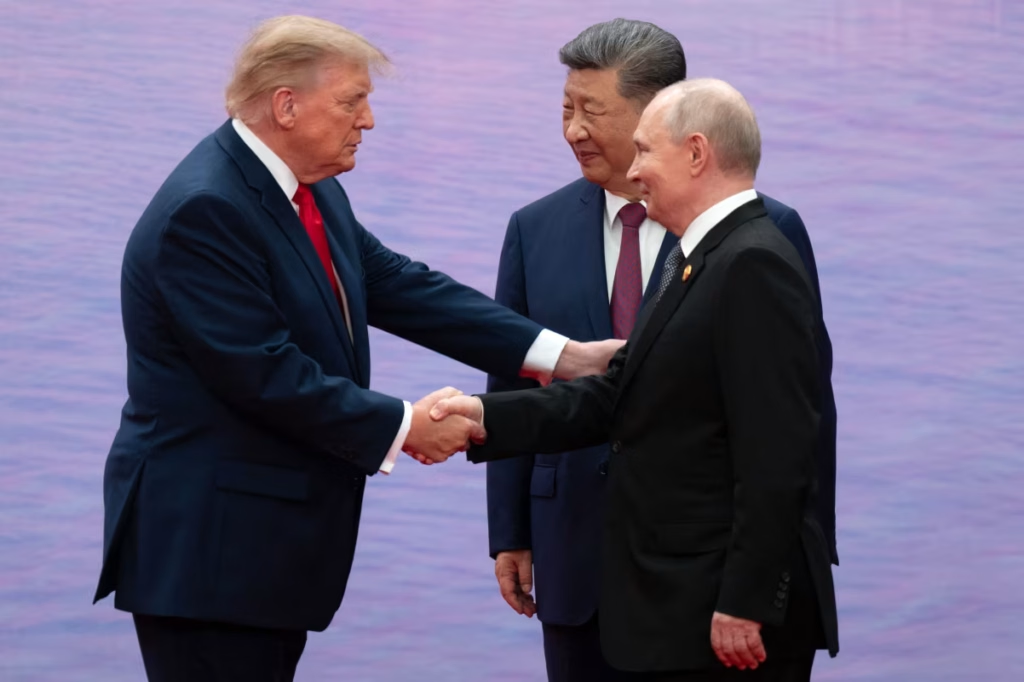
Key Points: Trump Putin Xi Jinping
- President Trump, Russia’s Vladimir Putin and China’s Xi Jinping are in Shenzhen for a first-ever three-way meeting on Thursday, November 19, on the sidelines of the APEC summit.
- The White House says the talks will cover nuclear weapons and the war with Iran. Reports differ on whether the Ukraine war will be formally discussed.
- As of Thursday afternoon, no outcome from the three-way meeting or the Trump and Xi one-on-one had been reported.
- Analysts expect symbolism more than a breakthrough, and some say a smooth handshake would count as a win.
- Two deadlines hang over the talks: a U.S.-China trade truce that runs to January 10, 2027, and the nuclear arms treaty that lapsed in February.
Three leaders, one city and a lot of cameras. That is the picture coming out of southern China today.
This story is still moving, so treat everything below as a snapshot, not a final word.
Latest News From Shenzhen: What Has and Has Not Happened
Trump flew into Shenzhen after stopping in Manila, and Xi greeted him on the tarmac. At a welcome banquet on Wednesday, the three leaders were photographed together, with Trump shaking hands with Putin.
Putin called Xi his “dear friend,” and Xi called Putin “my old friend,” according to an AP report. Xi added that China and Russia have stayed steady “through storms.”
Trump said he wanted to meet both leaders together because their countries work together. He also admitted that cutting nuclear stockpiles is “a very hard thing to do.”
What has not happened is just as important. No agreement, joint statement or announced result had been reported as of this writing.
Why Shenzhen? A City That Tells Its Own Story
Shenzhen, China, is a southern technology hub next to Hong Kong. It is home to companies such as BYD, Huawei and Tencent.
This is China’s third time hosting APEC, after Shanghai in 2001 and Beijing in 2014. Analysts say the city shows off Beijing’s Greater Bay Area plans and its confidence during tense times.
Here is a thought that daily coverage often skips. The venue is part of the message.
A city built into a tech giant within a few decades is the backdrop for talks about weapons and wars. It tells visitors that China wants to be seen as a builder, not just a party to someone else’s deal.
That is our reading, not a government statement. But it helps explain why Beijing is reportedly scripting the event so closely.
Three Leaders, Three Wish Lists
The three men are in the same room, but they are not after the same thing. Analysts describe their goals this way.
- Trump: A win he can show back home. Analysts say he is weakened after the midterms, and some say he is attending mostly for the photo.
- Putin: Cover for the Ukraine war, an end to isolation and Chinese backing. He also wants to keep Trump engaged and block new sanctions.
- Xi: A stable relationship with Washington, no return to tariff wars and no U.S. pushback on Taiwan. Analysts add that he wants to show he can convene world leaders before a Party Congress next year.
Because the goals differ, the likeliest result is a loose and symbolic one. Few analysts expect a binding deal.
The Nuclear Question and the Ukraine War
The White House says a possible three-way nuclear agreement is on the table. The old treaty between the U.S. and Russia, New START, lapsed in February.
Trump turned down a Russian offer to extend it. He wants a wider deal that includes China.
China has said no to joining such talks so far, pointing to the gap between its arsenal and the two bigger ones. Analysts note that its stockpile is growing fast.
On the Ukraine war, the picture is less clear. One report says Ukraine is not expected to be on the formal agenda because Xi prefers not to engage. Putin’s adviser has said the leaders will likely touch on it.
Ukrainians worry about becoming a bargaining chip in a deal among the big powers. That fear explains why this meeting is watched so closely in Kyiv and across Europe.
Two Clocks That Matter More Than the Photo
Most live updates focus on who said what. A more useful question is who is running out of time.
The first clock is the trade truce between Washington and Beijing, which runs to January 10, 2027. Reports say rare earth exports remain far below normal, and U.S. officials say China has not fully kept farm purchase promises.
The second clock is the missing nuclear treaty. For about nine months, there has been no formal cap on the two largest arsenals.
Donald Trump and Xi Jinping are also expected to meet again at the G20 in Florida in December. That means this week may be a first step, not the last.
How to Read the Live Updates Today
Fast moving stories can mislead. These four checks can help you judge what you are reading.
- Look for a signed paper or a joint statement. A handshake alone is not an agreement.
- Check who is speaking. Trump’s account, the Kremlin’s account and Beijing’s account can differ.
- Watch for dates and numbers. Real deals name deadlines and amounts.
- Wait for confirmation from at least two sources before sharing.
What to Watch Next
- Any joint statement: Even a short one on nuclear testing or missile notices would be notable.
- The Trump and Xi talks: Trade, rare earths and farm purchases are the main items.
- Ukraine: Any change in tone from Putin or Xi will be read closely in Europe.
- Reaction in Asia: Taiwan, Japan, South Korea and the Philippines want reassurance about U.S. commitments.
For now, the Shenzhen meeting is a stage and a test. The real answer will come in the days after the cameras leave.