


Published by TrenBuzz.com | May 1, 2026
Key Points at a Glance -Trump Rejects Iran Peace Proposal
- President Trump rejected Iran’s latest peace proposal on April 30 — calling it “not good enough, but a very significant step.”
- Iran countered the US temporary ceasefire plan with its own proposal for a permanent end to the war — which the US also rejected.
- Iran threatened a “painful and decisive response” if the US resumes military strikes.
- Trump is reviewing military options to escalate pressure on Iran and break the diplomatic deadlock.
- Trump threatened to bomb Iranian bridges, power plants, and oil infrastructure — a move legal experts say could constitute a war crime.
- US gas prices hit $4.30 per gallon — the highest since 2022 — as the Iran war enters its third month.
- GOP Sen. Lisa Murkowski announced she will introduce an AUMF (Authorization for Use of Military Force) measure if Trump doesn’t present a credible war plan within a week.
- Pakistan, Egypt, and Turkey are now jointly coordinating ceasefire mediation efforts.
- Iran offered a 45-day ceasefire guaranteeing permanent peace — during which it would discuss reopening the Strait of Hormuz.
- The US naval blockade has turned back 47 ships from Iranian ports as the standoff deepens.
- Iran’s parliament speaker warned Tehran would never accept “surrender” terms from Washington.
Sixty-two days into the most consequential American military engagement since the Iraq War, the peace table is crowded — but the gap between what each side will accept grows wider by the hour.
Iran’s state media said the country rejected a US plan for a temporary ceasefire and countered with a proposal of its own for a permanent end to the war, as President Trump again threatened to bomb Iranian bridges and power plants if it didn’t open the Strait of Hormuz.
Trump’s Verdict on Iran’s Latest Offer
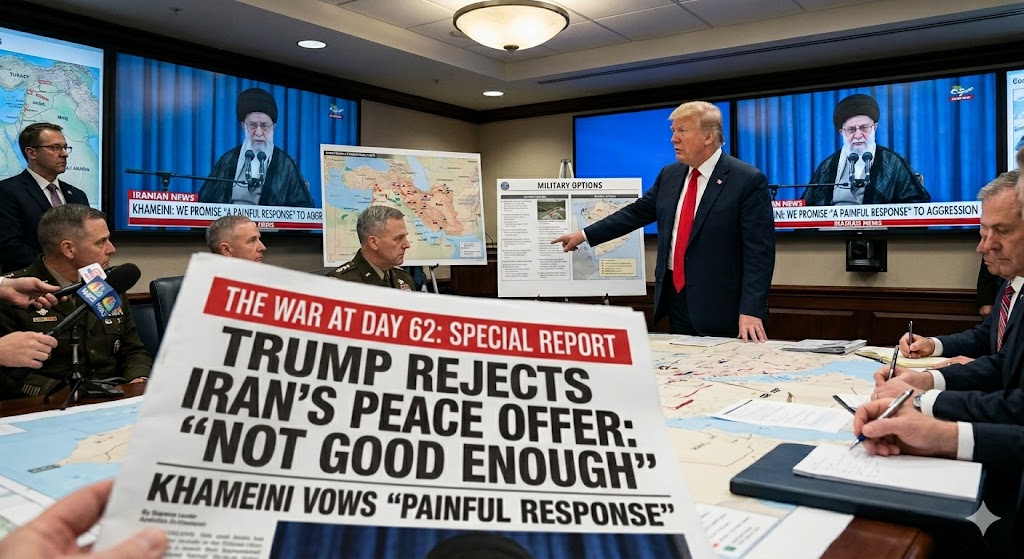
Speaking to reporters early Monday on the White House South Lawn, President Trump acknowledged a proposal and said it is “not good enough, but it’s a very significant step.” Pakistan, Egypt, and Turkey are coordinating efforts toward a negotiated settlement to end the war. Egyptian officials involved in these efforts told NPR that Iran is open to a 45-day ceasefire that guarantees a permanent end to the war, during which Iran would discuss opening the Strait of Hormuz.
Despite the rejection, Trump’s own language — “a very significant step” — left the door open, even as his military advisers briefed him on escalation options.
Iran’s “Painful Response” Warning — Words With Teeth
Iran launched hundreds of drones and ballistic missiles at Israel and at US military bases in neighboring Arab countries including Bahrain, Jordan, Kuwait, Qatar, Saudi Arabia, and the United Arab Emirates in the opening weeks of the conflict — demonstrating its capacity to strike deep and wide across the region.
Iranian state media and officials warned that any US resumption of strikes would trigger a response that would be “painful and decisive” — a warning the Pentagon is taking seriously given Iran’s demonstrated missile reach.

Trump Threatens Civilian Infrastructure — The War Crime Question
Trump again threatened to bomb Iranian bridges and power plants if Iran didn’t open the Strait of Hormuz. Attacking civilian infrastructure that doesn’t contribute to military action would be a war crime under international and US laws, according to legal experts. Asked by a reporter if he was concerned about committing a war crime, Trump said, “No. I hope I don’t have to do it.”
Earlier, Iranian officials condemned Trump’s warning as “threats to commit atrocities.” Trump added he believed the Iranian public was willing to suffer more US bombing to gain freedom.
The Strait of Hormuz — The Unbreakable Deadlock
Reestablishing freedom of navigation in the Strait of Hormuz is widely seen as the central issue in the talks. After the ceasefire announcement, Trump said the pause on US strikes was subject to the “complete, immediate, and safe opening of the Strait of Hormuz,” while Iran has described the US counter-blockade as a potential “prelude to a violation of the ceasefire.” Neither side has removed its blockade.
Iran’s Foreign Minister Araghchi said Tehran intends to “devise a new arrangement to ensure secure maritime traffic through the waterway” — a phrase Iran’s critics say still amounts to claiming sovereignty over an international passage.
Congress Loses Patience — Murkowski’s Warning
GOP Sen. Lisa Murkowski announced she plans to introduce a measure on whether to formally authorize Trump’s war with Iran if she does not see a “credible plan” from the White House within the next week. “I do not accept that we should engage in open-ended military action without clear direction or accountability. Congress has a role. Congress has to step up and fulfill that role,” Murkowski said in a somber Senate floor address as the Pentagon hits the 60-day mark of the war.
The US average price for a gallon of gas has now reached $4.30 as sources say Trump is laying the groundwork for an extended blockade of Iranian ports — a strategy that is squeezing Tehran but also squeezing American wallets heading into the summer driving season.
The Human Toll — And the World Cup Twist
The conflict has killed more than 3,375 people in Iran, 2,521 in Lebanon, 23 in Israel, and 13 US service members. Civilian infrastructure has been struck, including in Oman and Azerbaijan.
In an unexpected development, FIFA President Gianni Infantino reaffirmed that Iran will compete at the 2026 FIFA World Cup and play soccer matches in the United States, despite the ongoing conflict — a surreal diplomatic footnote in one of the most serious wars in modern American history.
The peace talks are alive. The ceasefire is technically still holding. But with Trump reviewing military options, Iran threatening a painful response, gas at $4.30, and Congress demanding answers — the next 72 hours may be the most consequential of this war.
Disclaimer: This article is for general informational and news reporting purposes only. All quotes, diplomatic developments, and war statistics are based on publicly available and credible sources including CNN, NPR, the House of Commons Library, and Wikipedia’s 2026 Iran War article as of May 1, 2026. The situation is evolving rapidly — details may have changed since publication. TrenBuzz.com does not represent any government or military body. Readers are encouraged to follow credible international news sources for real-time updates.