



Published by TrenBuzz.com | May 3, 2026 | BREAKING — LIVE UPDATE
Key Points at a Glance – Trump Reviews Iran’s 14-Point War-Ending Plan
- Iran has formally submitted a 14-point response to the US via Pakistani intermediaries on May 2, 2026.
- Iran’s plan counters the US’s earlier 9-to-15-point framework with its own comprehensive peace terms.
- Iran demands all issues be resolved and the war ended within 30 days — rejecting the US’s proposed two-month ceasefire.
- Key Iranian demands include: end to the naval blockade, US troop withdrawal from the region, frozen assets released, reparations paid, all sanctions lifted.
- Iran also wants fighting to end on all fronts — including Lebanon — and a new mechanism for the Strait of Hormuz.
- Iran’s parliament is drafting a law that would permanently ban Israeli ships from Hormuz and charge “hostile nations” fees to pass.
- Trump reviewed the document Saturday and said: “I can’t imagine it would be acceptable.”
- Friday night, Trump appeared to float abandoning the war entirely: “Maybe we’re better off not making a deal at all.”
- The US fast-tracked $8 billion in arms sales to Israel, Qatar, UAE, and Kuwait — including Patriot missiles and laser-guided rockets.
- Spirit Airlines shut down overnight — citing soaring jet fuel prices driven by the Iran war.
Sixty-four days into America’s most consequential military engagement since Iraq, Iran handed Washington a document — and Washington’s first response was skepticism.
Iran has submitted a 14-point response to the US proposal to end the conflict that began with US and Israeli attacks on Iran on February 28, according to the semi-official Tasnim news agency and the state-owned media organization Press TV. Key points of the plan include a demand to resolve all issues and end the war within 30 days, instead of observing a two-month ceasefire as the US had proposed.
The 14-Point Plan — What Iran Is Demanding
The Iranian plan includes security guarantees, a withdrawal of US forces from areas near Iran, and the lifting of the naval blockade. It also calls for the release of frozen Iranian assets, the removal of sanctions, and an end to the conflict “on all fronts”, including in Lebanon, according to the report.
Other demands listed by Iranian outlets include guarantees against future military aggression, the withdrawal of US forces from Iran’s periphery, an end to the naval blockade, the release of frozen Iranian assets, payment of reparations, the lifting of sanctions, an end to fighting in Lebanon, and a new mechanism governing the Strait of Hormuz.
Tasnim reported that the US proposed a two-month ceasefire, but that Iran believes “that the issues should be resolved within 30 days” and that negotiations should focus on the “termination of the war” rather than extending a ceasefire.
US vs. Iran — What Each Side Wants Side by Side
The US’s prior 15-point framework demanded: complete reopening of the Strait of Hormuz, an end to Iran’s nuclear enrichment program, destruction of advanced missile systems, and an end to support for Hezbollah, Hamas, and proxy forces across the region.

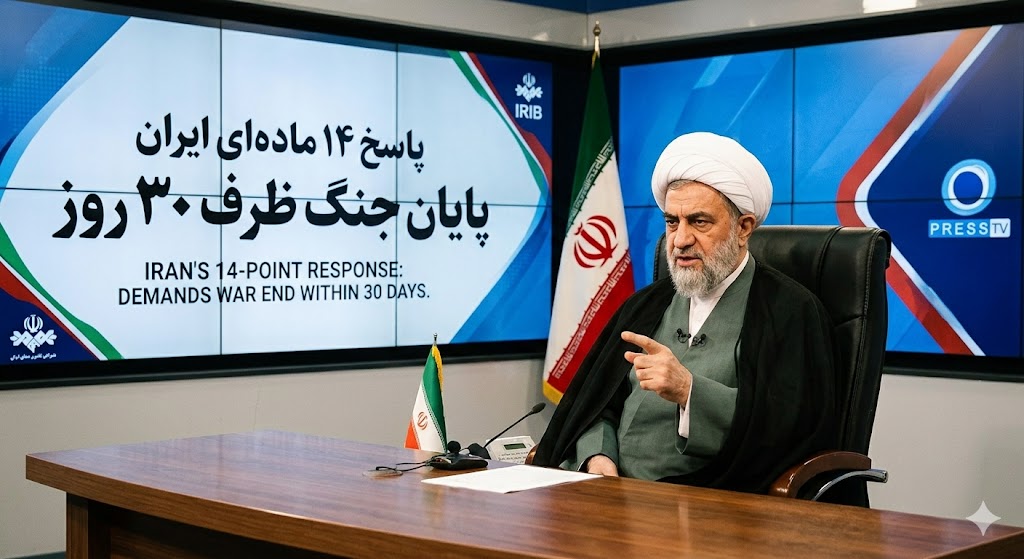
Iran’s 14-point counter demands the opposite in almost every category — assets back, troops out, blockade lifted, and sanctions gone before any permanent peace is formalized.
The gap between the two documents is not measured in points. It is measured in two fundamentally different visions of who won this war.
Trump’s Saturday Reaction — Reviewing but Deeply Skeptical
“They told me about the concept of the deal. They’re going to give me the exact wording now,” Trump said Saturday, after state media reported Iran sent the 14-point proposal. Trump said he “can’t imagine that it would be acceptable.”
The president also pushed back on remarks he made Friday night, when he said: “Frankly, maybe we’re better off not making a deal at all. Do you want to know the truth? Because we can’t let this thing go on.” He later clarified: “I said that if we left right now, it would take them 20 years to rebuild. But we’re not leaving right now.”
Iran’s Parliament Goes Further — New Hormuz Law Drafted
Iran’s parliament is poised to approve a law that would place restrictions on which vessels can pass through the critical waterway, Iranian state TV reported. Israeli vessels will never be allowed through, and ships from “hostile countries” will be required to pay reparations to obtain a permit, according to reports.
If passed, the law would effectively codify Iran’s Hormuz toll system into domestic legislation — making it dramatically harder to undo even if a peace deal is eventually signed.
The War’s Growing Civilian and Economic Toll
Spirit Airlines ceased operations overnight — as jet fuel prices, which have soared since the start of the Iran war, have led to thousands of flight cuts in Europe and in the US.
The Trump administration fast-tracked billions of dollars in arms sales to Israel, Qatar, the UAE, and Kuwait, valued at more than $8 billion. They include air-defense systems for Kuwait and Qatar, laser-guided rockets for Qatar, the UAE and Israel, and Patriot missiles for Qatar. In justifying the bypassing of Congress, Secretary of State Marco Rubio “determined and provided detailed justification that an emergency exists that requires the immediate sale” of the arms.
Fourteen points from Iran. Fifteen from the US. Sixty-four days of war. One planet watching a 34-kilometer waterway — and waiting.
Disclaimer: This is a breaking news article based on publicly available and credible sources including NPR, Al Jazeera, CNN, Middle East Eye, KPBS, and OPB as of May 3, 2026. The contents of Iran’s 14-point proposal have not been independently verified by NPR or TrenBuzz.com — they were reported by Iran’s semi-official Tasnim news agency and state-owned Press TV. TrenBuzz.com does not represent any government or diplomatic body. Readers are encouraged to follow credible international news sources for real-time updates as this story is rapidly evolving.