


Quick summary — the headlines in 60 seconds
Chancellor Rachel Reeves unveiled Budget 2025 on 26 November with tax and spending moves designed to shore up the public finances and fund targeted priorities.
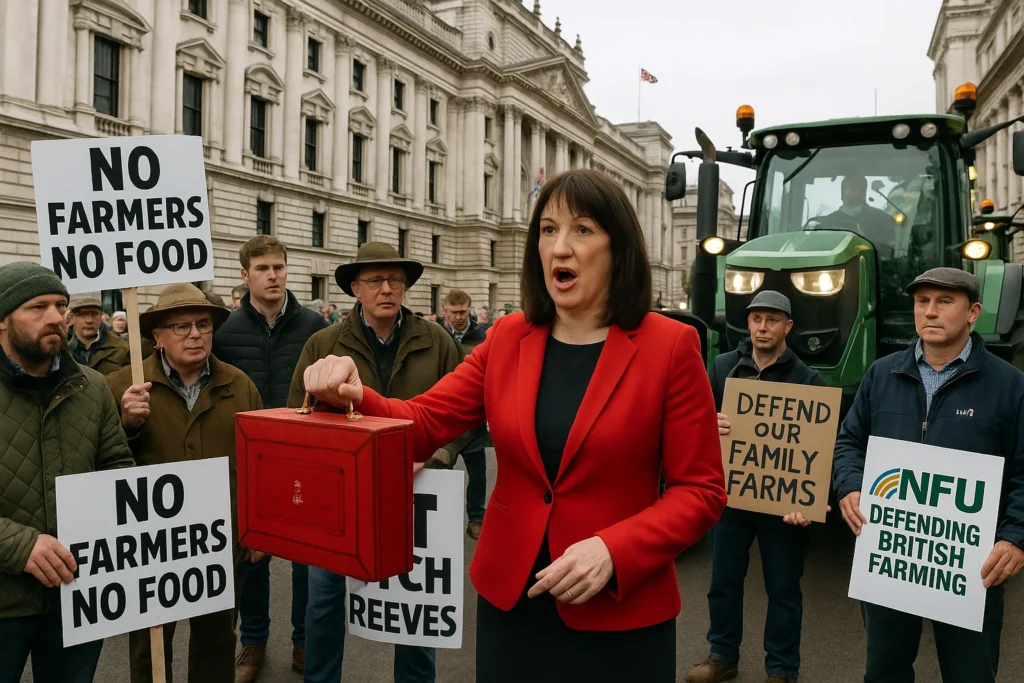
Farmers responded with protests on Budget Day because changes affecting agricultural inheritance tax, direct payments and some farm supports create real cash-flow and succession anxieties.
This article explains the Budget’s key measures that matter to farming, the specific policy changes that triggered protests, how farmers say they will be affected, and what to watch next for markets and rural communities.
It’s written to help readers quickly grasp both the numbers in the Budget and the human story behind the tractors in London.
What the 2025 Budget actually did (short version)
UK Budget 2025: The government’s Budget set out a package of tax-raising and spending moves intended to increase fiscal headroom over the medium term and free up funds for public services.
Key measures highlighted in coverage include a multi-billion-pound package of tax changes and targeted spending commitments across departments.
Official Budget documents stress the twin aims of stabilising borrowing and investing in priorities such as health, education and green transitions — while limiting headline tax-rate hikes.
But a combination of threshold freezes, new levies and targeted reforms created pressure points for specific industries — notably farming.

The two issues that most angered farmers: inheritance tax and cuts to some payments
Farm groups say the government’s proposed changes to how agricultural property is taxed on inheritance risk forcing heirs to sell land to meet tax bills.
The policy shift (narrowing or removing long-standing reliefs) has been central to sustained farmer protests since late 2024.
What farmers say the Budget will mean on the ground
Farmers argue that land is an illiquid asset: family farms look valuable on paper but are often cash-poor, making sudden inheritance tax bills or payment reductions existential threats.
Campaign groups, unions and affected families have repeatedly warned that forced sales of land would undermine food security and rural livelihoods.
NFU leaders and grassroots groups told media they felt sidelined by the speed and scale of changes, and they say more transitional relief — or a firmer threshold — is needed to protect generational farming.
For many farming households the fear is not about headline land value but about being able to meet tax liabilities while keeping farms operational.
Why Budget Day became a protest day — tractors on Westminster and more
Farmers deliberately staged protests on Budget Day to force the issue onto the national agenda when MPs and ministers would be in Parliament.
On Budget Day some groups drove tractors toward Westminster despite police restrictions, creating vivid images that spread across national and international media.
Organisers said the visual protest — tractors in the capital, rallies outside Parliament and coordinated local actions — was designed to make the human cost of the policy visible to lawmakers and the public.
The choice of Budget Day amplified the message: tax and spending decisions announced that day directly impact farm families and long-term rural planning.


How the government frames the changes — revenue, fairness and policy aims
The Treasury framed many of the Budget’s measures as necessary to stabilise public finances and to target relief to households most in need.
Officials argue reforms (including adjusting tax reliefs) prevent wealthy landholders from using legacy rules to avoid taxes and free up room for public investment.
DEFRA emphasises parallel commitments: the Spending Review had pledged multi-year funding to support sustainable farming and nature recovery as part of transitioning away from old-style direct payments.
For example, multi-year funding promises include increases in Environmental Land Management funding over the medium term — a counterpoint the government cites when defending transition plans.
The political context — why this is so combustible now
Agriculture policy is tightly linked to national identity, rural employment and local economies; sudden fiscal moves therefore create political heat.
The policy timing — following the earlier Spending Review and detailed consultations — left farmers feeling the changes were stacking up too quickly.
Opposition parties and rural-focused MPs quickly seized on the protests to press for concessions or more generous transitional arrangements.
Some political actors also pledged legal or practical support for arrested protesters and voiced skepticism about whether the Treasury had fully grasped the rural impact.
The financial detail: what the numbers mean for farm families
Government modelling suggests many farms will remain below the threshold once reliefs and exemptions are applied, but farm groups dispute the assumptions.
Estimates of affected farms vary — depending on valuation method, joint-ownership treatments and the treatment of couple allowances — so headline percentages mask complex household realities.
Likewise, reductions in delinked payments and the pace of Basic Payment Scheme (BPS) phase-out mean some farmers face sudden drops in predictable income streams.
That uncertainty affects borrowing, investment decisions and decisions about succession — all of which are core to keeping family farms viable.

Who’s most at risk — size, sector and geography matter
Smaller, family-run mixed farms with low annual cash returns but high land values feel the most exposed.
Certain sectors — hill farming, grazing and some dairy operations — already report thin margins, so tax or payment shocks risk pushing marginal farms to sell or exit.
By contrast, capital-rich large landowners and investors can often absorb tax changes or restructure holdings, which is why farmers argue reforms should focus on investment vehicles rather than family farms.
That nuance underpins much of the disputes about thresholds, valuation and relief design.
What farmers want: practical fixes they’re demanding now
Demanded fixes include higher or clearer thresholds for agricultural property relief, multi-year transition support, and the ability to pay inheritance tax in long-term, low-interest instalments.
Many ask for a targeted relief that protects genuinely active family farms while still clamping down on tax avoidance by large investors.
Farm leaders also want clearer, faster access to alternative funding — such as capital grants for productivity and environmental upgrades — to offset the phased loss of direct payments.
Improved consultation mechanisms and staged implementation timetables are high on the list of desired policy changes.
How markets and food supply chains could react (short-term and medium-term)
In the short term, news of protests and policy uncertainty can lift volatility in agricultural land markets and farmer borrowing costs.
If enough farms choose to sell, land supply could increase locally — depressing prices in affected regions but also potentially concentrating ownership.
In the medium term, policy clarity and well-targeted support can reduce risks to domestic production; conversely, botched policy rollouts could nudge some producers out and raise import dependence.
Policymakers often cite food security as a reason to balance tax fairness with protections for active producers.
What to watch next — signs a compromise is coming
- Treasury or DEFRA clarifications on thresholds, valuation rules and instalment options for agricultural inheritance tax.
- Rapid announcements of targeted transitional grants or delays to payment reductions to ease farm cashflow.
- Parliamentary debates and committee sessions that force ministers to publish impact assessments or revised timelines.
Those moves would signal the government is listening; conversely, silence or rigid implementation timetables will likely fuel more protests and political backlash.
Farmers say time-limited fixes could preserve generational farming while government pursues long-term fairness goals.
Do you think the government should pause agricultural inheritance tax changes while a compromise is negotiated?
Final takeaway — balancing fairness, revenue and food security
Budget 2025 is about fiscal stability and targeted investment — but the design and timing of farm-related measures have produced sharp rural backlash.
Policymakers must now decide whether to tweak thresholds, extend transition support or defend the timetable — a choice that will shape the politics and economics of UK farming for years.
Disclaimer
This TrenBuzz article summarises public documents and press reporting current as of November 2025. It is informational and not legal or financial advice.
For official details and the definitive legal text, rely on government releases and parliamentary records.