



Published by TrenBuzz.com | May 10, 2026
Key Points at a Glance – US-China Aviation Cold War
- The US-China superpower rivalry has opened a dramatic new front: the commercial aviation markets of South America.
- China’s state-owned COMAC C919 airliner — designed to compete directly with Boeing 737 and Airbus A320 — has received its first South American tentative orders in 2026.
- Brazil’s LATAM Airlines and GOL are being courted by both Boeing and COMAC, creating a geopolitical tug-of-war over multi-billion-dollar fleet deals.
- China is offering C919 deals bundled with infrastructure loans, port access, and Belt and Road financing — a package Boeing cannot match.
- The Trump administration has linked Boeing sales to trade deals and warned South American nations that buying Chinese aircraft could affect their US tariff status.
- China’s BeiDou satellite navigation system — a GPS rival — is already embedded in South American aviation infrastructure across 8 countries.
- Boeing’s 737 MAX reputational damage from 2019–2023 crashes created an opening China has been methodically exploiting.
- US military officials warn that C919 avionics and satellite links could give China real-time access to South American airspace data.
- Colombia, Chile, and Argentina are being most aggressively targeted by both Washington and Beijing.
- The International Civil Aviation Organization (ICAO) has no framework to adjudicate geopolitical interference in national fleet decisions.
It began with semiconductors, spread to ports and telecoms, and has now reached 35,000 feet. The US-China rivalry has found its newest battleground — and it’s flying over the Andes.
Why South America? The Market Beijing Has Targeted
South America’s commercial aviation market is one of the world’s fastest-growing. LATAM, GOL, Avianca, Copa, and Azul collectively operate more than 1,200 aircraft — with over 400 single-aisle jets due for replacement by 2030.
That is a market worth well over $50 billion — and every order that goes to COMAC instead of Boeing or Airbus is a strategic as much as a commercial loss for the United States.
China has not been blind to the benefits of having a robust aviation industry, which is why it is moving to build up its own capabilities. China’s C919 airliner, designed to compete in the same market as Boeing’s 737 and Airbus’ A320, has made its first commercial flights. While many of the C919’s critical components are currently supplied by western firms, China aims to replace these with indigenous Chinese parts, including a new jet engine, the CJ-1000A.
China’s South American Play — Not Just Planes
China’s offer to South American airlines isn’t simply a competitive aircraft deal. It’s a package — and the package is hard to refuse.
Beijing is bundling C919 purchase agreements with Belt and Road loans, infrastructure investment guarantees, and preferential trade terms — offering airlines and governments a financial ecosystem that a Boeing sale alone simply cannot replicate.
China offers satellites and launch services to developing nations, but the prosperity often flows one way. In Kenya, Zambia, Peru, and Sri Lanka, residents have raised concerns that Chinese-backed projects echo older patterns in which outsiders extracted wealth while locals absorbed the harm.

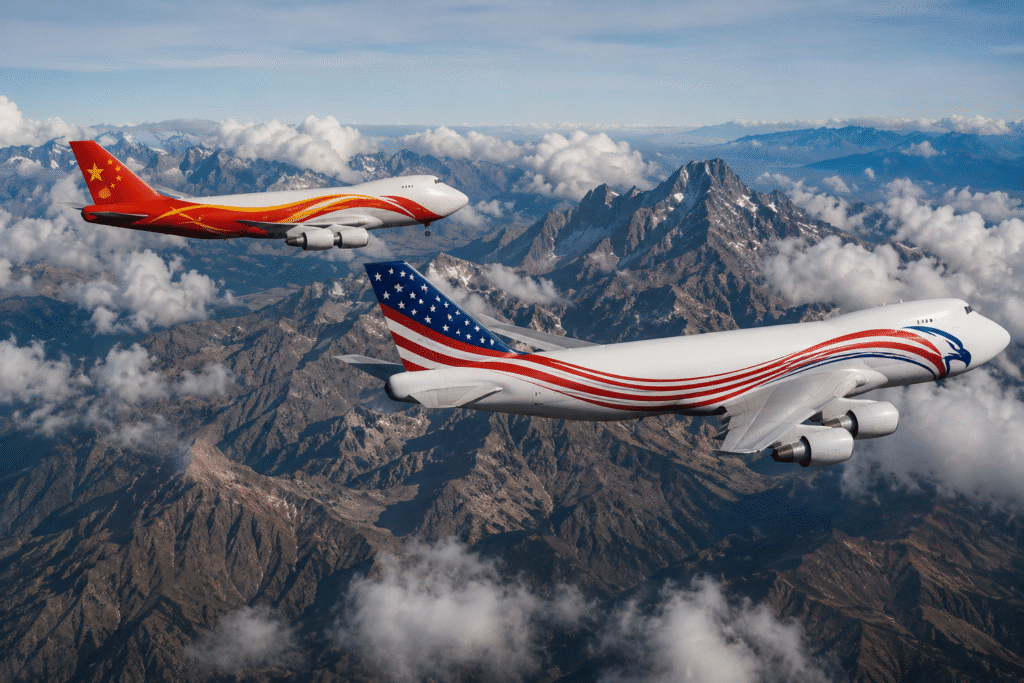
The Trump Countermove — Tariffs as Aviation Leverage
Washington has not stayed silent. The Trump administration has made clear — through diplomatic channels — that South American nations purchasing Chinese aviation technology at scale could face complications in their trade relationship with the United States.
When authoritarian pressure begins to dictate who can and cannot fly, those protective standards are no longer secure. This is not just a Taiwan issue — it is a global warning. If China can pressure countries on aviation access, it also can pressure them on trade, security cooperation and diplomatic relations. This is how malign influence becomes control.
The US has also flagged intelligence concerns about C919’s avionics systems and their potential connectivity to Chinese military satellite networks — warning South American governments that a C919 fleet may come with invisible passengers in the cockpit.
BeiDou Is Already There — The Invisible Head Start
Before a single C919 lands in Bogotá or São Paulo, China has already embedded itself in South American skies in a different way. China’s BeiDou Navigation Satellite System — a direct rival to GPS — is now operational across eight South American countries, integrated into aviation infrastructure, port logistics, and terrestrial communications.
That integration gives Beijing a form of airspace influence that no aircraft sale is needed to create — and the US is now scrambling to offer GPS upgrades as a counter-measure.
Boeing’s Vulnerability — The MAX Shadow
America’s flagship commercial aviation brand cannot compete in this fight without acknowledging its own wounds. The Boeing 737 MAX crises of 2019 and 2022 permanently damaged trust among South American carriers — several of which grounded their MAX fleets and are now actively evaluating alternatives for their next fleet cycle.
Despite China’s desire to build up its own aviation industry, Boeing has continued to engage in joint ventures with Chinese companies that place America’s edge in aerospace at risk. The power of American aviation remains one of Washington’s most potent soft power tools — but that edge is not guaranteed.
The Stakes — 35,000 Feet and the New World Order
The battle for South America’s skies is ultimately a battle for alignment. Every country that chooses a C919 fleet is implicitly deepening its aviation infrastructure dependency on China. Every country that stays with Boeing or Airbus maintains a technical and operational web that ties it to Western standards, Western parts supply chains, and Western satellite navigation.
That alignment, multiplied across an entire continent’s aviation industry, is not just an economic outcome. It is a geopolitical one — measured in overflights, data streams, and the quiet leverage that comes with knowing which way a partner’s planes are pointed.
The runway is set. The competition has begun. And in boardrooms from Santiago to Bogotá, executives are being asked to make a choice that is about far more than the price of a plane.
Disclaimer: This article is for general informational and news reporting purposes only. All facts, strategic assessments, and commercial aviation data are sourced from CSIS, the Washington Times, Aerospace America, Modern Diplomacy, and American Enterprise Institute publications as of May 2026. Aircraft sales negotiations referenced represent developing market dynamics, not confirmed signed contracts. TrenBuzz.com does not represent any government, airline, or aerospace manufacturer. Readers are encouraged to follow credible aviation and geopolitical news sources for the latest developments.