


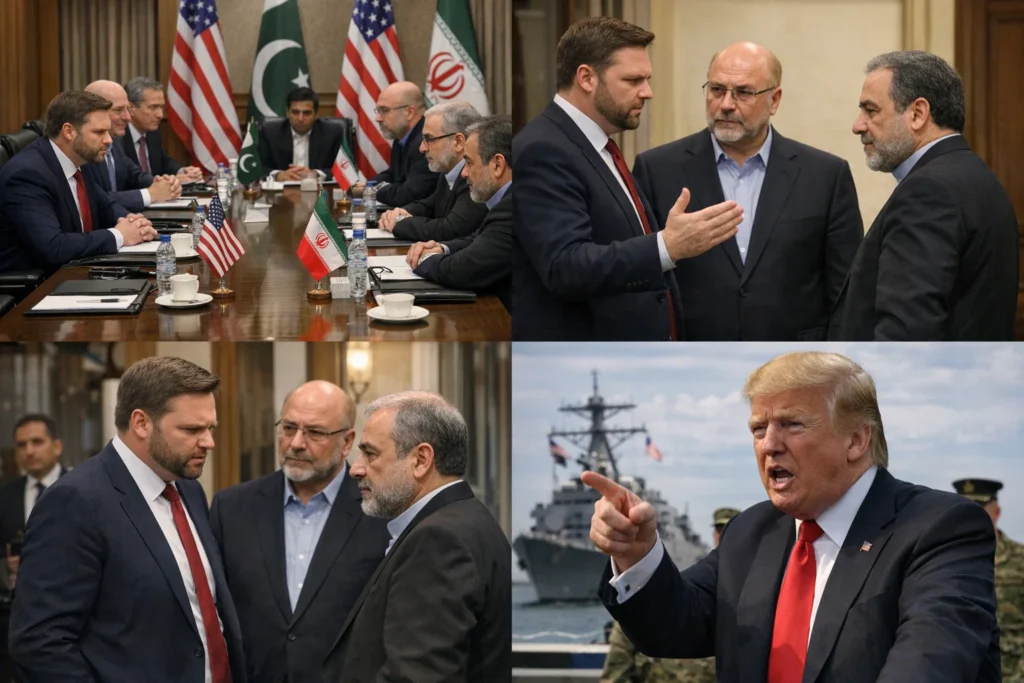
Published by TrenBuzz.com | April 12, 2026
Key Points at a Glance
- US-Iran peace talks in Islamabad, Pakistan ran for 21 straight hours on April 11–12, 2026 — and ended without a deal.
- VP JD Vance led the US delegation; Iran was represented by Parliamentary Speaker Mohammad Bagher Ghalibaf and FM Abbas Araghchi.
- It was the highest-level US-Iran meeting since the 1979 Islamic Revolution.
- Key agreement areas included some preliminary common ground on the war ceasefire framework.
- Major disagreements: Iran’s nuclear program, control of the Strait of Hormuz, war reparations, and sanctions.
- Iran’s foreign ministry confirmed “two or three key issues” prevented a deal.
- Trump responded by threatening a full naval blockade on Iran after talks collapsed.
- The fragile two-week ceasefire is now in serious jeopardy.
US-Iran Peace Talks Collapse: The world held its breath. After six weeks of war, 21 hours of negotiations, and the highest-stakes diplomatic gamble in decades — the US and Iran walked away from the table with nothing signed.
The United States and Iran failed to reach a deal after high-stakes talks in the Pakistani capital, with US Vice President JD Vance saying Tehran refused to accept Washington’s terms after 21 hours of negotiations in Islamabad.
How the Talks Began — and Why They Mattered
The talks were the first face-to-face engagement between the US and Iran since 2015, when the Obama administration negotiated a nuclear deal with Iran that was later scrapped by Trump.
On April 11, US Vice President JD Vance, along with Trump’s special envoy Steve Witkoff and son-in-law Jared Kushner, arrived in Islamabad. The Iranian delegation, including Foreign Minister Abbas Araghchi and Parliamentary Speaker Mohammad Bagher Ghalibaf, arrived earlier.
Pakistan served as the critical neutral mediator — a rare position of trust from both parties in one of the world’s most tense conflicts.
✅ What Iran and America DID Agree On
Iran’s foreign ministry spokesperson Esmaeil Baghaei confirmed that common ground was found on a number of issues, though he said “on two, three key topics there were significant differences.”
Iran’s Foreign Ministry confirmed that in the past 24 hours, discussions were held on various dimensions of the main negotiation topics, including the Strait of Hormuz, the nuclear issue, war reparations, lifting of sanctions, and the complete end to the war.
Both sides agreed that diplomacy should continue — Iran’s foreign ministry noted that “diplomacy never comes to an end,” keeping a door technically open.
❌ What Blew the Talks Up — The Core Disagreements
1. Iran’s Nuclear Program
Vance stated the US needed to see “an affirmative commitment that they will not seek a nuclear weapon, and they will not seek the tools that would enable them to quickly build one.” Iran refused to make that commitment.
2. Control of the Strait of Hormuz
According to a source briefed on the talks, some of the key disagreements had to do with Iran’s demand to control the Strait of Hormuz and its refusal to give up its enriched uranium stockpile.
3. War Reparations and Frozen Assets
Iran’s demands included the release of $6 billion in frozen assets, guarantees around its nuclear program, the right to charge ships passing through the Strait of Hormuz, and an end to Israel’s attacks against Hezbollah.
4. Trust — Or the Lack of It
Iran’s Parliamentary Speaker Ghalibaf said his delegation raised “forward-looking” initiatives, but the US side “ultimately failed to gain the trust of the Iranian delegation.” He added: “America has understood our logic and principles, and now it’s time for it to decide whether it can earn our trust or not.”

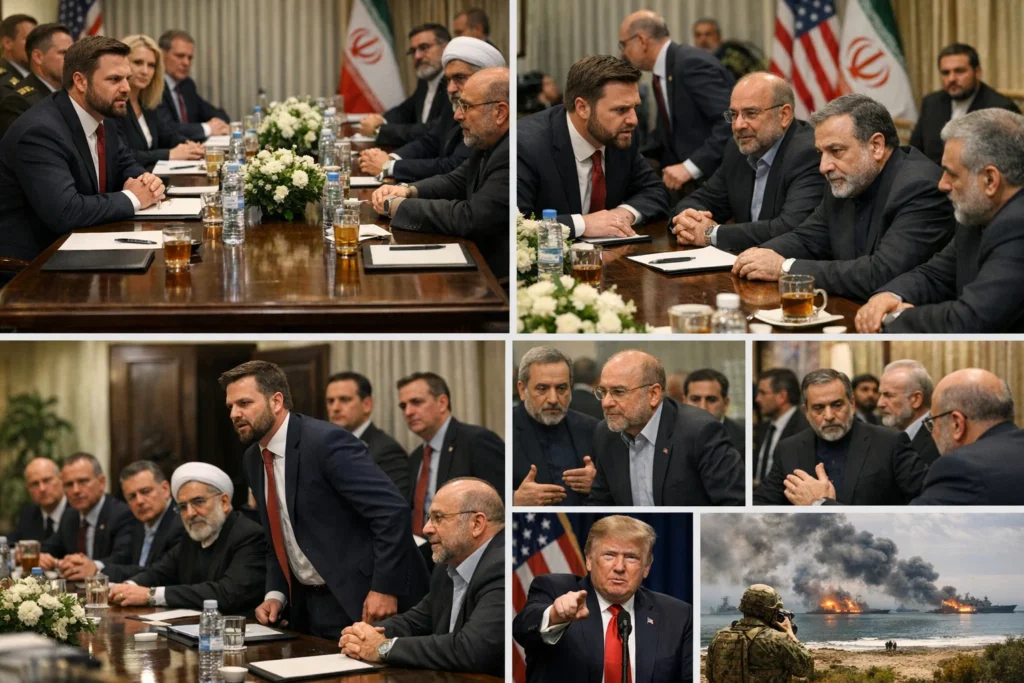
Vance’s Verdict — And Trump’s Threat
Vance said: “We were quite accommodating. The president told us, ‘You need to come here in good faith and make your best effort to get a deal.’ We did that, and unfortunately, we weren’t able to make any headway.”
Vance left the door slightly ajar, saying: “We leave here with a very simple proposal — a method of understanding that is our final and best offer. We’ll see if the Iranians accept it.”
Following the failure of negotiations, Trump threatened a “full naval blockade” on Iran.
What Happens Now?
Former State Department negotiator Aaron David Miller said the Iranians “hold more cards than the Americans,” noting: “They still have the highly enriched uranium. They’ve weaponized geography and control the Strait of Hormuz. The regime has survived.”
Pakistan said it would continue to play its mediator role, with Foreign Minister Ishaq Dar urging both sides to keep talking after negotiations broke down.
The two-week ceasefire clock is ticking. The world watches — and waits.
Disclaimer: This article is for general informational and news reporting purposes only. All quotes, facts, and data are based on publicly available and credible news sources as of April 12, 2026. TrenBuzz.com does not represent any government, diplomatic body, or political party. Readers are encouraged to follow official government and credible international sources for real-time updates.