


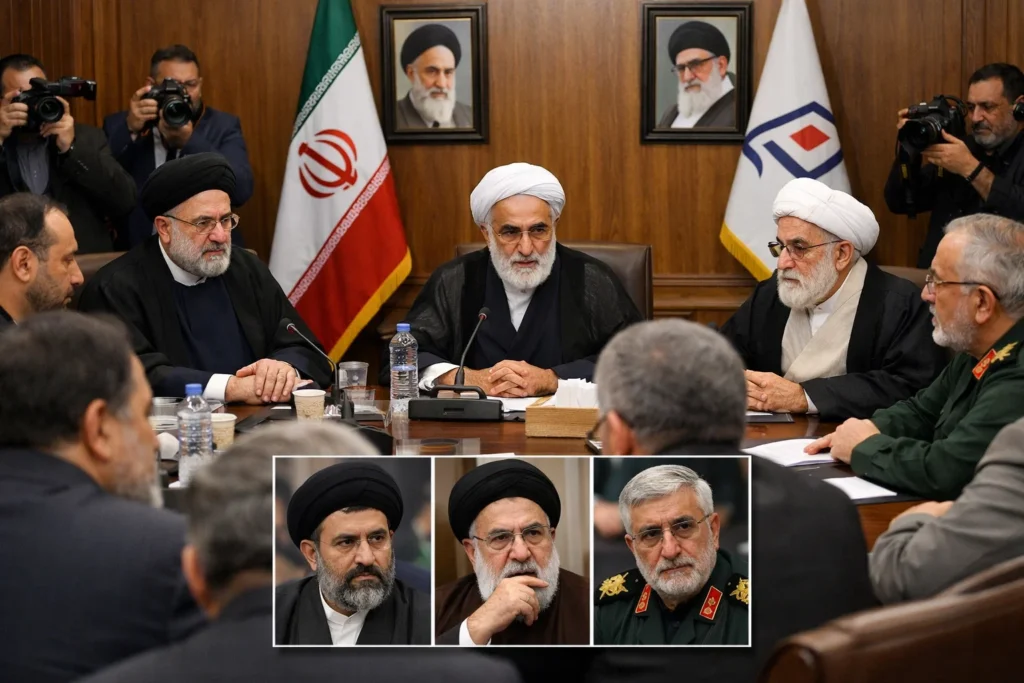
Key points
- Iranian state media and international outlets report Supreme Leader Ayatollah Ali Khamenei died after strikes; Iran has invoked constitutional transition rules.
- The constitution (Article 111) creates a temporary leadership council to carry out the supreme-leader duties until the Assembly of Experts selects a new leader. That council includes the president, the head of the judiciary and a Guardian Council jurist chosen by the Expediency Council.
- Who might succeed Khamenei is uncertain. Analysts name several possibilities — from senior clerics to powerful security figures and, controversially, Khamenei’s son Mojtaba — but the ultimate choice rests with the Assembly of Experts and the balance of influence among the Revolutionary Guard, Guardian Council and senior clerics.
What the constitution says (Who Would Succeed Khamenei)
If the supreme leader dies or is incapacitated, the constitution calls for a temporary three-member council to assume duties.
That body governs until the 88-member Assembly of Experts convenes to appoint a new supreme leader.
Who is in the temporary leadership council now
Officials and reporting name the sitting president, the head of the judiciary and a Guardian Council jurist selected by the Expediency Council as the interim collective leadership.
The arrangement is designed to preserve continuity while the Assembly considers candidates.
Who actually chooses the next supreme leader?
Formally: the Assembly of Experts, a body of clerics elected (with candidate vetting) to evaluate and appoint the supreme leader.
In practice: key unelected institutions — the Guardian Council, the Expediency Council, and the IRGC’s senior commanders — heavily shape outcomes.

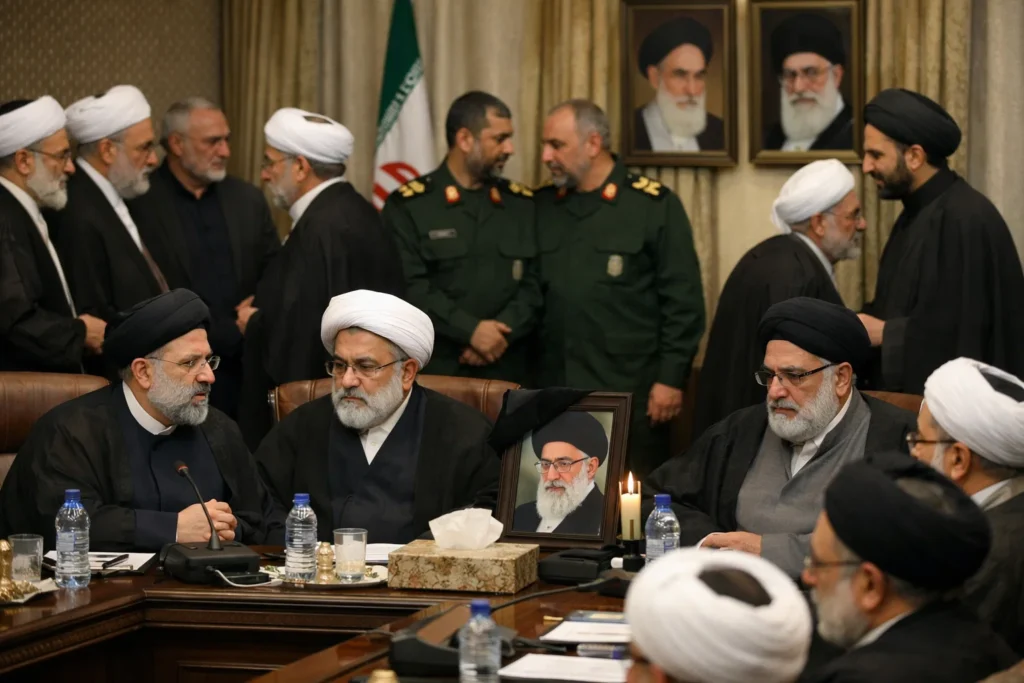
Names analysts point to (with caution)
Experts have repeatedly flagged: Mojtaba Khamenei (the supreme leader’s son) as a possible contender; senior clerics such as Gholam-hossein Mohseni-Ejei (judiciary chief) and conservative ayatollahs; and powerful political/military figures (parliament speaker or IRGC-aligned leaders).
Sources stress no single figure currently commands Khamenei’s broad legitimacy — any successor will need both clerical endorsement and security-sector buy-in.
Why a successor is not guaranteed to be a cleric alone
Since 1989 the role of the supreme leader has blended religious authority with control over the military and state institutions.
That hybrid nature means the next leader must be acceptable to clerical bodies and to the IRGC and other security-economy patrons — a recipe for intense behind-the-scenes bargaining.
Two fast scenarios experts warn about
- Managed succession: establishment insiders rush a candidate with clerical credentials and IRGC support to signal continuity and control.
- Contest for control: factional fights among clergy, the Guardian Council and the IRGC create instability, opening space for either a hard-line military-dominated arrangement or broader unrest. Analysts say both are plausible.
What to watch in the coming days (practical checklist)
- Official convening date and membership announcement of the Assembly of Experts session.
- Public statements (and funerary ritual timing) that signal which clerical networks back which candidates.
- Movements and public posture of the IRGC, Guardian Council and Expediency Council — their posture will be decisive.
Quick FAQ — short, verifiable answers
Is there a single obvious successor to Khamenei?
No. Analysts say several figures are possible, but no one now enjoys Khamenei-level authority; the Assembly of Experts and powerful institutions will determine the outcome.
Could Mojtaba Khamenei succeed his father?
His name is frequently mentioned by analysts and opposition commentators, but a father-to-son transfer would be politically fraught and is not automatic; it would require clerical and security elite approval.
How long before a new leader is chosen?
The constitution does not fix a single deadline for the Assembly’s decision in extraordinary circumstances; political urgency and stability pressures typically make the process happen quickly, but timing will depend on the balance of power.
Final take — constitutional text vs. real power
Iran’s constitution describes a clear, clerically led succession mechanism, but real outcomes depend on extra-constitutional power brokers — chiefly the IRGC and the Guardian and Expediency councils.
That means “who would succeed Khamenei” is both a legal question and a contest among Iran’s most powerful institutions; the immediate days ahead will show which side holds sway.
Disclaimer: This article summarizes rapidly evolving reporting and expert analysis as of February 2026. Succession outcomes are fluid; for live developments consult reputable news outlets and official Iranian statements.