


Key Points: Why Trump Ballroom
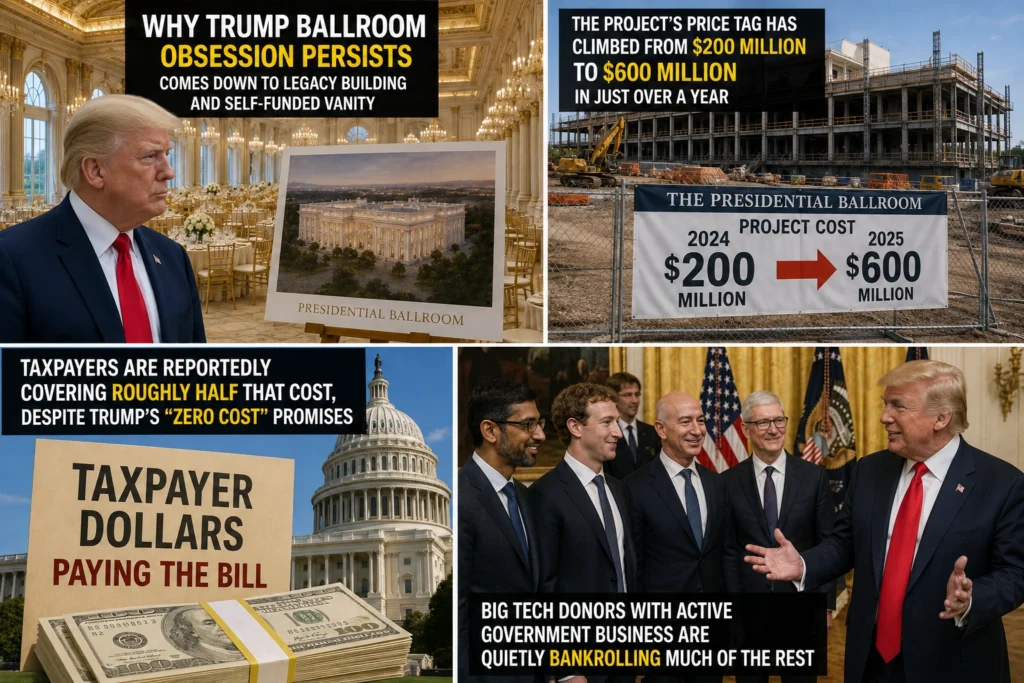
- Why Trump ballroom obsession persists comes down to legacy building and self-funded vanity
- The project’s price tag has climbed from $200 million to $600 million in just over a year
- Taxpayers are reportedly covering roughly half that cost, despite Trump’s “zero cost” promises
- Big Tech donors with active government business are quietly bankrolling much of the rest
President Trump has fought harder for this single construction project than almost any other domestic priority this term, and the numbers explain exactly why critics are paying such close attention.
Why Trump Ballroom Fixation Runs So Deep
Trump first announced plans for a White House ballroom in July 2025, framing it as a long-overdue upgrade to a building that’s lacked large-scale event space for decades.
Here’s the historical context making this project genuinely significant. It represents the first major structural change to the White House complex since 1948, a detail Trump has repeatedly emphasized publicly.
He’s consistently framed the project in personal, legacy-defining terms too, telling reporters he’s honored to be “the first President to finally get this much-needed project underway.”
Trump has also increasingly leaned on a national security justification, describing the underground portion of the complex as essential protection infrastructure for himself and future presidents.
Tracking The Real Cost Explosion
Here’s how dramatically this project’s price tag has moved. Trump originally estimated $200 million when construction began in October 2025.
By March 2026, that figure had doubled to $400 million. Recent USA Today reporting now places the total cost closer to $600 million, with taxpayers reportedly covering roughly half.
That taxpayer exposure directly contradicts Trump’s repeated public promises. “I am honored to be the first President to finally get this much-needed project underway, with zero cost to the American Taxpayer,” he wrote on Truth Social.
Here’s where that “zero cost” claim gets complicated. Congress separately approved $1 billion in the reconciliation bill for “security adjustments and upgrades” at the White House, funding the administration insists is distinct from the ballroom itself.
Who’s Actually Paying For This Project
Here’s the donor list revealing the project’s real funding structure. Apple, Amazon, Google, Meta, Microsoft, Lockheed Martin, and Coinbase all appear among 37 disclosed contributors.
One donation stands out for its origin story. Alphabet, Google’s parent company, is contributing $22 million specifically as part of a legal settlement tied to Trump’s 2021 YouTube suspension lawsuit.
Here’s why ethics experts find this arrangement troubling. Columbia law professor Richard Briffault noted many donors have done “significant” business with the federal government, raising questions about what access their contributions might buy.
Watchdog group CREW has flagged another concerning pattern. At least 22 companies involved in funding the project reportedly failed to disclose their donations in required lobbying filings.
With a federal appeals court now blocking further construction and the case heading toward the Supreme Court, this ballroom’s true final cost, and who ultimately pays it, remains genuinely unresolved.