


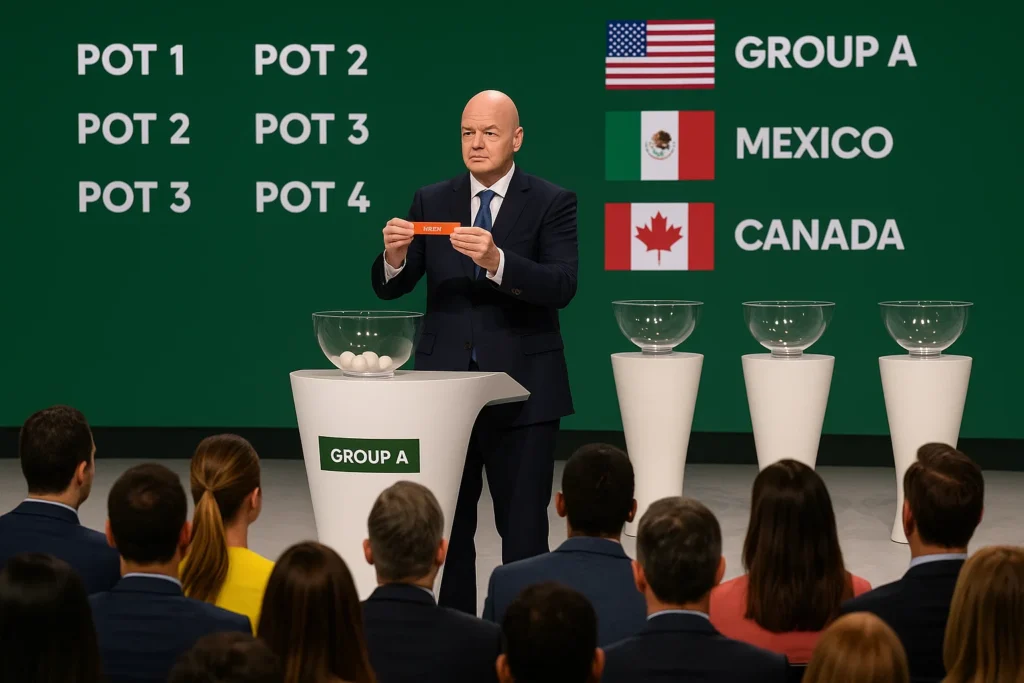
The FIFA World Cup draw 2026 — the moment every national-team fan has circled — happens today at the John F. Kennedy Center in Washington, D.C.
The ceremony begins at 12:00 p.m. ET (17:00 GMT / 18:00 CET) and will set the groups for the expanded 48-team tournament.
This explainer answers the most-asked questions: what time is the World Cup draw, how the pots and procedures work, where to watch live (TV and streams), and the key storylines to follow.
Short paragraphs, plain language, and a quick checklist at the end so you don’t miss a single moment.
When is the World Cup draw 2026 — exact times you can use
The final draw takes place on Friday, 5 December 2025, at 12:00 p.m. ET at the Kennedy Center.
That’s 17:00 GMT, 18:00 CET, 10:30 p.m. IST, and early Saturday morning in parts of Asia/Australia — check your local converter.
Broadcasters will begin pre-show coverage earlier than the official start; in the U.S., Fox’s pregame begins about 30 minutes prior.
If you plan a watch party, log on 20–30 minutes early to catch analysis and the pot confirmations.
Where to watch the FIFA World Cup draw (TV and stream)
In the United States the draw will be broadcast live on Fox with streaming available via rights partners and major sports platforms.
Globally, FIFA will stream the draw on FIFA.com and FIFA’s official YouTube channel for viewers without regional TV rights.
Public broadcasters in many countries (BBC in the U.K., SBS in Australia, and others) will show the event or host live coverage windows.
If you prefer a neutral, ad-free feed, FIFA’s own stream is often the most direct option.


How the 48-team World Cup draw works — pots, rules, and hosts
The 2026 World Cup uses a 48-team format split into 12 groups of four; the top two in each group plus the eight best third-place teams advance to a 32-team knockout.
FIFA published the official procedures and pot definitions ahead of the final draw to ensure transparency.
The tournament’s three hosts are pre-assigned to groups: the United States, Mexico and Canada are slotted into specific groups to preserve host match scheduling.
That means those hosts will not be drawn like other teams and their group placements are known before the main ceremony begins.
Teams are placed into pots by FIFA based on ranking, confederation rules, and special constraints so that, for example, most confederations cannot have more than one team in the same group.
The pots and the drawing order are explained clearly during the pre-show; watch that segment if you want to follow exactly how the balls will be mixed and drawn.
Who’s already qualified — what the draw will include
As of the draw, 42 teams have clinched qualification and six places remain to be decided via UEFA playoffs and inter-confederation playoffs next March.
Those undecided slots appear in the draw as placeholders and will be filled later once the March playoffs conclude.
That means some groups will show “Playoff Winner A/B/C” until the final qualifiers are known, but the draw establishes each group’s path and matchups.
If your country is in pot 2 or 3, this draw determines the exact group opponents and the realistic path to the knockout rounds.
Major storylines to watch during the draw
- Who the U.S., Mexico and Canada get in their groups. Host group composition shapes home-market schedules.
- Tough “group of death” possibilities. With 12 groups, multiple stacked groups could emerge — watch how high-ranked teams are distributed.
- Playoff placeholders. See which groups contain inter-confederation and UEFA playoff slots — that affects late-March strategies.

Practical viewing tips (don’t miss the key bits)
Set an alarm for the pre-show — you’ll hear confirmations of pots, seeding rules, and any last-minute updates.
Use FIFA’s live visual feed if you want the simplest presentation of the balls, group boards, and countdown clocks.
Follow reputable liveblogs (news outlets or FIFA’s own feed) if you prefer text highlights rather than a full video watch.
Save the official match-schedule announcement the next day — FIFA usually releases the full match schedule within 24 hours of the draw.
How the draw affects teams and travel planning
The draw locks in the groups and therefore the city windows where teams will likely play; for fans buying travel, this is the moment to start firming plans.
Host cities will still finalise exact match dates and kickoff times in the schedule release, but group placement shows likely travel arcs.
If you’re a neutral fan planning a multi-city trip in June–July, map possible group locations and keep refundable bookings until the full match schedule is released.
Sporting calendars, flights and hotels for popular matchups will book fast after the schedule is published.
FAQs — short answers to the most-asked questions
Q: What time is the World Cup draw in my timezone?
A: It starts at 12:00 p.m. ET (17:00 GMT / 18:00 CET / 10:30 p.m. IST). Convert locally if you’re elsewhere.
Q: Where can I stream it for free?
A: FIFA streams the draw on FIFA.com and YouTube; regional broadcasters may also offer free streams.
Q: Will the full match schedule be released today?
A: FIFA typically issues the detailed match schedule within 24 hours of the final draw; watch for that follow-up announcement.
Which group stage outcome would excite you most from the World Cup draw?
Final checklist — before the draw starts
- Tune in to Fox (U.S.) or FIFA.com / YouTube (global) about 20–30 minutes early.
- Follow the pot and procedure explanation if you care about why teams can or cannot meet.
- After the draw, wait for FIFA’s match-schedule release to book any travel or tickets confidently.
Enjoy the draw — it’s the official start of the World Cup countdown and the first glimpse at the drama that will play out across North America next summer.
If you want more immediate updates, refresh this page after the ceremony for our instant group-by-group breakdown and what each draw means for the favorites and dark horses.
Disclaimer: This article summarises public schedule and broadcast information available as of the update time.
Local broadcast windows, stream availability, and match scheduling details are subject to change — check your local broadcaster or FIFA’s official channels for definitive timings.