


Key points
- South Africa hosted a high-profile BRICS naval exercise this week that brought China, Russia, Iran and other BRICS members and partners to sea — but two founding members, India and Brazil, did not take part as full participants.
- The drills are the most visible sign yet of BRICS’s expanding security footprint — an exercise in signaling and maritime capacity-building rather than a formal military alliance. Analysts say the maneuvers aim to project influence over shipping lanes and to give member navies more experience operating together.
- New Delhi’s decision to sit out reflects a mix of strategic caution, bilateral tensions with China, and its longstanding preference for strategic autonomy — a posture that keeps India outside clear bloc-style military commitments.
Lede — what happened and why readers should care
In early January, BRICS-hosted naval drills off the South African coast drew international attention not simply because of the scale of the exercise but because two founding BRICS members — India and Brazil — were absent as full participants. The operation underscores a turning point: BRICS is testing security cooperation beyond its traditional economic agenda, and India’s opt-out signals the limits of that security trajectory. That combination matters for regional stability, maritime trade routes, and how middle powers navigate great-power competition.
What were the BRICS wargames?
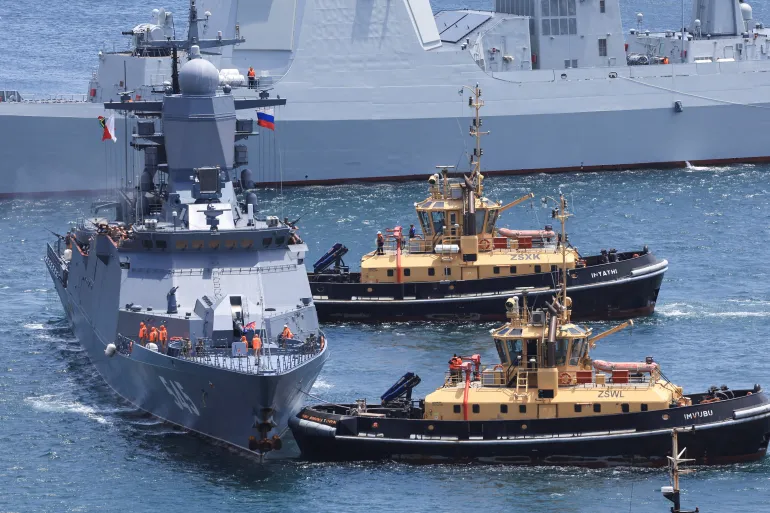
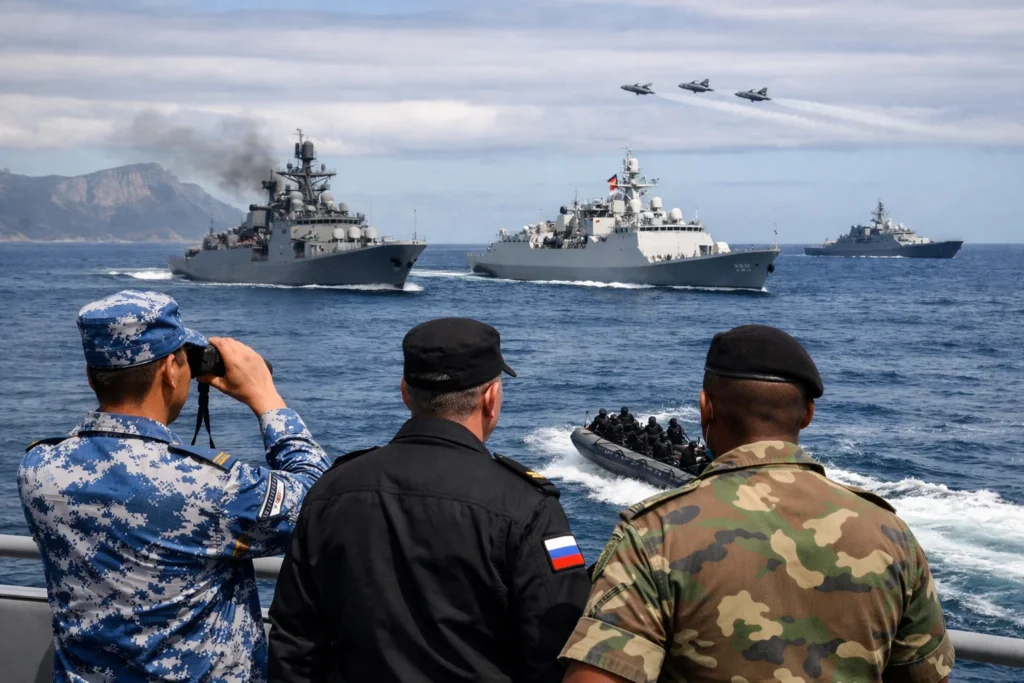
The exercises assembled a mix of BRICS members and partner states in coordinated naval drills that included maritime patrols, live-fire exercises in some reports, and coordination on “safety of navigation” and anti-piracy-style scenarios. Host statements framed the activity as defensive and aimed at preserving shipping lanes and maritime economic activity, while analysts note the symbolic value of joint deployments involving China and Russia. These activities represent an operational step beyond routine diplomatic communiqués and economic summits.
Why the drills matter (three strategic effects)
- Signaling and influence over maritime commons. Joint naval exercises allow participants to demonstrate reach, interoperability and the ability to influence critical sea lines of communication — particularly important in the Indian Ocean and South Atlantic. That messaging matters to trading states and naval planners alike.
- Institutionalizing military-to-military ties. Repeated exercises build habits: shared procedures, common command arrangements and interpersonal ties that can lower frictions in future operations — whether humanitarian or coercive. Over time this can shift regional threat perceptions even without a formal alliance.
- Geopolitical optics. China and Russia sailing together under a BRICS banner reframes the bloc from a purely economic forum toward a platform that can project geopolitical alternatives to Western-led security architectures. That perception alone can influence diplomacy and defense planning in Asia, Africa and Europe.
Why India opted out — a careful, deliberate calculation
India’s absence was not an accident. Public reporting and analyst commentary point to three overlapping rationales:
- Bilateral tensions with China. Recent border frictions and strategic mistrust make close military cooperation with Beijing politically and operationally fraught. Participating in a China-led or China-heavy naval drill would risk normalizing military ties at a moment when New Delhi is cautious about Beijing’s intentions.
- Strategic autonomy, not bloc membership. New Delhi has long preferred flexible, issue-based partnerships (e.g., Quad, bilateral ties with Russia and the U.S.) rather than being boxed into bloc-based military commitments. Skipping the drill helps preserve that autonomy and avoids the perception India has joined a military counter-bloc.
- Diplomatic balancing with the West. Since geopolitical competition with China and strategic alignment with Western partners have intensified, India is sensitive to moves that could be construed as siding with China-Russia military initiatives — especially in the maritime domain that overlaps with Western security interests. Remaining outside helps New Delhi reassure partners while keeping channels to BRICS open for economic cooperation.
Taken together, these factors explain why New Delhi would publicly decline participation while continuing to engage with BRICS politically and economically.

Reactions from capitals and analysts
- South Africa (host): Framed the exercises as essential for maritime safety and economic stability, defending BRICS’s right to broaden its agenda. Officials emphasized non-confrontational aims.
- China and Russia: Presented the drills as evidence of deepening security cooperation among Global South partners; state media highlighted interoperability and joint presence.
- India: New Delhi has described its posture as a policy choice rooted in sovereign considerations; analysts interpret the move as an attempt to avoid entanglement and preserve diplomatic flexibility.
What this means for the region and global order
- No instant military bloc — but an expanding security forum. BRICS is not NATO. There is no mutual-defense clause. Yet repeated military cooperation, exercises and security dialogues create institutional momentum that can slowly reconfigure regional expectations.
- Space for hedging states. Countries that prize strategic independence (India, Brazil) will continue to hedge — participating selectively in economic BRICS initiatives while avoiding full security integration. That hedging keeps the system messy and unpredictable.
- Implications for maritime governance. More BRICS activity at sea will complicate maritime diplomacy: freedom-of-navigation claims, contestation over maritime resources, and multilateral patrol coordination could all be affected by overlapping presences.
Interactive: quick reader checklist — what to watch next
(Answer Yes / No; then read the recommended follow-up.)
- Are more BRICS security exercises announced for 2026? — If Yes, expect deeper operational cooperation; if No, the exercises likely remain episodic.
- Does India change course and join future drills? — If Yes, it signals a major policy shift toward closer security coordination; if No, India’s strategic autonomy endures.
- Do Western or regional navies increase patrols in response? — If Yes, expect heightened naval encounters and an uptick in maritime diplomacy.
(If you want, TrenBuzz can send weekly updates that track BRICS security activity and India’s policy statements. Reply “Track BRICS” and we’ll prepare a short briefing.)
Practical takeaways for policy watchers and businesses
- For diplomats and planners: Treat BRICS security cooperation as an increasingly relevant variable in regional contingency planning — even if it does not amount to a formal alliance.
- For maritime trade operators: Monitor naval activity around critical sea lanes and confirm insurance coverage for transits through contested or congested areas.
- For investors and strategists: Consider how emerging security cooperation among BRICS members could affect supply chains, especially for energy and raw materials that transit contested maritime corridors.
Bottom line
The BRICS wargames mark a meaningful step in the bloc’s evolution: they convert political statements into operational practice, testing whether BRICS can sustain security cooperation without becoming a classical military alliance. India’s decision to opt out underscores the limits of that evolution — a reminder that tactical military cooperation under BRICS will run up against deep-seated strategic choices by members who prize autonomy and complex diplomatic balancing. For observers, the episode is less about an immediate shift in global power and more about the slow institutionalization of alternative security practices that will shape regional calculations in the years ahead.
Disclaimer: This article is informational and analytical; it does not represent policy advice. For primary texts, official communiqués and exact drill schedules consult host-nation releases and BRICS secretariat statements.