


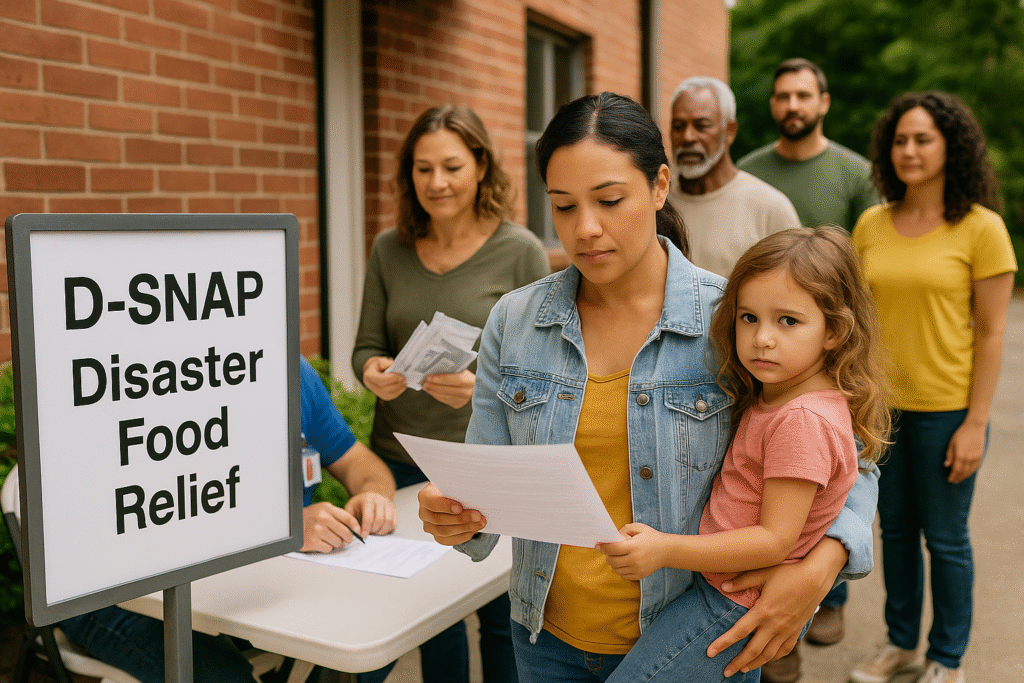
Disaster Food Relief: When a disaster hits, putting food on the table becomes an urgent need. The Disaster Supplemental Nutrition Assistance Program (D-SNAP) — often called “disaster food stamps” — gives short-term food benefits to households in presidentially declared disaster areas. This practical, step-by-step guide shows who can get D-SNAP, how to apply, what documents you’ll need, and smart tips to speed your application.
Quick summary — the essentials
- What D-SNAP is: short-term SNAP benefits loaded on an EBT card for households affected by a presidentially declared disaster.
- Who runs it: the U.S. Department of Agriculture Food and Nutrition Service (USDA FNS) authorizes D-SNAP; state or tribal SNAP agencies operate it locally.
- Who can apply: people who live in a declared disaster area and were affected (income loss, damage, evacuation, injury). Both households that don’t normally get SNAP and current SNAP households (for supplemental benefits) may qualify.
Step 1 — Confirm your address is inside a declared area
D-SNAP is available only when USDA and state authorities approve D-SNAP for counties or areas included in a Presidential disaster declaration for Individual Assistance. Your state will announce which counties are authorized. Check the USA.gov disaster food page or your state SNAP website for the official list.
Quick action: Search your county on your state’s emergency page or the USDA/FNS guidance announcements to confirm eligibility.
Step 2 — Know who may qualify (two groups)
1) Households that do not normally receive SNAP: you may qualify if the disaster caused a loss of income, costly disaster-related expenses, evacuation/relocation costs, or personal injury that affects your ability to buy food.
2) Households that already receive SNAP: you may receive a D-SNAP increase (a supplement or replacement) if your normal SNAP benefit does not cover losses caused by the disaster; the state will determine supplemental amounts.
Step 3 — How benefits are calculated and how long they last
- Benefit amount: many D-SNAP operations issue one month of benefits equal to the maximum SNAP benefit for a household of your size (state rules and waivers can vary).
- Benefit period / expiration: states may set the issuance and expiration periods—some states issue benefits that expire within a set number of months (check your state notice). If you still need food help after D-SNAP, ask how to apply for regular SNAP.
Step 4 — Where and how to apply (state-run process)
Important: The USDA FNS authorizes D-SNAP, but you apply through your state, territory, or tribal SNAP agency. Each state runs its own application events and schedules after they receive authorization. Typical ways to apply include:
- In-person application events (pop-up D-SNAP sites) announced by the state.
- Local SNAP office intake (some states accept applications at county offices).
- Phone or online guidance — some states provide phone registration or online signups depending on the event.
State notices will say exactly where to go, what days are open, and what ID/documents to bring. If you don’t see D-SNAP posted yet, call your state SNAP office or check their disaster announcements.


Step 5 — Documents and information to bring (plan ahead)
Bring the following if you can — states may accept partial documentation but having these speeds approval:
- Proof of identity (photo ID, driver’s license).
- Proof of residency in the affected county (utility bill, lease, or statement).
- Social Security numbers for household members (or document why you don’t have them).
- Proof of disaster impact (photos of damage, repair estimates, insurance claim numbers, employer notice of lost income, evacuation receipts).
- Household income information (pay stubs, bank statements).
If you’re currently a SNAP household and need a replacement or supplement, bring your current SNAP ID or EBT card information. States sometimes allow people to pre-register by phone and then complete the interview at the site.
Step 6 — Common state variations & waivers (what to expect)
States may request waivers or flexibilities from USDA to speed delivery (for example, simplified interviews, relaxed ID rules, or alternate application locations). This means processes can differ by state and disaster—follow your state SNAP announcements closely. If a state publishes a D-SNAP plan or toolkit, it will explain application windows and any special rules.
Tip: Find your state’s D-SNAP page (search “[Your State] D-SNAP”); it will usually include dates, locations, and a downloadable application checklist.
Step 7 — Watch for deadlines and avoid common mistakes
- Apply during the announced D-SNAP application window — missed deadlines can mean missed benefits.
- Don’t assume automatic eligibility — even if you live in a declared county, you must apply and provide evidence of disaster impact.
- Do not give your EBT card to anyone else and report lost/stolen cards to your state SNAP office immediately. D-SNAP rules prohibit selling or trading benefits.
Short FAQ — fast answers
Q: I never had SNAP before — can I still apply for D-SNAP?
Yes. People who don’t normally qualify for SNAP may qualify for D-SNAP if the disaster caused income loss, evacuation costs, or other disaster-related expenses. Apply through your state SNAP office when D-SNAP is announced.
Q: I already get SNAP — will I get extra?
Possibly. SNAP households affected by the disaster may receive replacement benefits or a supplemental payment to reach the maximum household SNAP level; contact your state SNAP office.
Q: How long do D-SNAP benefits last?
Benefit amounts are typically for one month (state issuance rules apply). Some states set an expiration window—check your state notice for exact dates.
Where to get official help right now
- Start at the USA.gov disaster food help page for plain-language guidance and links to state resources. (USAGov)
- USDA Food and Nutrition Service (FNS) posts D-SNAP authorizations, guidance, and state resources. (USDA Food and Nutrition Service, Food and Nutrition Service)
- Your state/territory SNAP or Department of Human Services will post the local application events and required documentation — search “[State name] D-SNAP” or call your local SNAP office. (Arkansas Human Services, NY State OTDA)
Final checklist (copy / paste or print)
- Confirm your county is included in the D-SNAP authorization. (disasterassistance.gov)
- Note application dates, times, and locations (state announcement). (Arkansas Human Services)
- Bring ID, proof of residency, SSNs, photos of damage, and income info. (Food and Nutrition Service)
- If you already get SNAP, bring your EBT card or SNAP ID. (Cabinet for Health and Family Services)
- Apply during the window; keep copies of everything submitted. (Food and Nutrition Service)
Disclaimer: This article is for informational purposes only and does not constitute legal, tax, or financial advice. Program details, application windows, and state rules can change — always confirm deadlines, eligibility, and the application process with your state SNAP office and the official USDA/FNS or USA.gov pages before applying. Images used in this article are royalty‑free or licensed for commercial use and are provided here for illustrative purposes.
Helpful official links (clickable)
- Disaster food help — USA.gov (D-SNAP overview and links to state resources). (USAGov)
https://www.usa.gov/disaster-food-help - D-SNAP & disaster nutrition resources — USDA Food & Nutrition Service (FNS). (USDA Food and Nutrition Service, Food and Nutrition Service)
https://www.fns.usda.gov/disaster - State D-SNAP plans & notices — search your state SNAP or Department of Human Services site (example: Kentucky D-SNAP page). (Cabinet for Health and Family Services, NY State OTDA)