


Key points
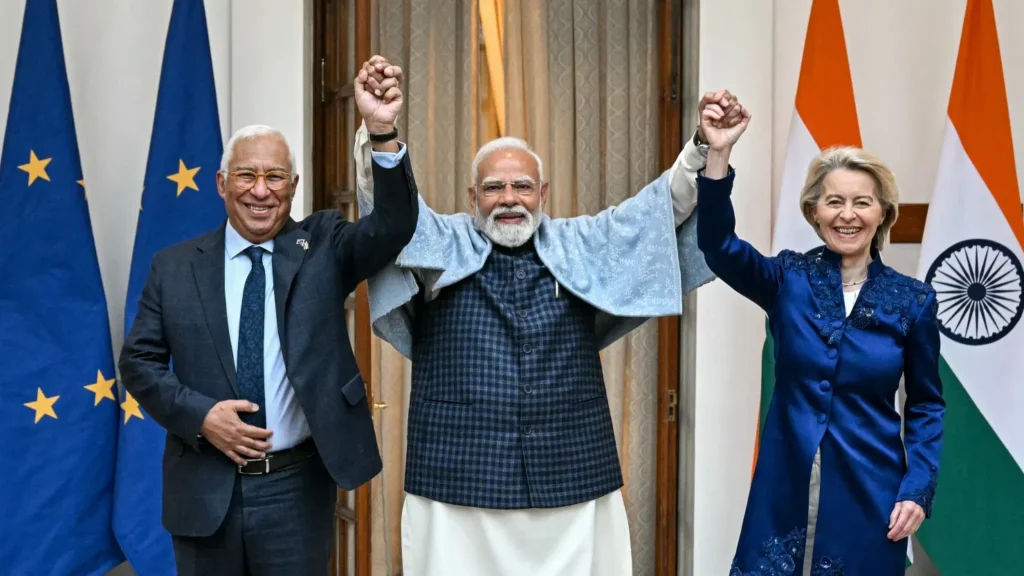
- India and the European Union concluded a landmark Free Trade Agreement (FTA) that reduces tariffs on the vast majority of goods traded between them and includes chapters on services, investment, digital trade, mobility and sustainability.
- The deal immediately eliminates duties on roughly 49.6% of tariff lines and will phase out duties on many more lines over 5–10 years; overall, it covers ~96–99% of trade lines depending on how you count phased liberalisation.
- European exporters — notably cars, wine, luxury goods and industrial machinery — gain sharply improved access to India; India wins improved access for textiles, gems & jewellery, leather, seafood and pharmaceuticals. Automotive parts, steel quotas and agriculture remain sensitive and managed.
- The agreement also advances services market access, regulatory cooperation, commitments on digital trade, and a first-of-its-kind mobility framework for skilled workers — opening routes for talent flows and services firms on both sides.
- Ratification and implementation will take time; businesses should use the transition windows (phase-outs, quota rules and rules-of-origin) to rework supply chains and market strategies.
India EU trade deal — why this deal matters
After nearly two decades of talks, the India–EU FTA is a big geopolitical and economic milestone. It’s being billed in Brussels as a major market-opening pact that strengthens economic ties with a partner of 1.4 billion people and gives Indian exporters wider access to Europe while delivering lower costs and clearer regulatory pathways for EU companies selling into India. For firms and policy makers this is both an opportunity and a juggling act: the gains are real but concentrated, and sensitive sectors (autos, some agriculture, steel) are carefully managed so the political cost of opening is limited.
What’s actually in the deal — the essentials
1) Tariffs and market access (goods)
- The EU will eliminate or significantly reduce duties on more than 90% of tariff lines (over 90% in value terms) for goods it exports to India, phased across immediate cuts and multi-year rollouts. India commits to cutting duties on the large majority of items too, but keeps protection on certain sensitive lines.
- Automotive: India agreed to cut car import tariffs substantially from very high levels but with phased schedules and quota/transition safeguards — for example, steep cuts to around 30–40% initially for some vehicles with a long glide path toward lower rates. This opens the Indian market to European automakers while protecting local manufacturing during a transition.
- Textiles, gems, pharmaceuticals and seafood: These are among India’s clear winners — several product lines move tariff-free or face rapid duty reductions, giving Indian exporters improved EU access.

2) Rules of origin, quotas and safeguards
- The pact uses detailed rules of origin (to prevent third-country transshipment) and includes tariff-rate quotas (TRQs) and transition periods for sensitive agricultural goods (e.g., apples, pears, some fruits) and steel. These technical rules will determine who can actually claim the preferential rates.
3) Services, investment and mobility
- The agreement broadens services market access (finance, professional services, ICT) and contains arrangements to facilitate skilled mobility — a structured framework that eases temporary movement of professionals and sets up mechanisms for skills recognition (not a visa-free regime, but a practical pathway). This is a major non-tariff gain, especially for Indian IT and professional-services firms and the EU’s knowledge economy.
4) Digital trade, standards and sustainability
- Chapters on digital trade, electronic signatures, data interoperability and a climate/green-hydrogen task force are included. The deal aims to align regulatory approaches on advanced tech, sustainability standards and verification of carbon footprints — a bid to make trade both smoother and greener.
5) Services for finance & clearing
- Regulatory dialogue between the RBI and ESMA and mechanisms to recognize certain Indian clearing houses are part of financial-market cooperation — a signal that capital and financial services integration is on the agenda.
Who stands to gain — winners and losers
Winners
- European exporters of capital goods and luxury goods: Lower duties and clearer rules can make EU cars, wine, machinery and medical equipment more competitive in India. Auto firms like Renault and Volkswagen highlighted expansion opportunities.
- Indian exporters in labour-intensive sectors: Textiles, leather, gems & jewellery and pharmaceuticals gain tariff relief and better access to EU buyers.
- Services firms & IT/tech professionals: A mobility and services opening benefits Indian IT and professional services and EU consultancies doing business in India.
- Investors & supply-chain integrators: Clearer rules of origin and phased tariff cuts create room for reconfiguring supply chains across the Indo-European corridor.
Sectors under pressure (managed opening)
- Some Indian manufacturing segments (parts of autos, certain steel-using industries) will face increased EU competition; the phase-in periods and safeguards are intended to buy time.
- EU farming/livestock lobby pressed for protections — the deal keeps sensitive agriculture under tighter rules and quotas to minimize domestic political fallout in member states.
Practical next steps for businesses
- Map exposure now — exporters and importers should identify which tariff lines matter to them and the timing of phase-outs.
- Update procurement and rules-of-origin documentation — to claim preferential tariffs you’ll need compliant origin paperwork and supply-chain visibility.
- Audit market-entry plans — European carmakers and Indian textile exporters alike should revise pricing and market-entry timetables around the negotiated glide paths.
- Engage regulators on digital and services standards — firms in fintech, e-signatures, green hydrogen and IT should track regulatory workstreams on interoperability and certification.
Timing and ratification
The agreement still needs formal ratification steps. The EU and India aim for rapid completion, but national parliaments and EU-level approval are required — expect implementation in stages as chapters enter into force according to schedules and contingent on domestic processes. Businesses should treat the deal as credible but phased: the headline coverage is immediate; the practical effect unfolds over years.
Bottom line
This India–EU FTA is a big structural step: it opens markets, modernizes trade rules for digital and services economies, and cements strategic economic ties. Gains will be concentrated — auto, industrial goods and services for Europe; textiles, gems, pharma and IT for India — while sensitive sectors get managed transition periods. For companies the order of business is the same: read the fine print, lock in origins and contracts now, and use phase-in windows strategically to adjust supply chains and pricing.