


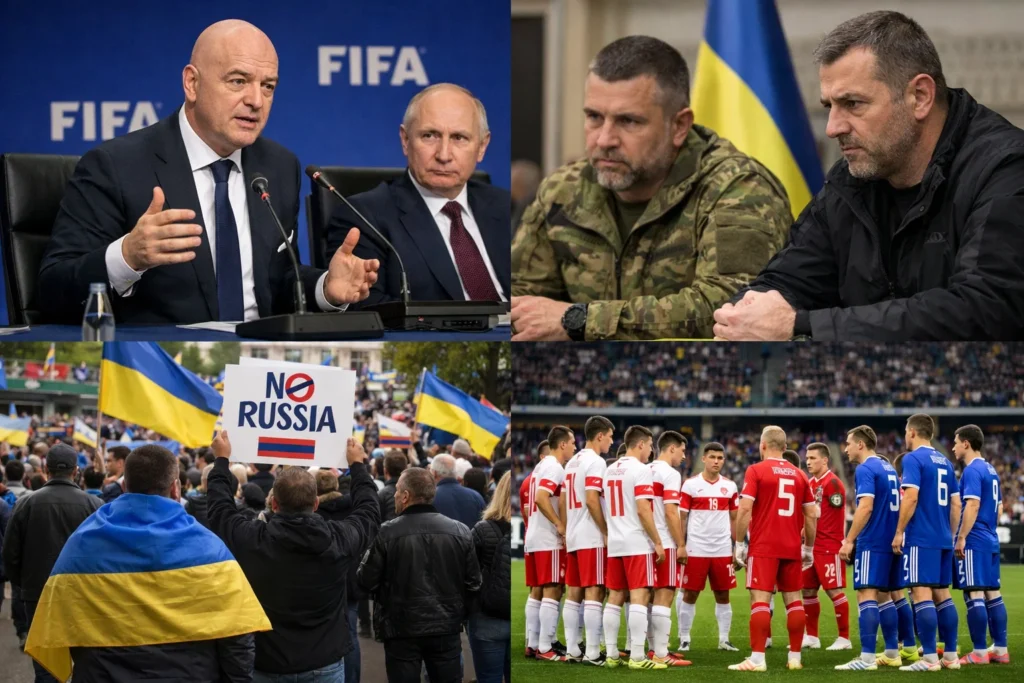
Key points
- FIFA President Gianni Infantino said FIFA “has to” consider lifting the suspension on Russian teams imposed after the 2022 invasion of Ukraine, suggesting at least a phased return (youth teams first).
- Infantino argued the ban “has not achieved anything” and warned it had instead “created more frustration and hatred,” comments that prompted sharp criticism from Ukrainian officials.
- UEFA’s leadership and many European federations say re-admission hinges on a political settlement and the end of the war — not a purely sporting decision. That creates a practical stalemate: FIFA can propose policy changes, but continental confederations and host nations control competitions.
- Any move to reinstate Russia risks boycotts, political blowback, and fractured tournament logistics — especially ahead of major events where national teams and clubs must be scheduled and insured.
FIFA’s Infantino opens door to Russia’s return — what Infantino said (and why it exploded)
In a high-profile interview, Gianni Infantino told Sky News that FIFA should reassess the four-year suspension that has excluded Russian national teams and clubs from international competitions since 2022, saying the ban “has not achieved anything” and suggesting that restoring participation at least at youth level should be considered. The remarks immediately provoked public anger in Kyiv and cautious, procedural pushes from European football bodies — underscoring how tightly politics and sport remain entangled.
The factual rundown
- What Infantino said: In the Sky News interview he said FIFA “has to” look at restoring Russian teams and that the suspension has produced frustration rather than results; he explicitly raised the idea of returning youth teams first.
- Why there was a ban: FIFA and UEFA suspended Russian teams in 2022 after Russia’s full-scale invasion of Ukraine, citing the extraordinary geopolitical and security context that made participation untenable for sport and safety reasons.
- Immediate reaction: Ukraine’s Sports Minister Matvii Bidnyi called Infantino’s comments “irresponsible” and “infantile,” while UEFA officials stressed that reinstatement would be conditional on the end of the war.

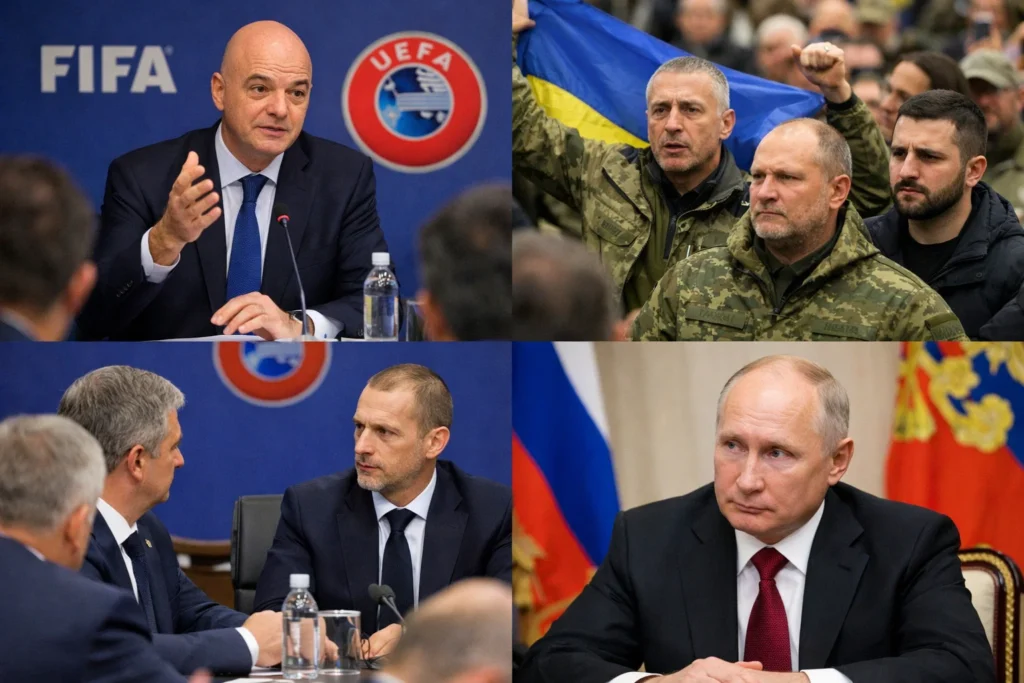
Why this is complicated — sport, law and politics collide
- FIFA vs. confederations: FIFA sets global policy, but UEFA and other continental confederations decide entries into their own competitions (e.g., European Championship, club tournaments). Even if FIFA wanted re-admission, UEFA can keep its competition suspensions in place — creating a political and legal tug-of-war.
- Host and opponent consent: Tournaments require agreements between national associations, hosts and insurers — many national associations made clear in 2022 they would not play Russia. That same unwillingness could persist and make reinstatement operationally impossible.
- Moral hazard and precedent: Reinstating a nation currently engaged in an international armed conflict raises precedent questions: will other governing bodies face pressure to separate politics from sport, and what standards govern such decisions? Critics argue there must be clear, rights-based conditions before normalization.
Reactions — what key stakeholders said
- Ukraine (government & sport): Strong condemnation. Ukrainian officials argued that lifting the ban while hostilities continue would be insensitive to victims and could be seen as rewarding aggression.
- UEFA leadership: Publicly firm that reinstatement is linked to peace and security — not only or primarily to sporting arguments. That position effectively gives European federations veto power over Russia’s return to UEFA competitions.
- Some national federations and fans: Divided. A minority argue for sport as a bridge; many others warn about forced normalization while the conflict rages. Expect vocal civil-society and diaspora campaigns to shape national federation stances.
Practical consequences if FIFA pushes ahead
- Tournament disruption: Draws, fixtures, and qualifying paths would need redesigning; hosts and teams could boycott or refuse to play, complicating scheduling and commercial contracts.
- Sponsorship and broadcast risk: Sponsors and broadcasters wary of reputational risk could threaten to withdraw funding or require contractual protections — a commercial headache for FIFA and confederations.
- Player safety and visas: Travel and visa rules for Russian teams remain politically sensitive; clubs and association staff could face security and access barriers.
What to watch next
- FIFA Council and executive committee reaction: Infantino can voice a position, but formal policy changes require FIFA governance processes and likely a Council debate and vote.
- UEFA’s formal statement: Any divergence between FIFA and UEFA positions will be decisive for Russian teams’ practical ability to re-enter European competitions.
- National federation positions (England, Germany, Poland, etc.): Federations that opposed playing Russia before may re-affirm their stances or signal openness — their responses shape feasibility.
- Civil-society campaigns: Advocacy from Ukrainian groups, human-rights organizations and fan bodies could pressure federations and sponsors.
Bottom line
Gianni Infantino’s public call to reconsider Russia’s suspension has turned a simmering debate into an immediate political problem for FIFA, UEFA and national federations. The technical path to reinstatement runs through governance votes, confederation consent, commercial contracts, and political judgments about whether sport can — or should — be separated from a major ongoing war. Expect intense debate in the weeks ahead, and for any practical reversal to be slow, conditional and contested.