


By Trenbuzz Team| April 2, 2026 | 6 Min Read
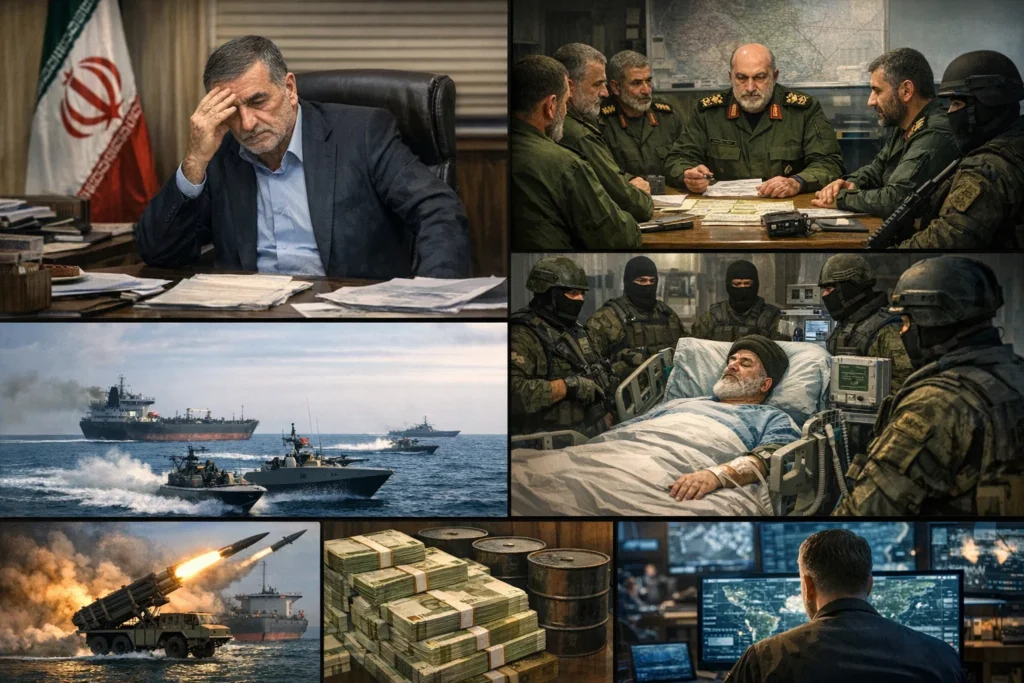
With a Supreme Leader in apparent coma, a president pushed into irrelevance, and missiles flying — Iran’s Revolutionary Guards have quietly taken over the country’s command structure. Here’s how it happened.
Key Points
- Iran’s Islamic Revolutionary Guard Corps (IRGC) has seized de facto control of the Iranian government, pushing President Masoud Pezeshkian into a “complete political deadlock.”
- A secret military council of senior IRGC officers is now making all key state decisions, completely bypassing the presidency and civilian government.
- New Supreme Leader Mojtaba Khamenei has not appeared publicly since assuming power and is reportedly in a coma, surrounded by an IRGC security cordon.
- IRGC chief Ahmad Vahidi has personally blocked all of Pezeshkian’s cabinet nominees, declaring wartime authority over all leadership appointments.
- The IRGC controls the Strait of Hormuz, Iran’s missile arsenal, and an estimated 10–50% of Iran’s entire economy.
- U.S. intelligence confirms the IRGC is consolidating power — warning the regime will emerge more hardline, not weaker, from the ongoing war.
A Coup Without a Declaration (IRGC Seizes Control)
Nobody announced it. There was no state broadcast, no military parade, no formal transfer of power. But over the past several weeks, Iran’s Islamic Revolutionary Guard Corps (IRGC) has executed what analysts are already calling a silent coup — methodically absorbing the functions of a government left headless by war, assassination, and leadership collapse.
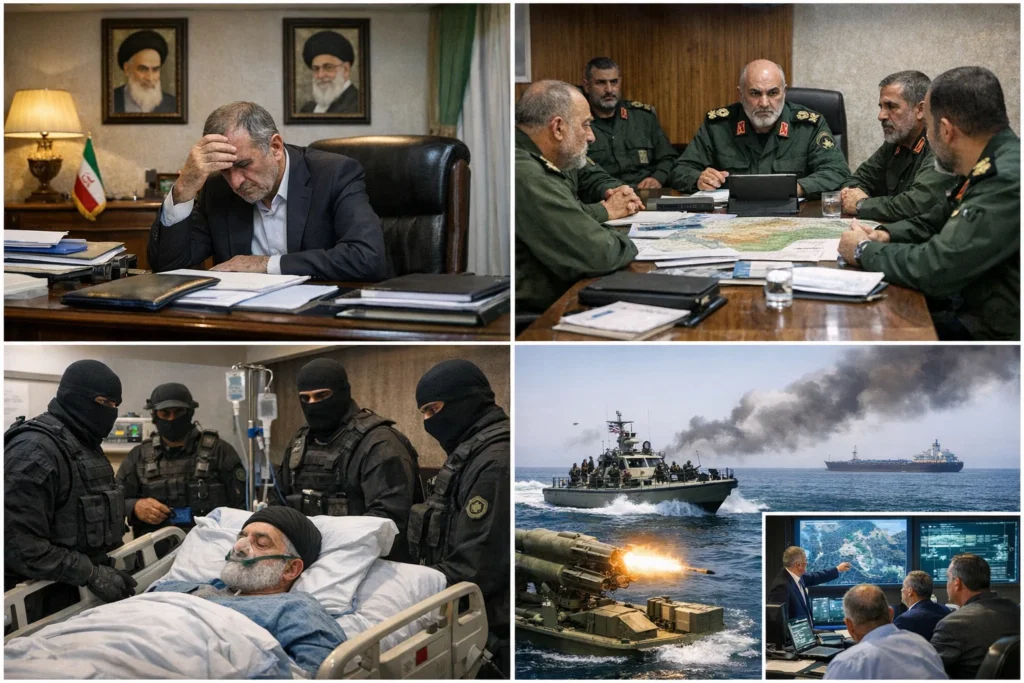
President Masoud Pezeshkian, elected just months ago on promises of moderation and economic relief, now finds himself trapped in what informed sources describe as a “complete political deadlock.” He cannot appoint ministers. He cannot reach the Supreme Leader. And he cannot push back against the generals who have effectively seized the steering wheel of an Iranian state careening through its worst crisis in decades.
The Military Council Running Iran
At the heart of this power grab is a newly formed military council of senior IRGC officers — a body that answers to no elected official and operates outside every framework Iran’s theocratic constitution ever envisioned. According to exclusive reporting by Iran International, this council has erected a strict security cordon around Mojtaba Khamenei, the son of slain Supreme Leader Ali Khamenei, who was hastily named successor after his father was killed in U.S.-Israeli strikes on February 28, 2026.
Mojtaba has not appeared publicly since assuming the title of Supreme Leader. U.S. Defense Secretary Pete Hegseth and President Trump have both suggested he may be critically ill or disfigured. Iranian media has hinted at a deep internal crisis within his inner circle. What is clear is that whoever holds the title on paper, the IRGC is the one exercising real power on the ground — blocking communication between the Supreme Leader and the political leadership, and filtering all government reports reaching the top.
“A military council of senior IRGC officers now exercises full control over core decision-making, enforcing a security cordon around Mojtaba Khamenei.” — Iran International

Pezeshkian: A President With No Authority
The clearest sign of Pezeshkian’s diminished authority came when he attempted to appoint a replacement intelligence minister after the incumbent, Esmaeil Khatib, was killed in an Israeli airstrike in March. Every candidate he proposed — including veteran official Hossein Dehghan — was flatly rejected by IRGC commander Ahmad Vahidi. Vahidi’s position was blunt: in wartime, the IRGC selects leadership, not the president.
Pezeshkian has reportedly attempted to reach Mojtaba Khamenei for urgent meetings multiple times. Every request has gone unanswered. The political machinery of Iran — the body that was supposed to check military power — has been quietly dismantled, one blocked phone call at a time.
Key Timeline: How the IRGC Took Over
| Date | Event |
|---|---|
| Feb 28, 2026 | Supreme Leader Khamenei killed in U.S.-Israeli strikes; leadership vacuum begins |
| Mar 1, 2026 | Ahmad Vahidi assumes IRGC command; Mojtaba named Supreme Leader — then vanishes |
| Mar 16, 2026 | U.S. intelligence: IRGC consolidating power; regime will emerge more hardline |
| Late March 2026 | IRGC blocks Pezeshkian’s ministerial appointments; military council takes over |
| Apr 1, 2026 | Iran International reports IRGC has seized de facto control of the Iranian state |
A State Within a State — Now the State Itself
The IRGC’s rise to total dominance didn’t happen overnight. Reuters described it as a “state-within-a-state” as recently as this year. It controls oil, banking, transport, and real estate. It operates over 100 affiliated companies. Estimates suggest it influences anywhere from 10% to over 50% of Iran’s entire economy, with annual business revenue exceeding $12 billion.
What This Means for the United States — and for You
When President Trump speaks of negotiating with “moderate” Iranian officials, U.S. intelligence has quietly pushed back. The moderates are not in charge. The men running Iran today are the same men firing missiles into Gulf states, blockading one of the world’s most critical shipping lanes, and accelerating the execution of political prisoners.
For American consumers, the consequences are already tangible — gas prices stubbornly above $4 a gallon, shipping delays rippling through store shelves, and mortgage rates rattled by geopolitical uncertainty. For the 90 million people of Iran, it means waking up each day under the authority of a military organization that has never once been chosen by a ballot.
The IRGC didn’t just seize control of a government. It seized control of a nation’s future. And right now, no one is anywhere close to taking it back.
Quick Facts
- IRGC Founded: 1979, after the Islamic Revolution
- Current IRGC Commander: Ahmad Vahidi (assumed command March 1, 2026)
- Economic Footprint: Controls 10–50% of Iran’s economy; $12B+ annual revenue
- Designations: Listed as a terrorist organization by the U.S. (2019), Australia (2025), and Argentina (2026)
- Strait of Hormuz: Controls ~20% of global seaborne oil trade daily
Disclaimer: This article is based on reporting from Iran International, U.S. intelligence assessments, Washington Post, Britannica, and other credible international sources as of April 2, 2026. Information is subject to change as the situation evolves.