


By TrenBuzz — Analysis
Key points
- A federal judge expressed clear skepticism this week about the Defense Department’s effort to downgrade retired Navy Capt. and U.S. Sen. Mark Kelly — a move that could reduce his retirement pay and rank — for appearing in a short video urging troops not to follow “illegal orders.”
- The judge questioned whether existing Supreme Court precedent supports disciplining a retired officer for political speech and flagged strong First Amendment concerns raised by Kelly’s lawyers.
- The Pentagon (and the Justice Department defending its position) argues retirees remain subject to the Uniform Code of Military Justice; Kelly’s team says that position would chill veterans’ speech and intrude on congressional independence. The judge pressed both sides on those legal tensions.
- A written ruling is expected shortly; whatever the judge decides, the case is likely to be appealed and has immediate political and institutional consequences for civilian control of the armed forces and free-speech safeguards for veterans.
Judge skeptical of Pentagon — the issue in one paragraph
A federal judge in Washington signaled substantial doubt this week about the Pentagon’s legal justification for disciplining Sen. Mark Kelly after he appeared in a 90-second public video telling service members they may refuse unlawful commands. The hearing highlighted a clash between the government’s view that military retirees remain subject to military law and First Amendment concerns about punishing political speech by a sitting senator and decorated veteran. Pentagon
The facts (what happened)
- In November 2025, Kelly — a retired Navy captain and elected U.S. senator — joined five other lawmakers in a short video urging troops to refuse unlawful orders; the video drew intense political backlash and threats. Later, the Pentagon opened an investigation and proposed administrative measures against Kelly, including demotion and cuts to retirement pay.
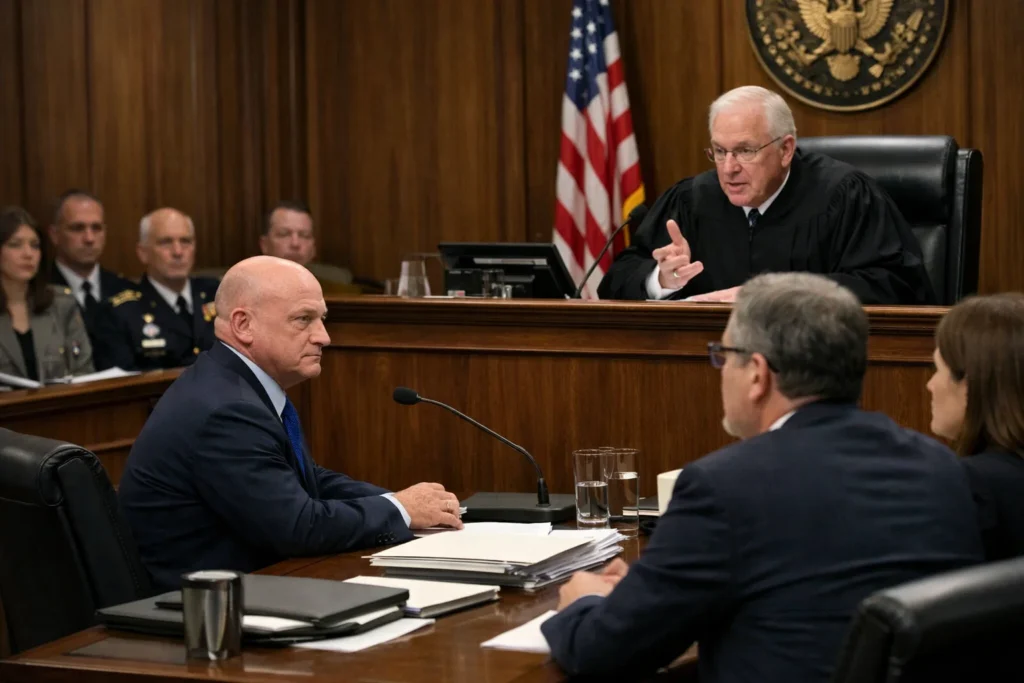
- Kelly filed for emergency judicial relief to block the Pentagon’s punitive steps. At the hearing this week, U.S. District Judge Richard J. Leon asked pointed questions about whether the government had legal grounds to proceed. The judge said he was aware of no Supreme Court precedent justifying such punishment in the First Amendment context.
Why the judge is skeptical — the legal tension explained
There are three legal fault lines the judge focused on:
- First Amendment protection vs. military law: Kelly’s lawyers argued that his speech—part political, part informational about lawful vs unlawful orders—falls squarely under constitutional protections. Government attorneys countered that military retirees occupy a unique status and that the Uniform Code of Military Justice (UCMJ) can reach certain retirees. The judge pressed whether disciplining a retired officer for public political speech would survive strict judicial scrutiny.
- Precedent gap: The judge repeatedly noted that he could find no Supreme Court decision that squarely endorses punitive action against a retired officer for political commentary of this kind — making the government’s position legally novel and potentially vulnerable.
- Separation of powers and chilling effect: Because Kelly is a sitting U.S. senator, the court must consider whether the executive branch’s disciplinary measures intrude on the legislative branch and whether the threat of military punishment would chill military-veteran participation in public debate. Judge Leon signaled concern that the government’s approach might set an alarming precedent.

What the government says (its argument)
The Defense Department asserts that Kelly’s retired status leaves him legally subject to certain military regulations and that the video could undermine discipline or be interpreted as encouraging insubordination. The DOJ — defending the Pentagon in court — argued that retirees can be subject to administrative action under longstanding regulations and that national-security and military-discipline interests justify scrutiny. The judge pressed DOJ lawyers for legal authorities that squarely support punitive measures for political speech.
What Kelly’s team says (their argument)
Kelly’s lawyers said the video was a lawful political statement and an effort to educate troops about their legal duty to refuse unlawful commands — a statement protected by the First Amendment and by constitutional norms protecting congressional speech and duties. They argued the proposed penalties are retaliatory and would chill veterans and former officers from participating in public life. The judge appeared receptive to some of those points.
Practical stakes — why this case matters beyond Kelly
- Veterans and public debate: A ruling upholding punishment could deter veterans from speaking publicly on matters of law and policy, narrowing civic discourse.
- Civil-military relations: The case tests boundaries between civilian oversight of the military and political independence for lawmakers and former service members. Critics say politicized discipline risks eroding trust in both institutions.
- Precedent for future cases: Courts will watch whether the judiciary gives broad deference to Pentagon disciplinary choices or insists on stricter constitutional scrutiny when speech is political and public.
What to watch next
- Judge Leon’s written order. The court indicated a decision could come quickly — that written opinion will clarify the standard of review and whether Kelly gets an injunction blocking punishment.
- Possible appeal and speed: Regardless of the ruling, the losing side is likely to appeal. Expect expedited litigation because of the political and retirement-pay stakes.
- Broader policy fallout: Watch for congressional hearings or proposed statutory fixes clarifying the reach of military jurisdiction over retirees and protecting veterans’ speech rights. Legal scholars already flag this as fertile ground for legislative response.
Quick FAQ
Q: Can retired military officers be disciplined at all?
A: Yes — in limited circumstances—under the UCMJ and DoD rules, certain retirees can be subject to administrative or disciplinary proceedings. But imposing penalties for political speech by a retired officer raises constitutional questions that courts will scrutinize.
Q: Does being a senator change the analysis?
A: It complicates it. A sitting senator’s speech can be part of legislative duties and is protected by separation-of-powers principles; the court must weigh that institutional context.
Bottom line
This week’s hearing showed a skeptical judiciary probing whether the Pentagon can constitutionally punish a retired officer and sitting senator for public political speech. Judge Leon’s pointed questions signalled that the government’s legal path is uncertain — and that the underlying clash between military discipline and First Amendment protections could end up before higher courts. The outcome will matter not just for Mark Kelly but for how the United States balances veterans’ civic participation, congressional independence and the limits of military jurisdiction.