


► Key Points – Trump Mail-In Voting Executive Order Survives First Court Test
- A federal judge on May 28, 2026 declined to block Trump’s executive order tightening rules on mail-in voting, handing the White House an early legal win
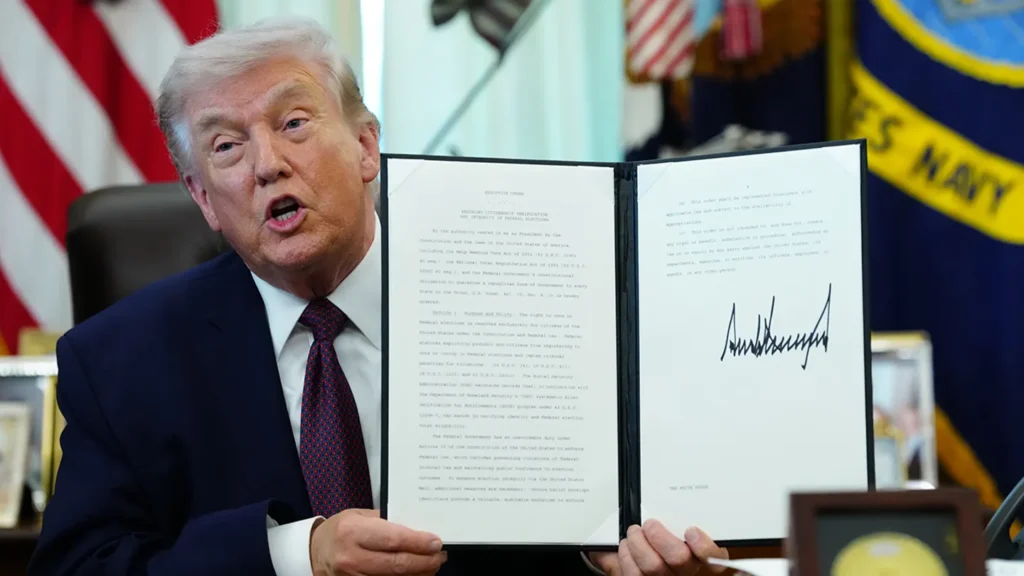
- Trump signed Executive Order 14399 on March 31, 2026, directing DHS to compile verified citizenship lists and ordering USPS to deliver ballots only to verified voters
- U.S. District Judge Carl Nichols, a Trump appointee, ruled the Democrats’ request for a preliminary injunction was “premature” as no agency has yet acted under the order
- Democrats and 24 Democrat-led states have sued, warning the order could disenfranchise millions of voters ahead of the November 2026 midterms
- The USPS has 60 days from March 31 to propose new rules for how it will implement ballot delivery restrictions
- Critics note that Trump himself voted by mail in Florida in March 2026, despite publicly calling mail voting “cheating”
- Judge Nichols left the door open for future challenges once the administration begins implementing the order
By TrenBuzz Staff · May 29, 2026 · 4 min read
With the 2026 midterm elections just months away, President Trump scored a significant legal victory on Thursday when a federal judge refused to block his controversial mail-in voting executive order. The ruling keeps alive one of the most sweeping attempts by any sitting president to reshape how Americans cast their ballots, and it has set off alarm bells from voting rights groups coast to coast.
U.S. District Judge Carl Nichols in Washington declined to issue a preliminary injunction against Trump mail-in voting Executive Order 14399, signed March 31, 2026. The judge ruled the legal challenge was premature because the administration had not yet taken action under the order. The door, he said, remains open for future challenges once implementation begins.
That day is coming fast. The USPS has until late May to propose new rules for restricting ballot delivery, and DHS is building the national citizenship verification list that would underpin the entire system. Millions of voters and the November midterm elections are directly in the path of what happens next.
What the Trump Mail-In Voting Executive Order Actually Does
Executive Order 14399, titled “Ensuring Citizenship Verification and Integrity in Federal Elections,” directs the Department of Homeland Security and the Social Security Administration to compile state-by-state lists of verified U.S. citizens eligible to vote. Only voters confirmed on those lists would receive mail-in ballots under the new rules.
The order also requires the U.S. Postal Service to refuse delivery of mail-in ballots to any voter not appearing on a state’s approved absentee ballot list. Election records must be preserved for five years. The White House framed the order as a commonsense measure to stop noncitizens from voting in federal elections, a practice that evidence shows is exceedingly rare.
Critics, including Senate Minority Leader Chuck Schumer, called it “voter suppression, plain and simple.” Voting rights attorneys warned that DHS citizenship databases are riddled with outdated and inaccurate records, meaning eligible American citizens could be wrongly denied ballots. Twenty-four Democrat-led states have already filed suit.
“Mail-in voting is safe and secure, a hallmark of our free and fair elections. Trump’s order is not about election integrity. It is voter suppression, plain and simple.”
— Senate Minority Leader Chuck Schumer (D-NY), May 28, 2026
The Judge’s Decision and What It Means
Judge Nichols, a Trump appointee, wrote that because no agency had yet produced a flawed citizenship list and the Postal Service had not yet implemented any new rules, the plaintiffs had not yet suffered any concrete harm. Without demonstrated harm, he could not justify issuing an emergency injunction. The ruling was narrow and explicitly did not address whether the executive order itself was constitutional.
That question remains wide open. Constitutional scholars widely agree that election rules are the domain of states and Congress, not the president. A separate Trump voting order signed in March 2025 was blocked by courts on exactly those grounds. The plaintiffs, led by the League of United Latin American Citizens and Senate Democrats, said they would challenge the order again once the administration moves to put it into practice.
Danielle Lang of the Campaign Legal Center said her clients “look forward to the next stage of this litigation.” That stage, given the USPS deadline and the November midterms, is expected to arrive within weeks rather than months.
🔗 Also Read:49 in One Shot: Senate Republicans Bulldoze Through Trump Nominee Backlog
The Irony Nobody Is Letting Go
Lost inside the legal filings and judicial rulings is one detail that Democrats and journalists have been quick to highlight. Trump, who has called mail-in voting “cheating” and has publicly pushed a years-long campaign to restrict it, cast his own ballot by mail in a Florida special election in March 2026. He also voted absentee in the 2018 midterms.
The contradiction has not slowed the administration’s pursuit of the order. The White House argues that the two situations are not equivalent since Trump’s mail vote was on a verified state list, while the executive order is designed to ensure every mail ballot recipient has that same verification. Critics call that a distinction without a difference.
With roughly one-third of all ballots in the 2024 election cast by mail and more registered Democrats than Republicans saying they used mail voting, the stakes of the litigation are enormous. If the order takes full effect before November 3, 2026, its impact on the midterm results could be substantial and arguably decisive in close races across the country.
Disclaimer: This article is intended for informational and news reporting purposes only. The content is based on publicly available information sourced from credible news agencies including NBC News, NPR, Al Jazeera, Washington Post, PBS, and Reuters as of May 28 to 29, 2026, and does not constitute legal, electoral, or political advice. TrenBuzz.com does not endorse any political party, candidate, or government policy. All trademarks and names belong to their respective owners. Content is produced in compliance with Google AdSense publisher policies.