


Published by TrenBuzz.com | April 28, 2026
Key Points at a Glance – Trump Rejects Iran’s Hormuz Plan
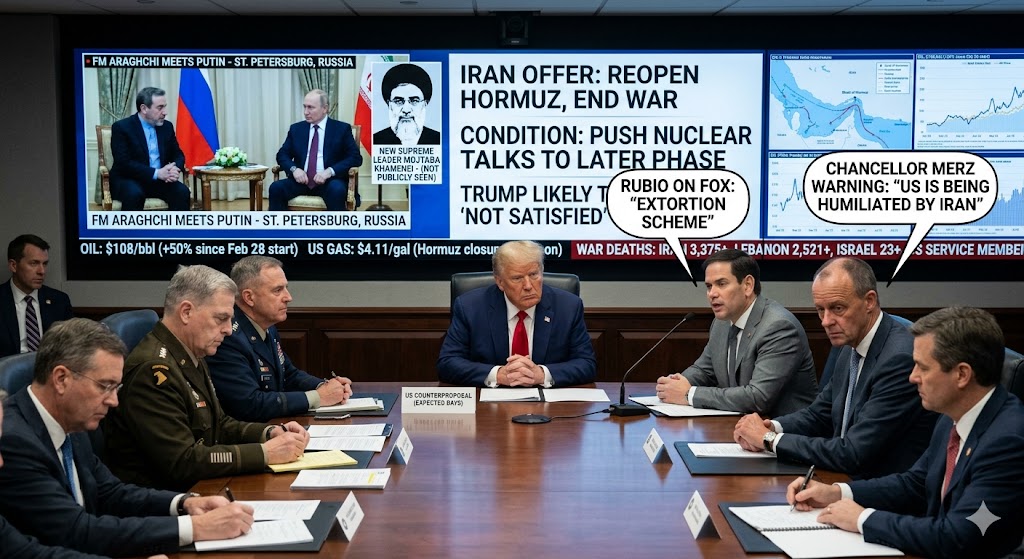
- President Trump and his national security team met in the White House Situation Room on April 28 to discuss Iran’s latest ceasefire proposal.
- Iran offered to reopen the Strait of Hormuz and end the war — on one condition: push nuclear talks to a later phase.
- Trump is unlikely to accept the offer — sources confirm he told advisers he is “not satisfied.”
- Secretary of State Marco Rubio rejected the proposal on Fox News, calling Iran’s Hormuz plan an “extortion scheme.”
- The White House is expected to send Iran a counterproposal within days.
- Oil prices have surged to $108 per barrel — nearly 50% higher than when the war began on February 28.
- US gas prices rose to $4.11 per gallon as the Hormuz closure drags on.
- Germany’s Chancellor Friedrich Merz warned the US is being “humiliated” by Iran’s stalling tactics.
- Iran’s FM Araghchi met Putin in St. Petersburg, who revealed he received a message from Iran’s new Supreme Leader Mojtaba Khamenei — who has not been seen publicly since his father’s death.
- The war has now killed at least 3,375 people in Iran, 2,521 in Lebanon, 23 in Israel, and 13 US service members.
Washington sat around the Situation Room table. The offer from Tehran was on the table. And when the meeting ended, Trump’s answer was essentially: not like this.
President Donald Trump signaled Monday he was unlikely to accept Iran’s latest proposal to end the conflict after Tehran proposed a plan that would reopen the Strait of Hormuz while leaving questions about its nuclear program for later negotiations. Two people familiar with the matter said Trump conveyed his views during a Monday meeting with top national security officials where Iran was discussed.
What Iran Actually Proposed
Iran offered to halt its chokehold on the Strait of Hormuz if the US lifts its blockade on the country and ends the war — in a proposal that would postpone discussions on the Islamic Republic’s nuclear program. The proposal was passed to Washington via Pakistan.
The proposal, presented by Iranian FM Abbas Araghchi during his weekend visits to Islamabad and Muscat, was aimed at breaking the deadlock and restarting negotiations. Under the plan, Iran would reopen the Strait of Hormuz if the United States agrees to end its blockade and conclude military operations.
Why Trump Said No — The Nuclear Leverage Problem
Reopening the strait without resolving questions over Iran’s nuclear enrichment or stockpile of near-bomb-grade uranium could remove a key piece of American leverage in the talks, officials said. Yet allowing the waterway to remain blocked would prolong the higher energy prices that have caused the cost of gas to spike in the US.
A US official said accepting the offer could appear to deny Trump a victory, adding to the administration’s reluctance to move forward with the terms as presented.
While Trump did not reject the offer outright, the Wall Street Journal reported he was skeptical about Iran not dealing in good faith or being open to meet his key demand — ending nuclear enrichment and vowing to never develop a nuclear weapon.

Rubio’s Blunt Dismissal — “That’s Not Opening the Straits”
Secretary of State Marco Rubio said on Fox News: “What they mean by opening the straits is, ‘Yes, the straits are open, as long as you coordinate with Iran, get our permission, or we’ll blow you up and you pay us.’ That’s not opening the straits. Those are international waterways.”
Rubio added: “Suffice it to say that the nuclear question is the reason why we’re in this in the first place. Iran’s nuclear program remains the core issue. We have to ensure that any deal definitively prevents them from sprinting towards a nuclear weapon at any point.”
What Happens Next — The Counterproposal Window
The US will continue to negotiate with Iran, the WSJ reported, with the White House likely to offer a counterproposal in the coming days. Trump has repeatedly touted ending Iran’s nuclear activities as the main objective of the war.
Sources familiar with the mediation process said the US and Iran aren’t as far apart as they may seem. Ongoing talks are centered around a staged process in which the first part of a potential deal would focus on returning to the status quo before the war and reopening the Strait of Hormuz without restrictions or tolls — with Iran’s nuclear program addressed later.
The Global Alarm — Oil, Food, and Humiliation
On Monday, Brent crude was trading at around $108 per barrel — nearly 50% higher than when the war began. Dozens of countries have called for the urgent and unimpeded reopening of the Strait of Hormuz. UN Secretary-General António Guterres warned the standoff could trigger a global food emergency, with about 20% of global oil and natural gas supplies passing through the strait.
Germany’s leader Friedrich Merz said the US is “being humiliated” by Iran, criticizing Washington’s attempts to extricate itself from the war and warning that Tehran is engaging in tactical delay while the US lacks a clear exit strategy.
The proposal is on the table. The counterproposal is being drafted. And somewhere in the 34-kilometer chokepoint between Oman and Iran, the fate of the global economy — and Trump’s war — hangs in the balance.
Disclaimer: This article is for general informational and news reporting purposes only. All quotes, negotiations details, and facts referenced are based on publicly available reporting from CNN, Al Jazeera, Fortune, WSJ, CNBC, and The Week as of April 28, 2026. TrenBuzz.com does not represent any government or diplomatic body. The situation is rapidly evolving — readers are encouraged to follow credible international news sources for real-time updates.