



► Key Points – Trump Walks Into Walter Reed for His Annual Physical
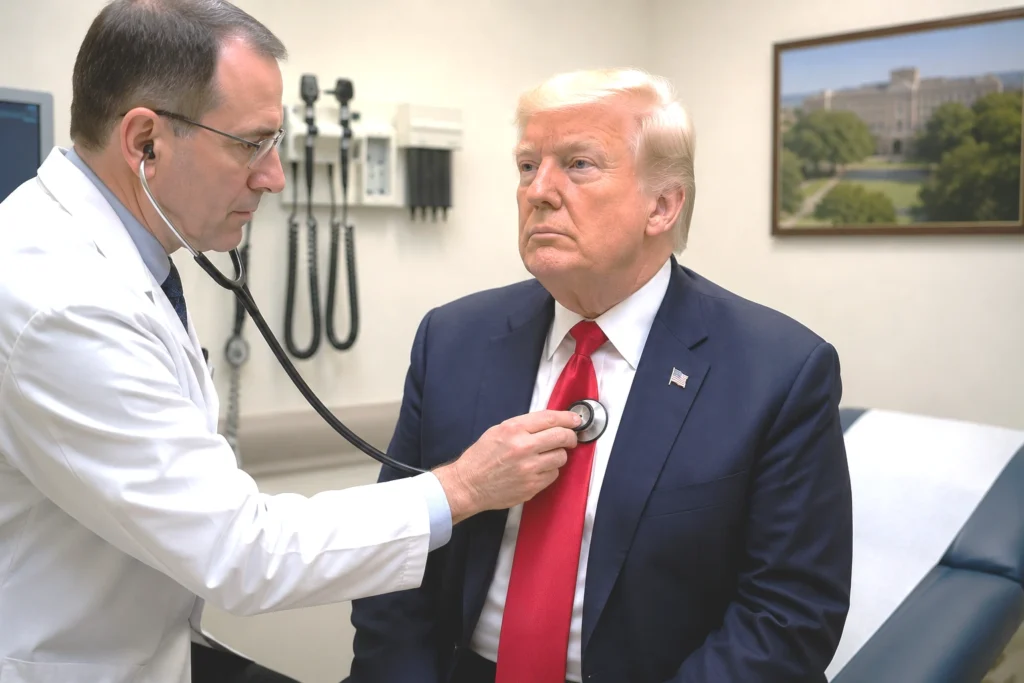
- President Trump traveled to Walter Reed National Military Medical Center on Tuesday, May 26, 2026 for annual preventive medical and dental checkups
- This is Trump’s third visit to Walter Reed in just 13 months — a frequency that has raised public concern about his health
- Trump, who turns 80 years old in June, is the oldest person ever to take the presidential oath of office and the second oldest president in U.S. history
- A Washington Post/ABC News/Ipsos poll from April found less than half of U.S. adults believe Trump has the mental sharpness or physical health to serve effectively
- Trump was diagnosed with chronic venous insufficiency last summer — a vascular condition causing his notably swollen ankles and bruised hands
- What the public learns from Tuesday’s exam is entirely Trump’s choice — there is no law requiring presidential health disclosures
- If Trump receives anesthesia, VP JD Vance would temporarily assume presidential powers under the 25th Amendment
By TrenBuzz Staff · May 26, 2026 · 5 min read
On the same week that he announced an Iran peace deal as “largely negotiated,” greeted Vladimir Putin’s arrival in Beijing with diplomatic choreography, and pushed a $1.776 billion federal compensation fund through a skeptical Washington, President Donald Trump added one more item to his schedule: a trip to the doctor. But this is no ordinary checkup, and this is no ordinary patient.
The Trump annual physical 2026 took place at Walter Reed National Military Medical Center in Bethesda, Maryland on Tuesday, May 26, with the White House describing it as “annual preventive medical and dental checkups.” Trump, who turns 80 in June, is the oldest person ever to have taken the presidential oath of office and this visit arrives under a level of public scrutiny that former White House physicians say is unlike anything they’ve seen before.
“I think concern for the president’s physical health is probably at an all-time high,” said Dr. Jeffrey Kuhlman, who served as White House physician under Presidents Obama, Bush, and Clinton. “Advanced physical age is the number one concern.”
Three Visits to Walter Reed in 13 Months — Why That Number Matters
Tuesday’s appointment marks Trump’s third visit to Walter Reed in just 13 months — a pace that is notable by any presidential standard. His first “annual” physical of his second term took place in April 2025, at which point the White House physician declared Trump in “excellent health.” Then came an October 2025 visit — described again as a “routine yearly” checkup, just six months after the last one.
Now, in May 2026, he’s back again. The White House has characterized each visit as routine. But the frequency itself has become part of the story, fueling public speculation that officials are monitoring something more closely than a standard annual wellness check would require. The White House has not offered an explanation for why three visits were needed within 13 months.
The scrutiny intensified after an AP photo published in July 2025 captured Trump’s noticeably swollen left ankle and foot during an Oval Office meeting — an image that circulated widely and prompted questions the White House was slow to answer. Weeks later, the administration confirmed Trump had been diagnosed with chronic venous insufficiency (CVI) — a condition in which veins struggle to return blood to the heart, causing swelling, skin discoloration, and fatigue.
“Advanced physical age is the No. 1 concern — and I think concern for the president’s physical health is probably at an all-time high.”
— Dr. Jeffrey Kuhlman, Former White House Physician (Obama, Bush, Clinton administrations)
What Is Chronic Venous Insufficiency — and Why It Matters for a President
Chronic venous insufficiency is a common vascular condition, especially in people over 70. When the veins’ one-way valves weaken, blood pools in the lower legs instead of flowing efficiently back to the heart. The visible result — puffy ankles, swelling, bruising, and in more advanced cases, skin changes — has been visible on Trump for much of his second term.
The White House was quick to frame the diagnosis as “benign,” with press secretary Karoline Leavitt noting it was “a common condition” and that Trump’s cardiovascular health remained “excellent” despite it. Cardiologists not connected to the White House were more measured — noting that while CVI itself is manageable, it can sometimes signal broader circulatory issues that warrant careful monitoring in a high-stress executive role.
The bruising visible on Trump’s hands — captured in multiple AP and Reuters photos throughout late 2025 and early 2026 — has also drawn attention. The White House has not publicly attributed the bruising to a specific cause, and Trump himself has waved off questions, saying during one press gaggle: “I feel great. I’ve always felt great.”
🔗 Also Read:Trump Says Iran Peace Deal Is “Largely Negotiated” — Everything We Know Right Now

What the Public Will — and Won’t — Be Told
Here is the uncomfortable truth about presidential health transparency: there is no law requiring any president to disclose the results of a medical examination. What the public learns about the Trump Walter Reed health exam 2026 is entirely up to Trump and his physician — a fact that has frustrated transparency advocates for decades but remains the legal reality.
Trump’s own history on medical disclosures is, to put it politely, uneven. During the 2016 campaign, his doctor Harold Bornstein issued a letter so effusively positive — calling Trump’s health “extraordinary” and his lab results “astonishingly excellent” — that Bornstein later admitted Trump had essentially dictated the letter himself. Trump promised to release full medical records during the 2024 campaign. He never did.
The April 2025 physical produced a memo stating Trump was in “excellent” cardiovascular health, despite the CVI diagnosis. It did not include cognitive test results, detailed bloodwork, or a neurology assessment — all items that public health experts and presidential historians say should be standard disclosures for an 80-year-old commander-in-chief managing two active war fronts, a domestic legislative sprint, and an around-the-world diplomatic schedule that would exhaust someone half his age.
The Public’s Verdict — and the Poll That Said It All
The American public has formed its own opinion, regardless of what the White House releases. A Washington Post/ABC News/Ipsos poll conducted in April 2026 found that fewer than half of U.S. adults believe Trump has the mental sharpness or physical health needed to serve effectively as president. That figure — striking for a sitting commander-in-chief — reflects months of accumulated public concern that no official memo has successfully reversed.
Nearly two-thirds of Americans surveyed in a September 2025 YouGov poll said they believed Trump’s health and age were affecting his ability to govern. Some 49% said they believed he was experiencing cognitive and physical decline. These numbers land in uncomfortable territory, particularly given that Trump himself spent much of the 2024 election campaign making President Biden’s age and fitness a central campaign theme.
The irony is not lost on observers. Trump — who led chants about Biden’s mental state at rally after rally — is now the subject of the same questions he once wielded so effectively as a political weapon. Whether Tuesday’s Walter Reed visit produces any meaningful transparency, or another carefully worded memo declaring all is well, will itself become a story that tells the public something important about this administration’s approach to accountability.
🔗 Also Read:Vance Defends $1.776B Federal Compensation Fund — What It Is and Who Can Apply
The 25th Amendment Question Nobody Wants to Ask Out Loud
There is one scenario tucked quietly inside Tuesday’s appointment that the White House prefers not to discuss. If Trump were to undergo any procedure requiring anesthesia — including a routine colonoscopy, which was last performed in 2024 with a recommended follow-up in three years — Vice President JD Vance would be expected to assume temporary control of the executive office under the 25th Amendment.
That last happened in 2021, when Vice President Kamala Harris was briefly handed presidential authority while President Biden underwent a colonoscopy. It’s a routine constitutional transfer, lasting minutes or hours. But for a president managing live peace negotiations with Iran, an active Cuba standoff, and a divided Congress racing toward a legislative deadline, even a temporary transfer of authority carries symbolic weight that the administration is keenly aware of.
For now, all eyes are on Bethesda. The motorcade arrived. The checkup is underway. America is waiting — not just for the results, but for whatever version of the results the White House chooses to share.
Disclaimer: This article is intended for informational and news reporting purposes only. The health information discussed is based on publicly available reporting from credible news agencies including AP, NPR, Washington Post, and People, as of May 26, 2026, and does not constitute medical advice, diagnosis, or treatment guidance. TrenBuzz.com does not endorse any political figure, medical position, or health-related claim. Readers with personal health concerns should consult a qualified medical professional. All trademarks and names belong to their respective owners. Content is produced in compliance with Google AdSense publisher policies.