


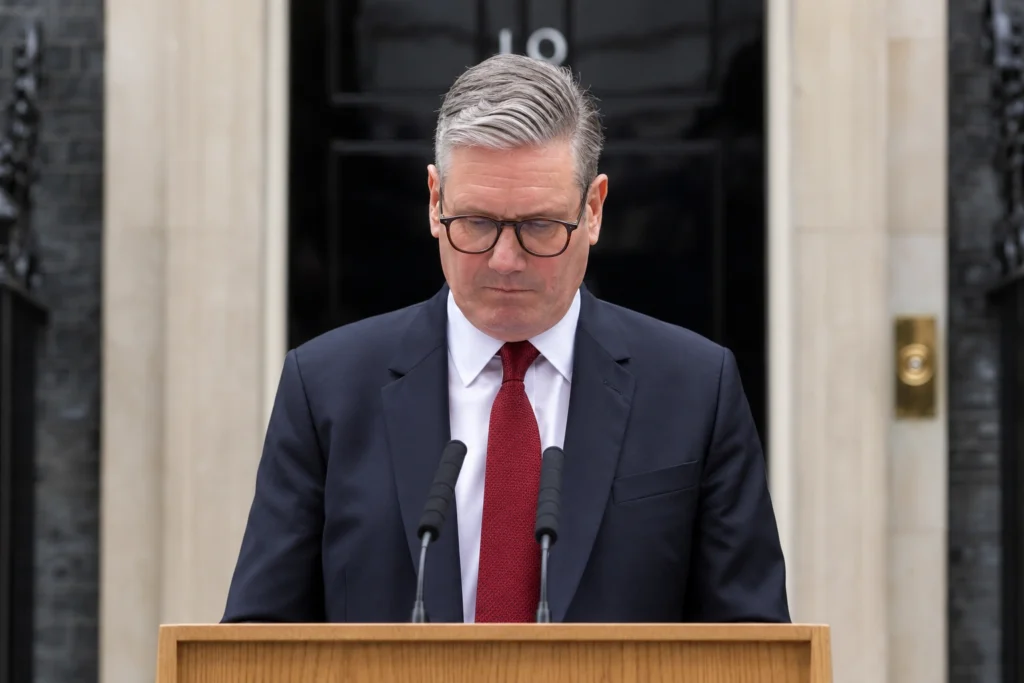
► Key Points – Why Keir Starmer Resigned Today Decoded
- Keir Starmer resigned as UK Prime Minister on June 22, 2026 in a televised statement from Downing Street, becoming Britain’s sixth PM to leave office in a decade
- His resignation followed Andy Burnham’s decisive by-election win in Makerfield on June 18, which cleared a direct path for a Labour leadership challenge
- More than 95 Labour MPs had called on Starmer to resign before he left, and Wes Streeting claimed he had the 81 MP signatures needed to trigger a formal challenge
- Two Cabinet ministers resigned within weeks of each other: Health Secretary Wes Streeting in May and Defence Secretary John Healey on June 11
- Starmer’s net approval rating collapsed to negative 46% by November 2025, one of the worst ratings for a sitting British prime minister in polling history
- Labour lost more than 1100 council seats in the 2026 local elections while Reform UK gained more than 1,450, triggering the political avalanche that followed
- Andy Burnham, Wes Streeting, Angela Rayner and David Lammy are the top names now being discussed as Starmer’s potential successor
By TrenBuzz Staff · June 22, 2026 · BREAKING
🚨 BREAKING: KEIR STARMER HAS RESIGNED AS UK PRIME MINISTER — JUNE 22, 2026
It happened. Just hours ago on June 22, 2026, British Prime Minister Keir Starmer resigned in a televised statement from Downing Street, ending his tenure after less than two years in office. The man who led Labour to its biggest election victory since 1997 in July 2024 has become the sixth prime minister to leave office in Britain in a single decade. Why did Starmer resign? The short answer is he had no path left. The longer answer is a story of cascading crises, a party in revolt, a rival’s political resurrection, and a public that had stopped listening long before he stopped speaking.
Step 1: The Collapse That Nobody Predicted at the Speed It Came
When Labour won the 2024 general election with a majority of 172 seats, Starmer looked almost immovable. He had ended 14 years of Conservative rule and delivered the party its largest parliamentary majority in a generation. Within 18 months, his net approval rating had collapsed to negative 46%, one of the worst scores recorded for any sitting British prime minister. That collapse was not caused by a single scandal. It was the result of a relentless accumulation of decisions, reversals, and controversies that slowly drained away every constituency that had put him in power.
The 2025 and 2026 local elections became the visible measure of the damage. In 2026, Labour lost more than 1,100 council seats in England in a single night. Reform UK, the Nigel Farage-led anti-immigration party, gained more than 1,450 seats in the same elections. It was not a bad night for Labour. It was a historic collapse. The party’s traditional left flank, its working-class base, and its younger voters had all moved elsewhere, many to the Greens, many to the Liberal Democrats, and a portion to Reform in a development that shocked Labour strategists who had assumed those voters had nowhere else to go.
The causes were multiple and compounding. A persistent cost-of-living crisis that the government appeared unable to address. A deeply unpopular welfare reform package that cut benefits for disabled people and carers. A Gaza war policy that alienated Muslim voters in dozens of marginal constituencies. A refusal to introduce a wealth tax despite campaign positioning that many on the left felt implied one was coming. And a series of communication failures that made the government look reactive, uncertain, and out of touch with the voters it was supposed to represent.
Step 2: The Cabinet Revolt That Made Resignation Inevitable
The final phase of Starmer’s premiership began when members of his own Cabinet stopped defending him and started publicly withdrawing their confidence. On May 14, 2026, Health Secretary Wes Streeting resigned, issuing a resignation letter that did not just note policy disagreements but directly questioned Starmer’s ability to lead. Streeting wrote that he had “lost confidence” in Starmer and that it would be “dishonourable and unprincipled” to remain in the Cabinet while holding that view. It was a politically devastating document, written by one of Labour’s most prominent rising figures and widely understood as a declaration that the leadership succession process had informally begun.
On June 11, 2026, Defence Secretary John Healey resigned, citing disagreements with the government’s Defence Investment Plan. Healey argued in his resignation letter that the Treasury settlement was insufficient to meet the United Kingdom’s strategic defence objectives and risked leaving the armed forces under-resourced amid international threats including the Iran war. Two further Ministry of Defence resignations followed within the same week. By mid-June, Starmer’s Cabinet had been visibly hollowed out from within, with the departing ministers not replaced quickly enough to project stability.
By that point, more than 95 Labour MPs had publicly called for Starmer to resign or set out a departure timetable. Streeting, now positioned explicitly as a potential leadership candidate, claimed he had secured the signatures of 81 Labour lawmakers needed to formally trigger a leadership challenge under Labour Party rules. The number mattered because it represented a formal, procedural threshold, not just political noise. When 81 signatures are submitted, Labour Party rules require a leadership contest to be held, stripping the sitting leader of the ability to avoid the question through delay or procedural manoeuvre.
“British Prime Minister Keir Starmer has resigned in a televised statement after coming under mounting pressure from his own Labour Party. It follows the decisive by-election win by his rival Andy Burnham to claim a parliamentary seat in North West England.”
Al Jazeera Breaking News, June 22, 2026
Step 3: Andy Burnham and the By-Election That Sealed It
The event that directly triggered Starmer’s resignation was one that had been carefully engineered by his opponents. Andy Burnham, the 56-year-old Greater Manchester mayor who had become the most prominent alternative Labour leader figure in the country, needed a parliamentary seat to mount a formal leadership challenge. On June 18, 2026, Josh Simons resigned as the MP for Makerfield in North West England, triggering a by-election. Burnham stood as the Labour candidate and won with 54.8% of the vote.
The significance of that result cannot be overstated. Burnham had been politically positioned outside Westminster for years as the elected mayor of Greater Manchester, building a national profile through the COVID-19 pandemic and positioning himself as the authentic working-class voice Labour had lost under Starmer’s centrist direction. His return to Parliament with a large majority and the explicit backing of many sitting Labour MPs was understood immediately by every political observer in Britain as the moment when Starmer’s time had effectively run out.
The Observer reported on Saturday June 21 that Starmer had concluded his position was “no longer tenable” after consulting with senior Cabinet ministers, party donors, trade union leaders, and political advisers. He also discussed the situation privately with his wife at Chequers, the Prime Minister’s country residence. By Sunday, Trump had posted on Truth Social that “Keir Starmer will resign as Prime Minister of the United Kingdom,” a prediction that proved accurate within 24 hours. On Monday June 22, Starmer delivered his televised resignation statement from Downing Street.
The Epstein File, Mandelson, and the Reputation That Never Recovered
No account of Keir Starmer’s resignation is complete without addressing the reputational blow delivered by the Peter Mandelson appointment. In December 2024, Starmer appointed New Labour figure Peter Mandelson as British Ambassador to the United States, citing the need to strengthen the UK-US relationship with the incoming Trump administration. In September 2025, following the release of Jeffrey Epstein-related government files, the extent of Mandelson’s relationship with the convicted sex offender became public. Starmer dismissed Mandelson and said he regretted the appointment. His Chief of Staff Morgan McSweeney, who had recommended Mandelson, resigned in February 2026.
Subsequent reporting revealed that Starmer had been warned before the appointment about the “reputational risks” of Mandelson’s ties to Epstein. The revelation that Starmer was warned and proceeded anyway became a defining moment in the public’s assessment of his judgment, and the episode generated weeks of damaging headlines at a moment when the government was already struggling to reset its narrative heading into the 2026 local elections. It did not cause the collapse on its own. But it hardened the perception, among voters who had been willing to give Starmer the benefit of the doubt, that his political instincts were fundamentally unreliable.
What Comes Next: The Race to Lead Britain
With Starmer’s resignation confirmed, Britain now faces a period of political transition that will unfold rapidly given the scale of Labour’s parliamentary majority. The immediate question is who will become the next Prime Minister. Under British constitutional convention, the Labour Party will hold a leadership contest and the winner will automatically become Prime Minister without requiring a general election, given that Labour still holds its 2024 majority in the House of Commons.
The names being discussed publicly as of June 22, 2026 include Wes Streeting, who positioned himself first and most explicitly for the succession. Andy Burnham, whose Makerfield by-election victory triggered the final sequence of events. Angela Rayner, the Deputy Prime Minister who has maintained cross-faction support within Labour. Foreign Secretary David Lammy, who has cultivated a strong international reputation. And Shabana Mahmood, the Justice Secretary, who has built a reputation for quiet competence that many Labour MPs find attractive precisely because it contrasts with the high-profile positioning of Streeting and Burnham.
Britain has experienced extraordinary political instability at the top since 2016: David Cameron resigned after Brexit. Theresa May resigned after Parliament repeatedly rejected her withdrawal agreement. Boris Johnson resigned after the Partygate scandal. Liz Truss resigned after 45 days, the shortest tenure in British history. Rishi Sunak resigned after Labour’s 2024 landslide. And now Keir Starmer has resigned, making him the sixth. The question the next Labour leader will need to answer is not just how to win the next election. It is how to make British government stable enough that a seventh resignation is not already being forecast before the ink is dry on the sixth.
🔗 Also Read: “The Highest Level in History”: Xi and Putin Sign 40+ Deals in Beijing – From Gas Pipelines to Electric Vehicles, the China-Russia Trade Machine Is Running at Full Speed
Disclaimer: This article is intended for informational and news reporting purposes only. Content is based on publicly available information sourced from Al Jazeera, Newsweek, TIME, The Observer, Wikipedia’s 2026 Labour Party Leadership Crisis article, and Reuters as of June 22, 2026, and does not constitute political, legal, or electoral advice. TrenBuzz.com does not endorse any political party, candidate, or government policy. All quotes attributed to public figures are drawn from verified published sources. Content is produced in compliance with Google AdSense publisher policies.