


Published by TrenBuzz.com | May 21, 2026
Key Points at a Glance – Xi and Putin Sign 40+ Deals in Beijing
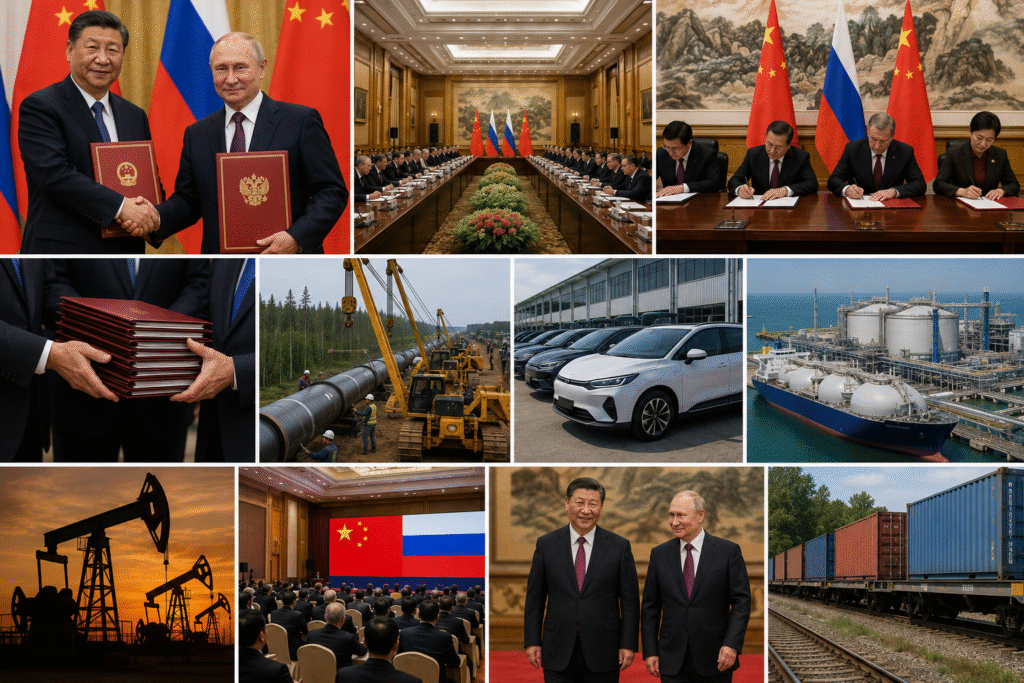
- Xi Jinping and Vladimir Putin signed 40+ cooperation agreements at the Great Hall of the People on May 20, 2026 — spanning trade, technology, energy, media, and education.
- Xi declared China-Russia ties have reached “the highest level in history.”
- Russia’s oil exports to China surged 35% in Q1 2026 — driven by the Iran war’s price spike and Western sanctions keeping Russia locked out of European energy markets.
- Chinese vehicle exports to Russia are rebounding sharply — with all-terrain vehicles, SUVs, and commercial trucks replacing European and Japanese brands.
- China and Russia agreed to advance Power of Siberia 2 — a massive gas pipeline that could carry 50 billion cubic meters per year from Siberia to China.
- 40 cooperation deals signed — covering energy, trade, technology transfers, AI research, cultural exchanges, and student youth programs.
- Bilateral trade has reached $244.8 billion — a level unimaginable before Russia’s 2022 Ukraine invasion.
- Chinese exports to Russia in Q1 2026 jumped 15% year-on-year — recovering from a brief 2025 dip when Russia raised import taxes and the rouble fell.
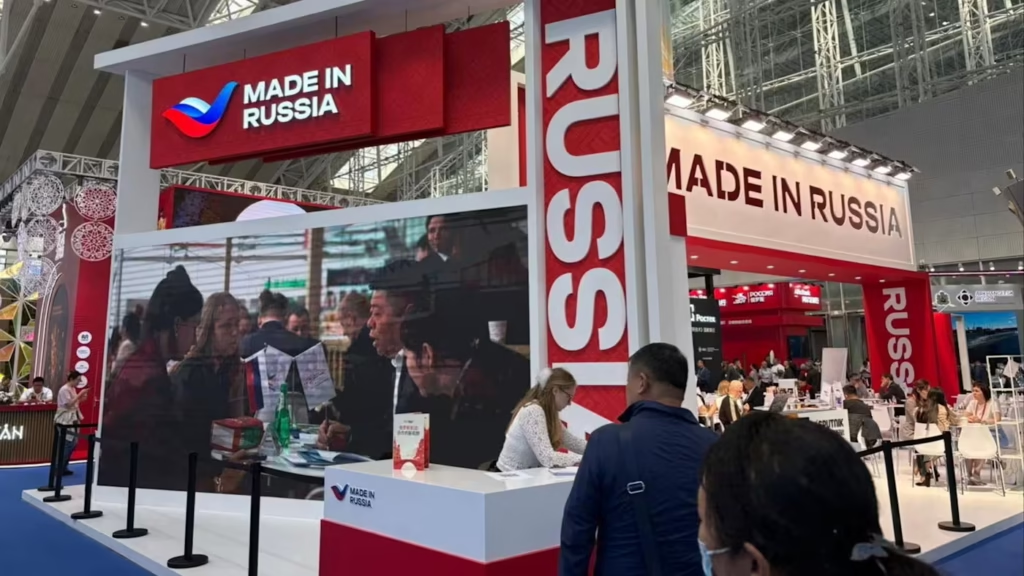
- Russia’s food exports to China have also surged — from bitter coffee blends to grain, fish, and soybeans.
- The Putin-Xi meeting came just five days after Trump’s departure from Beijing — a sequence Xi orchestrated deliberately.
He arrived five days after Trump left. He was greeted with the same red carpet, the same honor guard, the same military band. But the partnership Vladimir Putin brought to Beijing on Tuesday is one that Donald Trump can neither replicate nor disrupt — no matter what deals he signed at the Great Hall the week before.
Chinese leader Xi Jinping and Russian President Vladimir Putin hailed their strategic ties and growing energy trade as they met in Beijing Wednesday only days after a visit by U.S. President Donald Trump to China. Putin and Xi oversaw the signing of more than 40 cooperation agreements in areas such as trade, technology and media exchanges. The countries’ ties have reached “the highest level in history,” Xi said after the signing ceremony.
The Energy Partnership — The Iran War Makes Russia Indispensable
Beijing has bought more than €316.5 billion of Russian fossil fuels since the start of the full-scale invasion of Ukraine, far outstripping purchases by any other country.
Russian oil exports to China surged from 2022 onwards, reaching more than 108 million tonnes in 2024 — an increase of about 30% since 2022. Russia’s energy exports to China form the backbone of their bilateral trade. In 2026, oil trade has shot up further — driven by the Iran war disrupting Middle Eastern supplies and making Russian crude an even more attractive alternative for Beijing’s energy planners.
Xi and Putin this week discussed the Power of Siberia 2 gas pipeline — a long-mooted project that took a step forward during Putin’s last visit to China in September 2025. Conflict in the Middle East and the risk of future instability may now push Beijing to rely more on Russia for fuel.
From Bitter Coffee to All-Terrain Vehicles — The Consumer Trade Story
Chinese companies have jumped to fill the gaps in the Russian market left by the retreat of western businesses. Russian rubles have flowed into China’s border towns since the Ukraine war — from sanctioned cars to beauty clinics, from bitter coffee to electronics that European brands no longer sell to Russia. Last year exports to Russia from Heilongjiang province, which includes the border city of Suifenhe, increased by 22%.
As China boosts its electric vehicles industry domestically, Russia has become a top destination for petrol models that Beijing’s domestic market no longer needs — with Chinese-made cars lined up in Russia’s Vladivostok port ready for distribution across the country’s vast interior. All-terrain vehicles, SUVs, and commercial trucks carrying Chinese badges have replaced European and Japanese models on Russian roads.

The 40+ Agreements — What Was Actually Signed
Both countries signed nearly three dozen agreements, ranging from enhancing interbank ties and expanding settlements in national currencies to strengthening cooperation in education and the arts and student youth exchanges. They set lofty goals for 2030, including increasing trade in high-tech goods and expanding mineral resources processing.
The yuan and ruble now account for over 90% of the settlement currency in China-Russia transactions — dollar dependence has been almost entirely eliminated from this bilateral relationship, a structural shift with profound long-term implications for Western financial leverage.
The Geopolitical Message — Beijing As the World’s Indispensable Power
Back-to-back visits to Beijing by the American and Russian presidents are highlighting how China’s Xi Jinping is the world leader to be reckoned with and courted. Both Beijing and Moscow have looked to seize on Trump’s upending of traditional US foreign policy to advance their own vision of a world that’s not dominated by American power or a US-led alliance system.
Analysts note the relationship is asymmetric — “Putin needs this more than Xi. Russia is now the junior, dependent partner,” said Timothy Ash of Chatham House. “China has all the cards.”
This year marks the 30th anniversary of the establishment of China-Russia strategic partnership of coordination and the 25th anniversary of the signing of the China-Russia Treaty of Good-Neighborliness and Friendly Cooperation. China Daily called it “a stabilizing force in a turbulent world” — a framing designed to contrast directly with what Beijing describes as America’s destabilizing role in the Iran war.
Trump flew home with promises of “fantastic trade deals” and a “Board of Trade.” Putin flew home with 40 signed agreements and a gas pipeline moving forward. That contrast — more than any speech or summit statement — tells you everything about who is winning the global realignment of 2026.
Disclaimer: This article is for general informational and news reporting purposes only. All trade figures, summit details, and geopolitical analysis are sourced from NPR, CNN, China Daily, MERICS, Chatham House, Guardian/ChinaStrategy, and the Council on Foreign Relations as of May 19–21, 2026. TrenBuzz.com does not represent any government, trade body, or diplomatic institution. Readers are encouraged to follow credible international news and economic sources for the latest updates on China-Russia trade relations.