


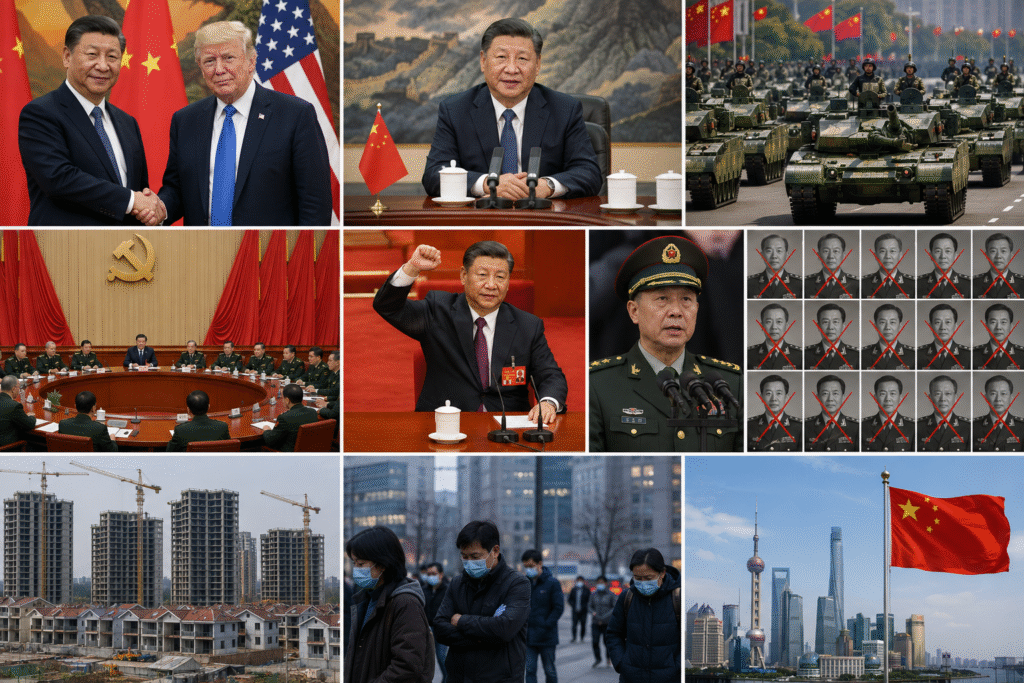
► Key Points – Xi Jinping Finally Stands Tall on the World Stage
- Xi Jinping hosted Trump in Beijing in May 2026, projecting China as a global stabilizer — scoring major diplomatic points without conceding ground
- China’s military budget hit a record $282 billion in 2026, more than doubling since Xi took power in 2012
- Xi has purged over 101 senior PLA military leaders since 2022 — gutting the Central Military Commission from 11 members down to just 2
- China’s economy is under structural strain: hiring freezes, falling salaries, weakening local government revenues, and a property market that hasn’t recovered
- Xi’s domestic grip is absolute — but analysts warn that loyalty-first governance risks brittleness, military miscalculation, and long-term stagnation
- The 2026 Trump-Xi summit positioned Beijing as a counterweight to US volatility — but Xi’s global rise has come with deep costs at home
By TrenBuzz Staff · May 19, 2026 · 5 min read
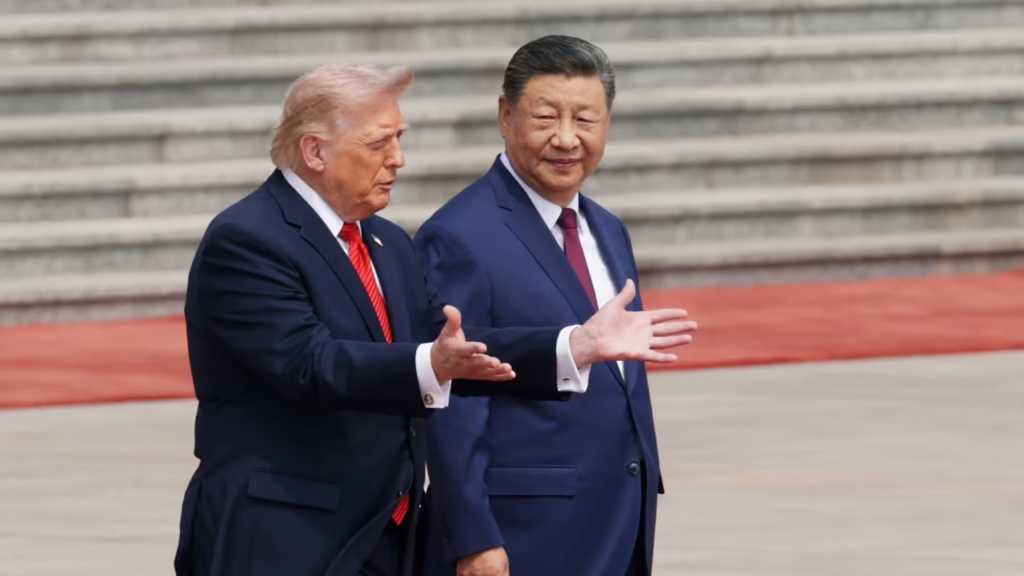
When Donald Trump’s motorcade pulled up to the Great Hall of the People in Beijing last week, the images that beamed around the world told a story Xi Jinping had been working toward for over a decade. There he stood — confident, unhurried, the host of the world’s most powerful guest — projecting China as a pillar of global stability in an era of American unpredictability.
In those 43 hours, Xi Jinping became the world leader he always wanted to be. He scored diplomatic points, conceded nothing of substance, and left Trump declaring “fantastic deals” while China’s state media played the summit as a masterclass in Chinese statecraft.
But behind the polished ceremony and the garden stroll through Zhongnanhai lies a more complicated story — one of a leader who has cemented absolute power at home by paying costs that are now becoming impossible to ignore.
The Diplomat Xi Wanted to Be — and the Summit That Proved It
Xi entered the 2026 Trump-Xi summit with a clear strategic objective: project Beijing as the responsible, stable alternative to Washington’s volatility — without making any real concessions on Taiwan, trade, or technology. He achieved exactly that.
While Trump left Beijing claiming victories on trade deals that weren’t formally signed, China’s foreign ministry framed the summit as a vindication of Xi’s “great power diplomacy.” There were no big breakthroughs but also no blunders — the summit positioned Xi at the height of his power, seeking global stability on his terms.
It was a performance shaped by years of deliberate positioning — the Belt and Road Initiative, the Global Development Initiative, the Global Security Initiative — each one building toward the moment when Beijing could credibly present itself as the world’s other indispensable nation.
“China in 2026 is ascendant yet constrained, powerful yet fragile, ambitious yet anxious.”
— Asia Society Policy Institute, China 2026: What to Watch
The Military He Controls — and the Generals He’s Destroyed
Nowhere is the cost of Xi’s consolidation more visible than in the ruins of China’s military command structure. Xi has purged 101 senior PLA leaders since 2022 — gutting the Central Military Commission from 11 members when he took over in 2012 down to just 2 today: Xi himself and General Zhang Shengmin, the military’s anti-corruption enforcer.
The most stunning purge was General Zhang Youxia — once considered “untouchable” due to his long personal relationship with Xi and his status as a fellow “princeling.” His removal sent a message louder than any policy speech: no one is safe, not even those closest to the throne.
Officers who remain are operating with extreme caution — initiative carries risk, visibility carries risk. In such conditions, compliance becomes the safest strategy, altering how the entire institution functions. For a military that Xi wants ready to deter the United States and threaten Taiwan, that culture of fear is a serious liability.

🔗 Also Read:Trump-Xi Summit 2026: “We Settled a Lot” — What Actually Happened in Beijing
The Economy He Promised — and the Strain Beneath the Surface
Xi entered 2026 boasting that China’s economic output had crossed RMB 140 trillion yuan, with the 15th Five-Year Plan setting an ambitious growth target of 4.5–5%. On paper, it’s the story of a rising superpower. On the ground in Shanghai, the picture is considerably darker.
Across sectors, companies are scaling back quietly. Hiring freezes are widespread. Salaries are being adjusted downward or delayed. Local governments — once financially cushioned by land sale revenues — are showing signs of fiscal pressure even in cities previously considered resilient.
The property sector, which once drove roughly 25% of China’s GDP, has not recovered. Consumer confidence remains fragile. And the tech sector — which Xi simultaneously needs for national competitiveness and fears for its political independence — continues to operate under the shadow of potential crackdowns. The innovation engine is running, but not freely.
The Global Ambition — and the Paradox It Creates
Xi’s foreign policy achievements are real. China’s military budget has more than doubled under his leadership, reaching a record $282 billion in 2026. The PLA Navy has grown faster than any Western fleet, adding carriers, submarines, and amphibious vessels at a pace that has alarmed Washington and its allies across the Indo-Pacific.
But the same paradox runs through every domain of Xi’s China. Xi prizes dynamism but insists on control — tech entrepreneurs are urged to partner in national development, but the memory of crackdowns and the lack of systematic protection still chill investment. The ambition and the anxiety exist side by side, inseparable.
On Taiwan, Xi has encouraged the PLA to act with increasing assertiveness — a record 5,709 aircraft sorties into Taiwan’s airspace last year alone. Yet his own military command structure, hollowed out by purges, has never been less capable of executing the complex operations such brinkmanship could require.
🔗 Also Read: China’s Xi presses Trump on Taiwan in phone call — what was said
The Leader He Became — and the Question That Remains
As Xi prepares to present himself at the 21st Party Congress in 2027 as the indispensable architect of China’s future, the question isn’t whether he has achieved the global standing he sought. He has. The Trump summit proved it. The world now organizes itself around Beijing’s position in ways that would have seemed unlikely ten years ago.
The question is whether the version of China he has built — one optimized for his personal authority — can sustain the weight of the ambitions he has placed upon it. The regime could drift toward a full loyalty-first model where governance becomes brittle and repressive, amplifying economic stagnation and social frustration.
Xi Jinping is now, undeniably, the world leader he wanted to be. But the cost of that crown — in gutted military institutions, chilled entrepreneurship, structural economic strain, and a governance system built for his control rather than China’s resilience — is a bill that hasn’t fully come due yet.
Disclaimer: This article is intended for informational and news analysis purposes only. The views and analysis expressed are based on publicly available information sourced from credible international news agencies and research institutions and do not constitute political, legal, or financial advice. TrenBuzz.com does not endorse any government, political figure, or foreign policy position. All trademarks and names belong to their respective owners. Content is produced in compliance with Google AdSense publisher policies.