
7.4 Magnitude Earthquake Philippines: A powerful earthquake struck off the coast of Manay, Davao Oriental (Mindanao) on 10 October 2025, prompting tsunami warnings, evacuations and reports of damage across southern Philippines. This step-by-step guide explains what happened, where the impact was greatest, how the tsunami alerts were issued and later lifted, what authorities advise, and where to find verified updates and help. All major facts in this article are drawn from official agencies and reputable news organizations and are current as of October 10–11, 2025.
Quick summary (7.4 Magnitude Earthquake Philippines)
A major offshore earthquake — recorded between 7.4 and 7.6 magnitude by different monitoring agencies — struck off Manay, Davao Oriental early on October 10, 2025. Tsunami warnings and coastal evacuations were issued for several provinces, small tsunami waves and aftershocks were observed, at least two fatalities were reported and buildings (including schools and a hospital) sustained damage in the Davao region. National and international tsunami alerts were later cancelled after the immediate threat passed, but response and recovery efforts were underway.
1) Exactly what happened — the basic facts
Seismological agencies recorded a large offshore earthquake near Manay, Davao Oriental at 09:43 local time (PST) on 10 Oct 2025. Magnitude estimates varied slightly between agencies — PHIVOLCS and the European-Mediterranean Seismological Centre (EMSC) initially reported the event around 7.6, then PHIVOLCS revised to 7.4, while USGS reported 7.4 — with reported focal depth in the range of about 20–25 km. The quake produced strong shaking across Mindanao and was felt in other islands.
2) Why tsunami warnings were issued (and later lifted)
Because the quake was offshore and fairly shallow, the Philippine Institute of Volcanology and Seismology (PHIVOLCS) — together with the Pacific Tsunami Warning Center (PTWC) and other tsunami services — issued tsunami warnings and advisories for coastlines within roughly 300 km of the epicenter. Authorities warned that hazardous waves up to several meters were possible and ordered evacuations for several coastal provinces. Hours later, after sea-level monitoring showed only small sea fluctuations and no destructive waves, the tsunami alerts were cancelled or downgraded.
3) Where damage and casualties were reported
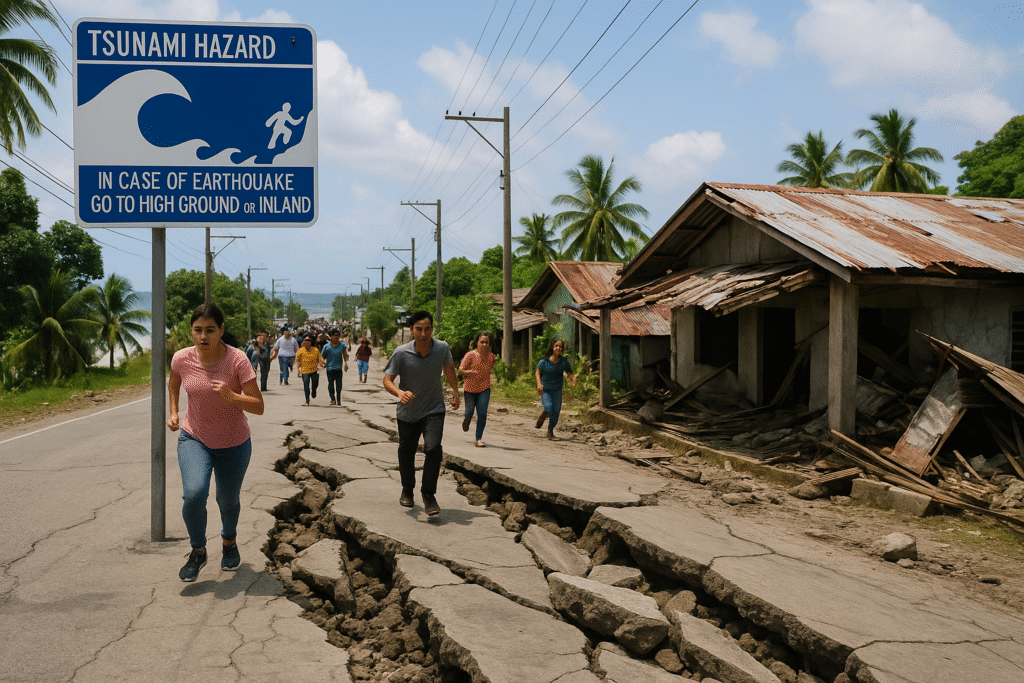
Initial reporting confirmed at least two deaths and multiple injuries, with fatalities reported in Mati City (Davao Oriental). Several structures — including a hospital that evacuated more than 200 patients, schools and other public buildings — sustained damage and cracks. Power outages and localized interruptions to services were reported in places close to the epicenter and in greater Davao. Local authorities and national agencies began search-and-rescue assessments immediately after shaking subsided.
4) Which provinces were placed on alert / evacuated
PHIVOLCS and the NDRRMC (National Disaster Risk Reduction and Management Council) issued tsunami warnings and advisories for Davao Oriental, Dinagat Islands, Surigao del Norte, Surigao del Sur, Eastern Samar, Southern Leyte and Leyte, among others, advising coastal residents to move to higher ground. Schools and workplaces in many towns were suspended as local governments coordinated evacuations. The PTWC extended warnings to nearby nations (parts of Indonesia and Palau) as a precaution. Those warnings were later lifted after monitoring.
5) Aftershocks and ongoing seismic activity
Large earthquakes are commonly followed by numerous aftershocks. PHIVOLCS and monitoring networks recorded dozens to hundreds of aftershocks, including several sizable ones in the magnitude-4 to magnitude-5+ range in the hours after the mainshock. Authorities warned that additional strong aftershocks were possible and reminded the public to stay away from damaged structures and from coastlines until official “all clear” notices were given. (Wikipedia)
6) What international monitoring centers said
The Pacific Tsunami Warning Center issued messages predicting potentially hazardous waves of up to 1–3 meters in parts of the Philippines and noted possible smaller effects in regions farther away. International seismic services (EMSC, USGS and regional centers) provided magnitude and location updates, which is why magnitude readings show minor variation (7.4–7.6) as agencies refine their calculations. Governments base evacuations and warnings on the most conservative assessments to protect life.
7) Who coordinates national response in the Philippines
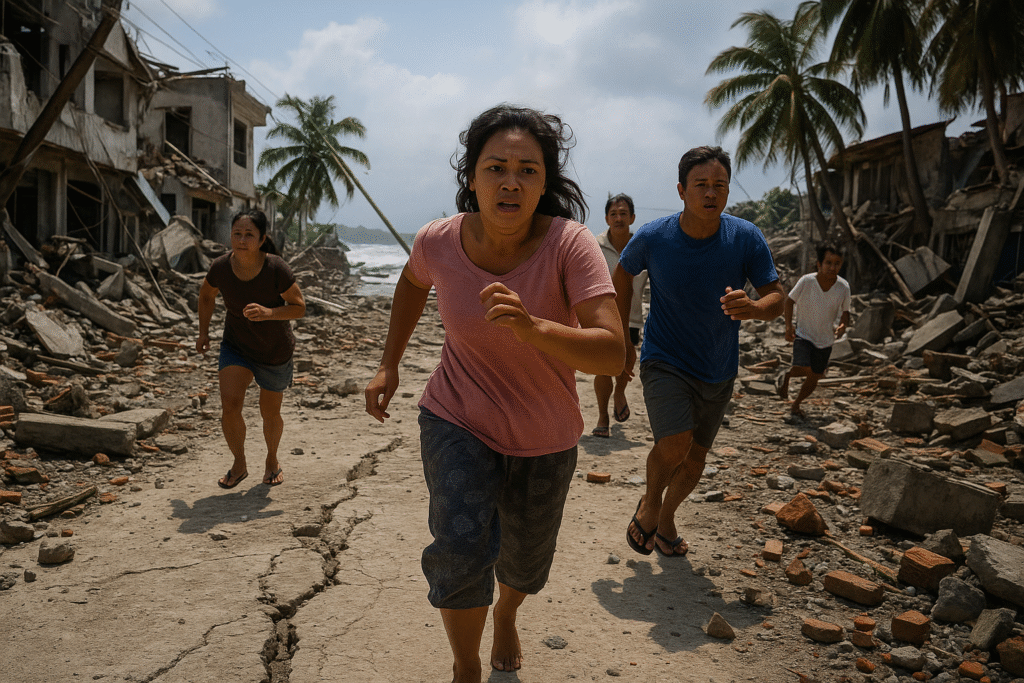
On the ground, the NDRRMC, regional civil-defense offices, and local government units (LGUs) coordinate evacuations, emergency sheltering and damage assessments. PHIVOLCS leads scientific advisories about volcanic and seismic hazards (including tsunami bulletins), while the Department of Health, regional hospitals and humanitarian responders manage medical and shelter needs. International embassies and agencies issued bulletins for foreign nationals and coordinated consular assistance where needed.
8) Immediate safety steps if you are in an affected area
If you were in or near the affected coastline:
• Move inland and to higher ground immediately when a tsunami warning or advisory is issued.
• Avoid the shoreline even if sea levels appear calm — tsunami waves can arrive hours after the quake and can be unpredictable.
• Stay out of damaged buildings; aftershocks can cause further collapse.
• Follow official NDRRMC, PHIVOLCS and local government instructions on evacuation routes, shelters and when it’s safe to return.
9) How to check verified, real-time updates (official channels)
For authoritative information consult:
• PHIVOLCS earthquake and tsunami advisories (official bulletins and Twitter/X feed).
• NDRRMC for national disaster bulletins, evacuation orders and relief coordination.
• Pacific Tsunami Warning Center (PTWC) bulletins for regional tsunami messages.
• Trusted international outlets (AP, Reuters, Al Jazeera, BBC) for verified reporting and context. Use official pages and agency posts first for safety directives.
10) What to expect in the next 48–72 hours
Expect ongoing aftershocks, more localized damage assessments, temporary closures of schools and some airports for inspections, and continued emergency sheltering for evacuees. Critical infrastructure inspections (bridges, hospitals, power substations) typically happen immediately; restoration work may be gradual depending on damage extent. Humanitarian and local government relief operations focus first on search-and-rescue, emergency medical needs and providing safe shelter and water.
11) How you can help safely (for people who want to donate or volunteer)
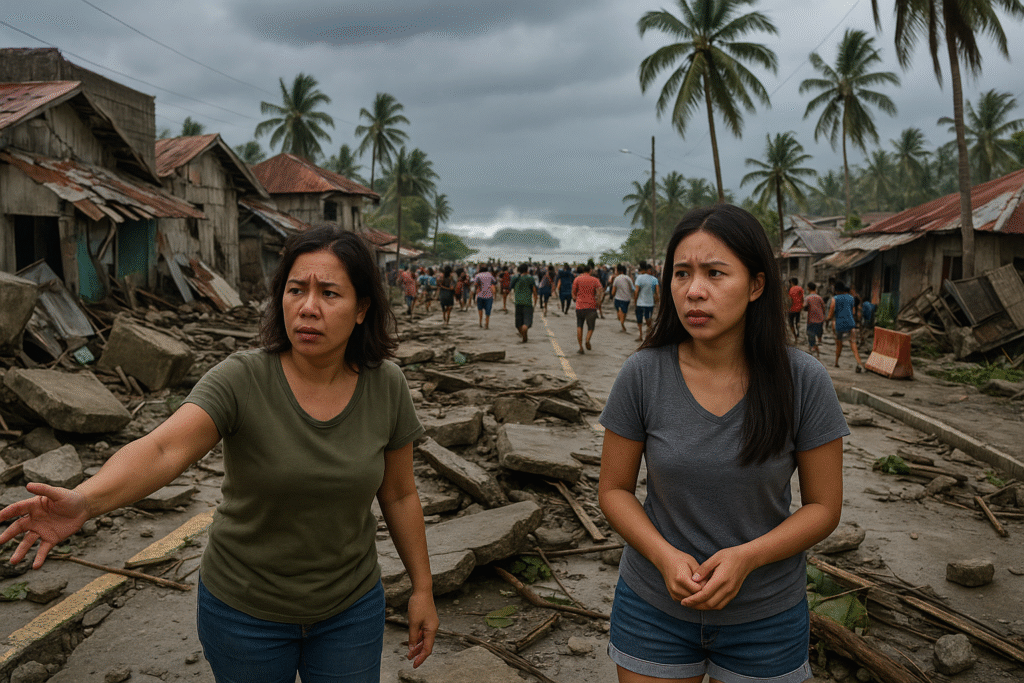
If you’re overseas and want to help, give to reputable organizations working through local partners (international humanitarian NGOs with Philippines programs or accredited local NGOs). Avoid sending unsolicited goods — cash donations to vetted disaster-response funds are often the fastest, most flexible help. If you are local and wish to volunteer, coordinate with LGU or the NDRRMC to avoid overwhelming response efforts; trained first responders should lead search-and-rescue in damaged structures. Verify donation channels via official appeals before contributing.
12) Context: why the Philippines is vulnerable to big quakes and tsunamis
The Philippines sits on the western Pacific “Ring of Fire,” a zone of active tectonic boundaries and subduction trenches (including the Philippine Trench). This geography leads to frequent seismicity and tsunami risk, which is why preparedness systems (PHIVOLCS, NDRRMC, community evacuation plans) are central to saving lives. Major events within weeks of one another (for example the late-September Cebu quake and this Davao quake in October 2025) underline the need for sustained disaster-resilience investments.
FAQ — Fast answers readers ask
Q: Was a tsunami observed?
A: Small sea-level fluctuations and minor waves were recorded; initial tsunami warnings were later cancelled after monitoring indicated no destructive waves.
Q: How many people were killed or injured?
A: As of initial reports, at least two people were confirmed dead and dozens were injured; authorities continue damage and casualty assessments. Expect official tallies to be updated as rescue teams report.
Q: Should I travel to Davao/nearby areas now?
A: Travel advisories and transport disruptions can follow major quakes. Check airline and local government notices; prioritize safety and avoid travel into areas under evacuation or those with damaged infrastructure.
How we verified this story (transparency & sources)
This article relies on official bulletins (PHIVOLCS tsunami and earthquake advisories, NDRRMC announcements), regional warning centers (PTWC) and on-the-ground reporting from established news agencies (Reuters, AP, Al Jazeera, CBS/AFP). Where seismological magnitude values differed slightly, we reported the range (7.4–7.6) and cited the relevant agencies. For safety instructions, we used official PHIVOLCS and NDRRMC guidance as the primary references.
Verified links (official & reputable sources)
Below are the authoritative pages and reputable news stories readers should consult for the official record and further updates. (All links were live and authoritative as of October 10–11, 2025.)
- Philippine Institute of Volcanology and Seismology (PHIVOLCS) — Tsunami Advisory & Earthquake Bulletins (official). (PHIVOLCS)
https://www.phivolcs.dost.gov.ph/index.php/tsunami/tsunami-advisory-and-warning3 - National Disaster Risk Reduction and Management Council (NDRRMC) — official updates and evacuation notices. (Facebook)
https://www.ndrrmc.gov.ph - Pacific Tsunami Warning Center (PTWC) / NOAA — global tsunami messages and updates. (U.S. Embassy in the Philippines)
https://www.tsunami.gov - Reuters — “Powerful 7.5 magnitude earthquake strikes off southern Philippines, tsunami warnings issued.” (Oct 10, 2025). (Reuters)
https://www.reuters.com/business/environment/magnitude-72-earthquake-strikes-philippines-mindanao-emsc-says-2025-10-10/ - Associated Press — “Powerful earthquake off southern Philippines kills 2 people, causes damages and tsunami evacuations.” (Oct 10, 2025). (AP News)
https://apnews.com/article/b4136101b62a313ff327737433748e27 - Al Jazeera — “Tsunami threat passes for Philippines, Indonesia after 7.4 quake hits Davao.” (Oct 10, 2025). (Al Jazeera)
https://www.aljazeera.com/news/2025/10/10/strong-magnitude-7-6-earthquake-strikes-off-southern-philippines - U.S. Embassy Philippines — Natural Disaster Alert (advice for U.S. citizens). (U.S. Embassy in the Philippines)
https://ph.usembassy.gov/natural-disaster-alert-magnitude-7-5-earthquake-and-tsunami-warning-affecting-mindanao/
Final notes & disclaimer
This article aggregates official advisories and reputable reporting as of October 10–11, 2025. It is intended to inform — not to replace emergency instructions from local authorities. Disaster situations evolve quickly: always follow PHIVOLCS, NDRRMC and local government unit instructions for evacuation routes, shelter locations and safety updates. Trenbuzz.com and the author are not responsible for individuals’ actions; please use the official links above for operational directives.