
By TrenBuzz — Markets & policy
Key points
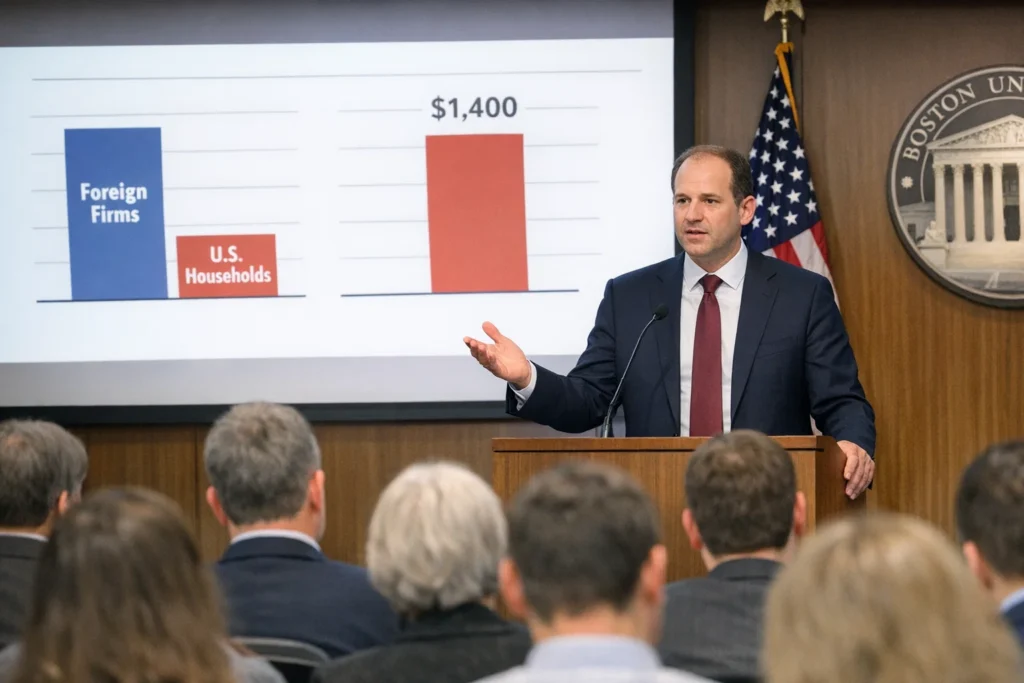
- Federal Reserve Governor Stephen Miran told an audience at Boston University that recent data suggests foreign firms — not U.S. households — have borne much of the cost of the Trump-era tariffs, arguing pass-through to American consumers is smaller than widely reported.
- Miran acknowledged other research that finds the opposite: the Yale Budget Lab estimates the tariffs add roughly $1,400 a year in costs for the median U.S. household. Miran said accounting quirks — for example, U.S. subsidiaries of foreign firms appearing in the data — can mask who actually pays.
- His remarks come as the Supreme Court reviews the legality of some of the tariff measures and as policymakers debate whether tariffs are a temporary inflation driver or a structural tax on U.S. consumers.
Americans aren’t shouldering tariff hit— the short version
At a speech in Boston, Fed Governor Stephen Miran pushed back on the dominant narrative that Americans are bearing the full brunt of recent U.S. tariffs, saying the raw data can be misleading and that foreign firms — or foreign corporate parents of U.S. subsidiaries — may be absorbing more of the cost than previously believed. The comment reopened a live policy debate: are tariffs acting mainly as a tax on American households, or are they being borne elsewhere in global supply chains?
What Miran actually said (and the context)
Speaking at Boston University’s Questrom School of Business, Miran argued that accounting and corporate structure can make it look like a U.S. entity is bearing tariff costs when, in fact, the legal incidence rests with foreign parents or exporters. He noted that some commonly cited data series do not disentangle U.S. subsidiaries of foreign firms from genuinely domestic producers — which can skew simple pass-through calculations. Miran also downplayed the tariffs’ persistent effect on headline inflation, calling much of their impact “temporary.”
Why many economists disagree — the Yale Budget Lab estimate
Not all analysts buy that interpretation. The Yale Budget Lab’s detailed modelling of the 2025–26 tariff packages finds the median U.S. household faces about $1,400 in higher costs per year from tariffs already imposed — a result driven by pass-through of import taxes into consumer prices and by the composition of consumption patterns. That study also highlights distributional effects: lower-income households pay a larger share of income toward tariffed goods. Miran acknowledged this research but argued that headline numbers can overstate consumer incidence without accounting for corporate ownership chains.
The mechanics — who can actually pay a tariff?
A tariff is levied at the border on imports. Economically, that cost can be borne by exporters (reducing their revenue), importers and distributors (cutting margins), or consumers (through higher prices). How the burden splits depends on market structure, elasticities, and contractual arrangements. Miran’s point is technical but important: when an import is sold in the U.S. by a U.S. subsidiary of a foreign parent, the accounting ledger may show the U.S. firm as the party “paying” the tariff even if parent-company profit margins or global pricing strategies ultimately absorb the cost. That nuance does not, however, resolve the empirical question of whether consumers are seeing higher prices at checkout.
Policy stakes — why this debate matters
- Monetary policy: The Fed has linked part of last year’s overshoot in inflation to tariffs; if tariffs are a continuing inflationary tax on households, that argues for tighter policy. If their effect is modest or fleeting, the Fed’s stance can be more relaxed. Miran signalled the latter view in his remarks.
- Fiscal & trade policy: Tariff revenues have swollen federal receipts; Miran noted tariffs have improved the government’s near-term fiscal position, an argument used by some policymakers to defend the measures. Opponents counter that revenue gains come at the cost of higher living expenses for Americans.
- Legal risk: The Supreme Court’s pending review of the tariffs means the entire policy could be curtailed — a ruling against the administration would force a rapid re-pricing of affected goods and could trigger refund claims. Miran referenced that legal uncertainty as part of the policy backdrop.
What markets and households should watch next
- Retail price indices and import price data in coming months — if consumer prices for tariffed categories keep rising, that will undercut Miran’s “foreign-firm bears the cost” interpretation.
- Corporate earnings reports from companies that import heavily — margin compression suggests firms, not consumers, are absorbing costs; rising retail prices suggest pass-through to households.
- Supreme Court action and implementation guidance — any judicial curtailment or administrative recalibration of tariffs would be the clearest near-term shock to prices and trade flows.
Quick explainer — three simple scenarios for tariff incidence
- Mostly exporters pay: If foreign suppliers cut prices to protect market share, domestic retail prices may not rise much; importers’ margins fall. (Good for consumers, bad for some foreign producers.)
- Mostly importers/retailers pay: Firms accept lower margin for a time and delay passing costs to consumers — costs may show up in earnings, not at the checkout.
- Mostly consumers pay: Firms pass tariffs onto retail prices; household budgets shrink, and lower-income families are hit hardest (this is the Yale finding). Which scenario dominates depends on industry specifics and competitive dynamics.
Bottom line
Governor Miran’s speech reminds us that the question “who pays for tariffs?” is both technical and empirical. His accounting caveat — that corporate ownership can obscure incidence in headline statistics — is valid as a warning against sloppy interpretation. But the Yale Budget Lab and other empirical studies present a strong counterargument: for many categories and for many households, tariffs have translated into higher prices. Policymakers, markets and the courts will now weigh those competing claims as they decide how persistent tariffs should be, who ultimately bears their cost, and what that means for inflation and fiscal policy.