Published by TrenBuzz.com | April 25, 2026
Key Points at a Glance- Iran Found Its Nuclear Weapon
- Iran does not yet have a functional nuclear weapon — but it is closer than it has ever been.
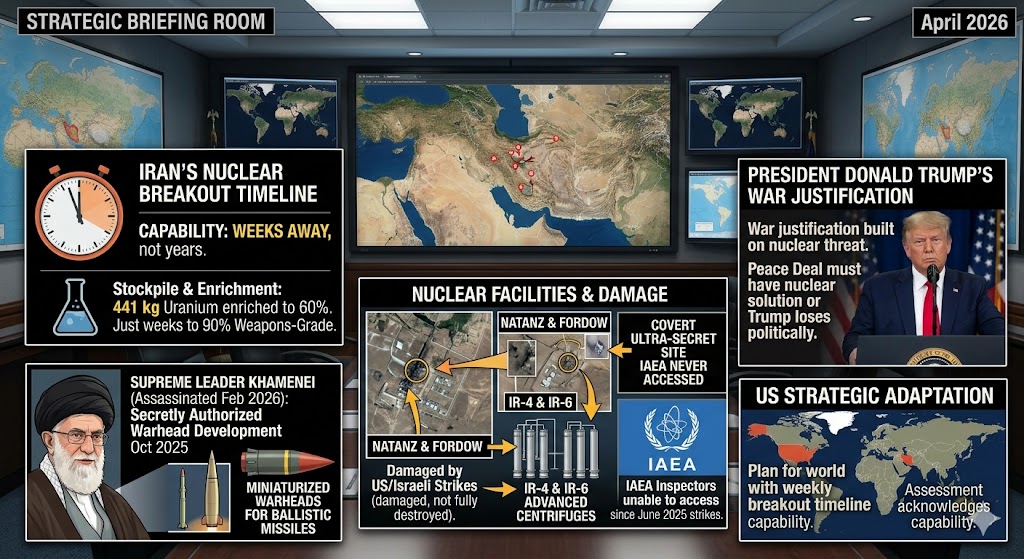
- In October 2025, Supreme Leader Khamenei secretly authorized the development of miniaturized nuclear warheads for ballistic missiles before his assassination in February 2026.
- Iran holds 441 kg of uranium enriched to 60% — just weeks away from weapons-grade at 90% using advanced IR-4 and IR-6 centrifuges.
- US and Israeli strikes have damaged Natanz and Fordow — but neither has been fully destroyed.
- The IAEA has not been able to inspect Iranian nuclear facilities since the June 2025 strikes.
- Iran is suspected to have a covert ultra-secret enrichment program at a site IAEA inspectors have never accessed.
- The US 2026 worldwide threat assessment does not confirm Iran decided to build a bomb — but acknowledges the capability is weeks away.
- Trump built his entire war justification around the nuclear threat — meaning a peace deal must now have a nuclear solution or he loses politically.
- The real adaptation required: the US must now plan for a world where Iran’s nuclear breakout timeline is measured in weeks, not years.
Strip away the military strikes, the ceasefire negotiations, and the political theater — and at the heart of the US-Iran conflict sits one question that nobody has yet answered: what happens when a country doesn’t need a nuclear weapon to have nuclear power?
In a 20-minute speech on April 1, President Donald Trump referred to nuclear weapons over 20 times. By relying on the nuclear justification for the war, however, Trump may have painted himself into a corner — the end of the war must also have a nuclear solution. The nuclear issue is likely to determine not only when the war ends, but also how it ends, and who can claim “victory.”
What Iran Actually Has — The Real Weapons Picture
Iran does not yet have a nuclear weapon, but it has a long history of engaging in secret nuclear weapons research in violation of its international commitments. Western analysts say the country has the knowledge and infrastructure to produce a nuclear weapon in fairly short order should its leaders decide to do so.
According to the Institute for International Political Studies, sources in Tehran reported that in October 2025, Iranian Supreme Leader Ali Khamenei had authorized the development of miniaturized nuclear warheads for ballistic missiles. Although such warheads would require uranium enriched to 90%, this could be achieved in a matter of weeks by processing Iran’s existing stockpile of 441 kg of 60% uranium with its advanced IR-4 and IR-6 centrifuges.
Accounts also indicate the existence of an ultra-secret enrichment program at one of Iran’s covert nuclear sites, to which the IAEA has never been given access.
Why the Strikes Didn’t Solve the Problem
Despite ongoing negotiations in early 2026, the United States and Israel launched a large-scale offensive against Iran in February with the stated aim of destroying its nuclear and missile capabilities. Although there has reportedly been some damage to one Iranian nuclear site, there is no confirmed evidence of major damage to the country’s overall nuclear facilities.
On March 3, 2026, the IAEA confirmed that while recent bombings failed to destroy the Natanz nuclear facility, significant damage to its entrance buildings had now made it inaccessible. The facility itself — built deep underground — remains intact.
The IAEA has not been able to inspect the attacked Iranian nuclear facilities at all since the June 2025 strikes — leaving the world operating on assumptions, not verified facts.
The Breakout Timeline — America’s New Reality
The United States and the international community would need to adapt to a world in which Iran’s breakout timeline, even in a best case scenario, is measured in months rather than years. The JCPOA’s key restrictions had kept that timeline to one year — but those restrictions are now gone, the deal is terminated, and Iran’s centrifuges keep spinning.
Although Iran could technically use its uranium enriched to 60% to build a bomb, it is far more likely that it would enrich the material to weapons-grade levels of 90% before converting it to the metallic form necessary for a nuclear warhead. The 2026 US worldwide threat assessment does not indicate that Iran had made a decision to weaponize its nuclear program — but the capability is no longer a question of if, only when.
The Negotiating Trap the US Set for Itself
The US position throughout 2025 and 2026 has been that Iran must conduct “zero enrichment.” This was rejected by Iran on every occasion. Axios reported the US may be time-limiting the commitment to a 20-year period — Iran countered with five years. Iran’s foreign ministry has stated that enriched uranium “will under no circumstances be transferred anywhere.”
Trump needs a face-saving and expeditious off-ramp to resolve the nuclear issue. He justified an entire war on preventing a nuclear Iran — so whatever deal is struck must credibly neutralize that threat, or Trump’s political case for the war collapses entirely.
How the US Must Now Adapt
The 2026 National Defense Strategy stated US strikes “obliterated” Iran’s nuclear program — but intelligence reports tell a more complicated story. The US intelligence community has for years assessed that Iran could have the capability to produce nuclear weapons but had not mastered all the necessary technologies — that assessment is rapidly becoming outdated.
The adaptation required is profound. The US must now negotiate not from a position of preventing a nuclear Iran — but from one of managing a near-nuclear Iran, with a stockpile buried underground, centrifuges potentially still spinning at hidden sites, and a ceasefire clock ticking.
Iran’s real nuclear weapon was never a bomb. It was the uranium it’s been quietly accumulating for decades. And now, America has to figure out what to do with that truth.
Disclaimer: This article is for general informational and educational news reporting purposes only. All assessments, intelligence references, and expert analyses cited are drawn from publicly available and credible government, think tank, and news sources as of April 25, 2026. TrenBuzz.com does not represent any government, military, or intelligence body and makes no independent claims about Iran’s nuclear capabilities. Readers are encouraged to follow official government and credible international sources for real-time updates.