
Published by TrenBuzz.com | May 13, 2026
Key Points at a Glance
- Britain announced on May 12, 2026 it will contribute HMS Dragon, Typhoon fighter jets, and autonomous mine-hunting drones to a multinational defensive mission in the Strait of Hormuz.
- UK Defence Secretary John Healey made the announcement during a virtual summit of 40+ defence ministers from allied nations.
- The UK is committing £115 million in new funding for mine-hunting drones and counter-drone systems.
- HMS Dragon — the Royal Navy’s advanced air defence warship — is already en route to the Middle East.
- The RFA Lyme Bay is being converted into a “mothership” for autonomous uncrewed systems — a first for the Royal Navy.
- The mission is strictly defensive — designed to restore confidence for commercial shipping, not to fight Iran.
- The mission will become “operational when conditions allow” — likely after a peace deal or further ceasefire stabilization.
- Over 40 nations are involved in the multinational framework — with the UK taking a coordinating leadership role.
- The Strait of Hormuz handles approximately 20% of the world’s oil — keeping it open is an economic emergency for Europe, Asia, and beyond.
- The UK move follows King Charles’s state visit to Washington last month and Trump’s specific ask for allies to share the Hormuz burden.
When King Charles visited Washington last month and Trump told the world’s cameras that “we need help” in the Strait of Hormuz, Britain was already planning its answer. On Tuesday, it delivered one.
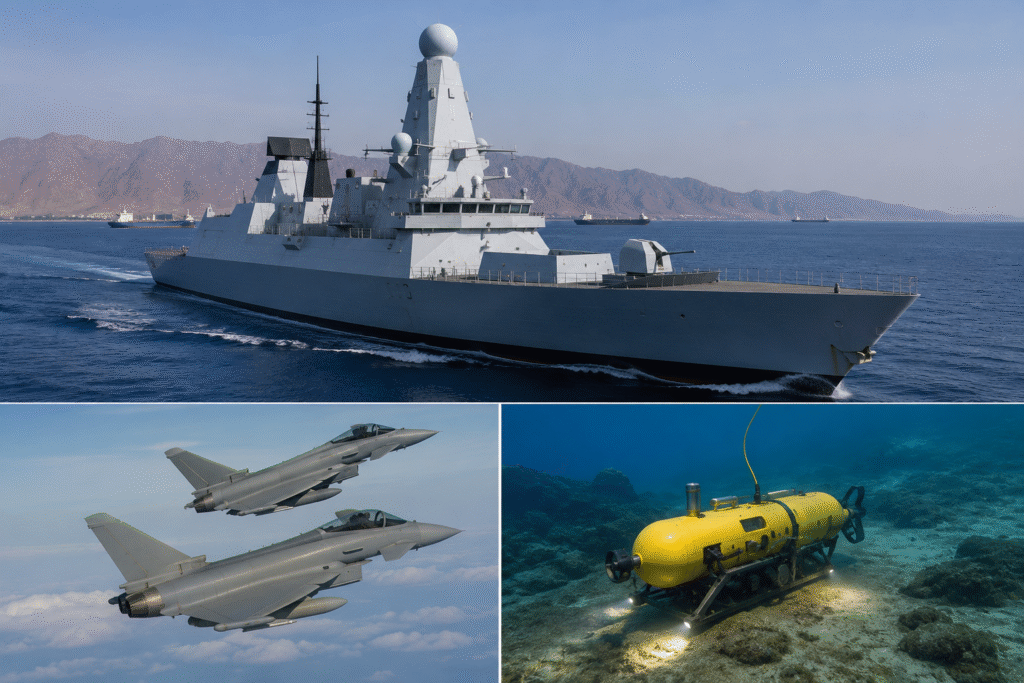
Britain will deploy autonomous mine hunting equipment and cutting-edge counter drone systems, along with Typhoon jets and HMS Dragon as part of a future defensive mission to secure freedom of navigation in the Strait of Hormuz. The defensive mission, which would become operational when conditions allow, is backed by £115m new funding for mine-hunting drones and counter-drone systems.
What Britain Is Actually Sending — Asset by Asset
HMS Dragon is already on her way to the Middle East, having undergone additional training and preparation to ensure that her crew are ready, including further calibrating her advanced systems. This will ensure that the air defence ship is ready for potential future operations in the Strait. RFA Lyme Bay also continues to be upgraded by the Royal Navy to add new cutting-edge uncrewed equipment, allowing it to be used as a ‘mothership’ for autonomous systems, if required.
The Typhoon jets bring both air defense capability and strike reach — meaning Britain’s contribution is genuinely multi-domain, covering surface threats, aerial drones, mine-detection, and air superiority simultaneously.
Healey’s Message — “Defensive, Independent, Credible”
“The UK is playing a leading role to secure the Strait of Hormuz, and we are demonstrating that today with new cutting-edge kit to protect our interests and secure the Strait,” Defence Secretary John Healey said. “New funding for autonomous mine-hunting and counter-drone systems, our advanced Typhoon jets, and HMS Dragon are strong and clear commitments — commitments to strengthen the confidence of commercial shipping and reduce the burden of the conflict on people at home.”
“With our allies, this multinational mission will be defensive, independent, and credible,” Healey added in his statement.
The 40-Nation Summit — Why This Is Different From Before
During a virtual summit of Defence Ministers, with representation from over 40 nations involved in the Multinational Military Mission, the Defence Secretary also reaffirmed the UK’s leadership, including as part of a multinational HQ to coordinate efforts.
The involvement of 40+ nations is the critical distinction between this mission and the US’s largely unilateral Project Freedom operation. A multinational framework gives the mission international legitimacy, shared legal footing, and — crucially — a far more credible deterrent signal to Iran than any single navy can project alone.
Why This Matters — The Economic Equation
The multinational plan is strictly defensive in nature and is designed to restore confidence for commercial shipping along the Strait of Hormuz, one of the world’s most critical trade routes through which a fifth of the world’s oil passes.
The Iran war has sharply curtailed traffic through the Strait of Hormuz, disrupting oil exports and sending energy prices higher.
For Britain specifically, the economic stakes are direct: elevated oil prices are feeding UK inflation, suppressing consumer spending, and threatening the growth targets set by Chancellor Rachel Reeves in the Spring Budget. Getting ships moving through Hormuz again is not just a military objective — it is a domestic economic imperative.
The “When Conditions Allow” Caveat — What It Really Means
The mission’s most important phrase is a deliberately quiet one: “when conditions allow.” That phrase signals Britain is not jumping into active combat alongside the US — it is positioning forces for the moment a durable ceasefire or peace deal creates the legal and political space for a multinational escort regime to operate without becoming a party to the Iran conflict.
It is a measured, coalition-first approach that charts a distinctly different course from Washington’s go-it-alone Project Freedom — while still sending Iran a clear message that the cost of keeping the Strait closed is rising, one navy at a time.
Disclaimer: This article is for general informational and news reporting purposes only. All military assets, funding figures, and diplomatic details are sourced from the UK Government’s official press release (gov.uk), Reuters, Al-Monitor, and The Business Standard as of May 12–13, 2026. The Strait of Hormuz multinational mission had not yet reached operational status as of publication — its activation depends on geopolitical and ceasefire conditions. TrenBuzz.com does not represent any government or military body. Readers are encouraged to follow official UK Government, MOD, and credible international news sources for real-time updates.