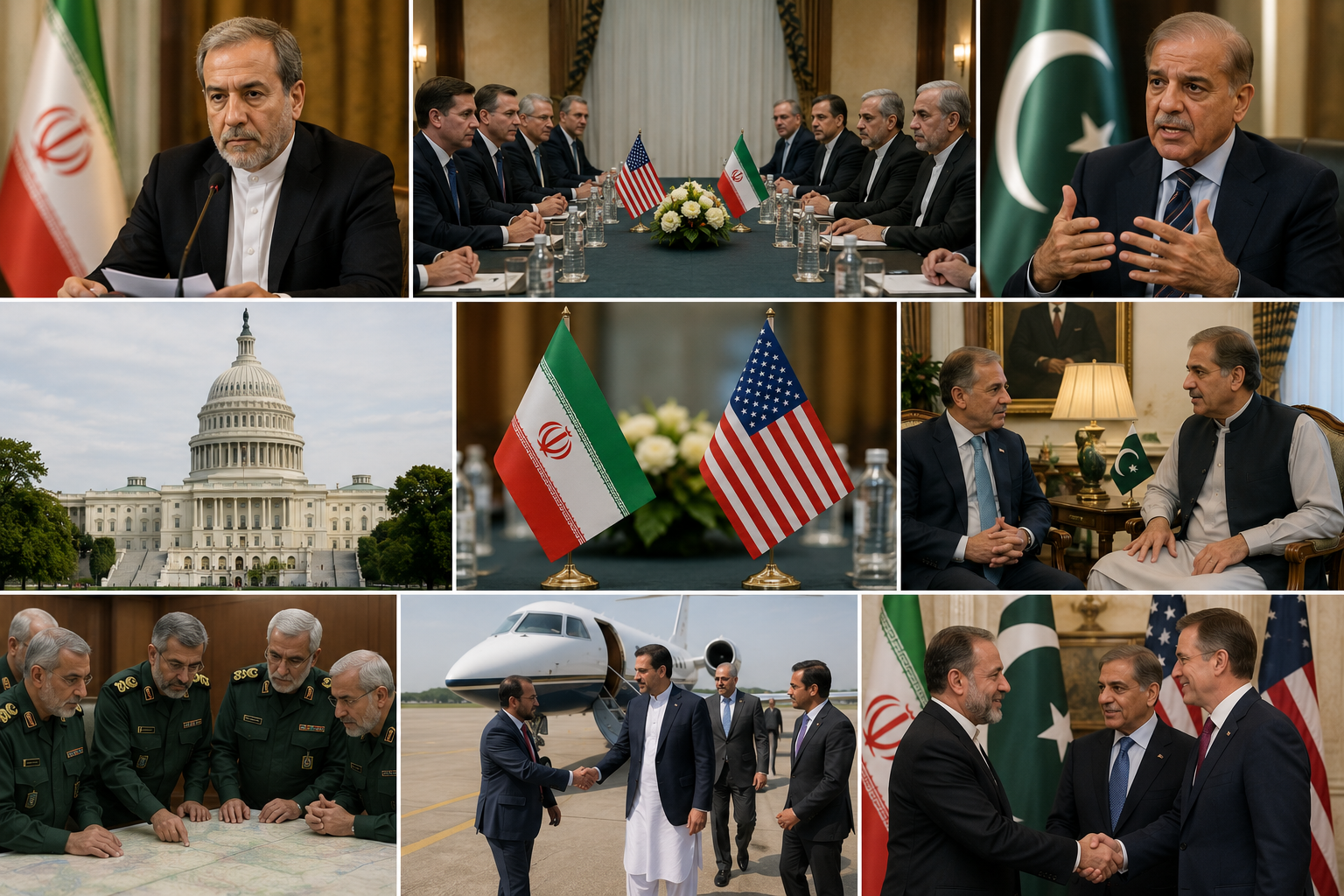
► Key Points – Iran’s Revised Peace Proposal Lands in Washington
- Pakistan has delivered a revised Iranian peace proposal to Washington, as of May 18, 2026
- A Pakistani source warns: “We don’t have much time” — and that both sides “keep changing their goalposts”
- Iran’s latest offer focuses on ending the war and securing the Strait of Hormuz first, with nuclear talks deferred to a later phase
- The US previously handed Iran a 5-point framework demanding it keep only one nuclear facility and transfer its enriched uranium stockpile
- Iran’s Foreign Ministry confirms exchanges are “continuing” through Pakistani mediators
- Pakistani PM Shehbaz Sharif says he is “optimistic” and is pushing for a second round of direct talks in Islamabad
- Trump says he’s open to Iran suspending enrichment for 20 years — if there’s a “real” guarantee
By TrenBuzz Staff · May 18, 2026 · 5 min read
The Middle East war between the United States and Iran has produced one of the most complex diplomatic chess matches in modern history — and on Monday, Pakistan made its boldest move yet. Islamabad has officially delivered a revised Iranian peace proposal to Washington, according to a Pakistani source who spoke to Reuters, in what could be a pivotal moment in the long-stalled negotiations.
But the same source delivered a chilling caveat: “We don’t have much time.” When pressed on whether the gaps between Tehran and Washington could be closed, the source bluntly added that both countries “keep changing their goalposts” — a frank admission that the path to peace remains deeply uncertain.
This latest development in the Iran peace proposal Pakistan US 2026 saga comes as ceasefire talks teeter between cautious diplomacy and the very real threat of resumed military strikes — with the entire world watching.
How Pakistan Became the World’s Most Important Mediator
Pakistan’s unlikely rise to the center of this geopolitical storm didn’t happen overnight. When the US and Israel launched attacks on Iran on February 28, 2026, the fallout was immediate — Iran responded by de facto blockading the Strait of Hormuz, cutting off a critical artery for roughly a fifth of global oil and gas supplies.
With direct communication between Washington and Tehran virtually nonexistent, Pakistan stepped in. Pakistani army staff chief Asim Munir, VP JD Vance, and US envoy Steve Witkoff worked behind the scenes to broker a fragile two-week ceasefire that took hold on April 8 — a stunning diplomatic achievement for Islamabad.
Since then, every proposal, counter-proposal, and revised offer has flowed through Pakistani hands — making Islamabad the de facto post office for one of the most consequential negotiations since the Cold War.
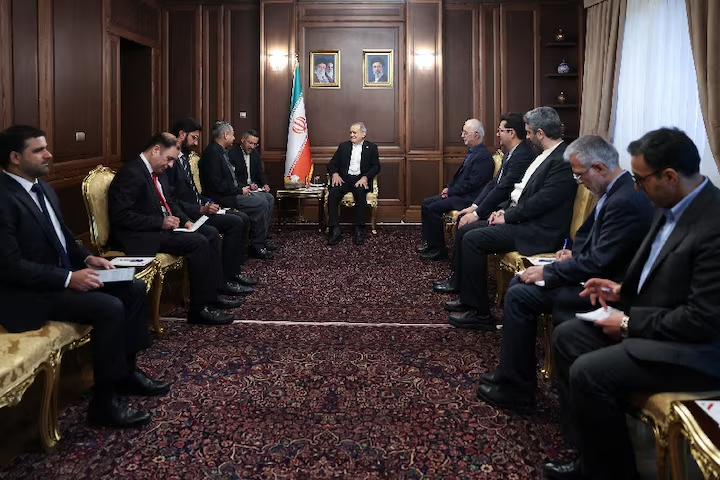
“We don’t have much time. Both countries keep changing their goalposts.”
— Pakistani Source, Reuters, May 18, 2026
What’s Inside Iran’s Revised Proposal?
Tehran’s revised offer — now in Washington’s hands — represents a strategic shift in Iran’s negotiating posture. Rather than demanding resolution of all issues simultaneously, Iran’s updated plan proposes a two-phase approach: first, end the war and resolve the Strait of Hormuz crisis; then, deal with the nuclear question at a later stage.
Iran’s earlier 14-point proposal had demanded everything at once — the lifting of all sanctions, withdrawal of US forces from the region, war reparations, and recognition of its sovereign rights over the Strait of Hormuz. That sweeping list had hit a wall in Washington, with Trump saying he was “not satisfied” with the offer.
The revised approach, which separates the maritime and nuclear tracks, appears designed to give both sides an off-ramp — though analysts warn that agreeing to end the blockade before resolving nuclear issues could strip Trump of his primary leverage over Tehran.
🔗 Also Read: US Weighs Iran Ground Operation: How Generals Assess Iran Strike Risks in April 2026
America’s Demands — and Why Tehran Calls Them “Excessive”
The US has not been sitting still either. Washington’s most recent framework — a five-point plan — demanded that Iran shut down all but one of its nuclear facilities and hand over its entire stockpile of highly enriched uranium to the United States. Iranian state media immediately described the demands as “excessive” and a non-starter.
Iran’s Foreign Ministry spokesman Esmaeil Baqaei confirmed Monday that Tehran had conveyed its “concerns” to the American side and that exchanges were “continuing through the Pakistani mediator.” The careful diplomatic language suggested neither a breakthrough nor a breakdown — just more slow-moving talks under enormous pressure.
Trump, for his part, told reporters he would be open to Iran suspending nuclear enrichment for 20 years — if there was a “real” guarantee. It was his most flexible public position yet, though Tehran has given no indication it would accept such a condition.
Pakistan’s PM Is Betting on Islamabad as Peace Central
Pakistani Prime Minister Shehbaz Sharif has publicly stated he is “optimistic about achieving permanent peace” between the US and Iran, and that Islamabad is working “to do its utmost” to make that happen. Sharif has also hinted strongly that a second round of direct face-to-face talks between American and Iranian officials could be hosted in Islamabad.
That would be a remarkable development — direct talks between Washington and Tehran, mediated by Pakistan, on Pakistani soil. The first round of direct talks, which were being arranged in Islamabad in late April, fell apart after Iran’s foreign minister visited and left without a breakthrough, prompting Trump to cancel his envoys’ travel plans.
“I see no point of sending them on an 18-hour flight in the current situation,” Trump had said bluntly at the time. Whether he changes his mind as Iran’s revised proposal is reviewed in Washington could define the next chapter of this crisis.
🔗 Also Read:Live Updates: Trump Not Under Pressure on Iran War Deal
Where Does This Leave the World?
The stakes of the Iran peace proposal Pakistan US 2026 negotiations extend far beyond two nations at odds. The partial blockade of the Strait of Hormuz has already rippled through global energy markets, pushed oil prices higher, and rattled shipping companies around the world. Iran’s own World Cup football team has left for Turkey — a quiet signal that even in Tehran, life goes on amid the fog of war.
Meanwhile, drone strikes have hit targets as far as the UAE’s nuclear station, Saudi Arabia has intercepted drones over its territory, and Iran’s foreign minister has been shuttling between Islamabad, Muscat, and now Moscow — seeking Russian backing for its negotiating position. The diplomatic map has never been more complicated.
With the ceasefire technically still holding and Pakistan carrying yet another revised proposal through its channels, the next 72 hours could be the most consequential in months. The source’s warning rings loud: we don’t have much time.
Disclaimer: This article is intended for informational and news reporting purposes only. The views and analysis expressed are based on publicly available information sourced from credible news agencies and do not constitute political, legal, or financial advice. TrenBuzz.com does not endorse any government, political position, or military action. All trademarks and names belong to their respective owners. Content is produced in compliance with Google AdSense publisher policies.