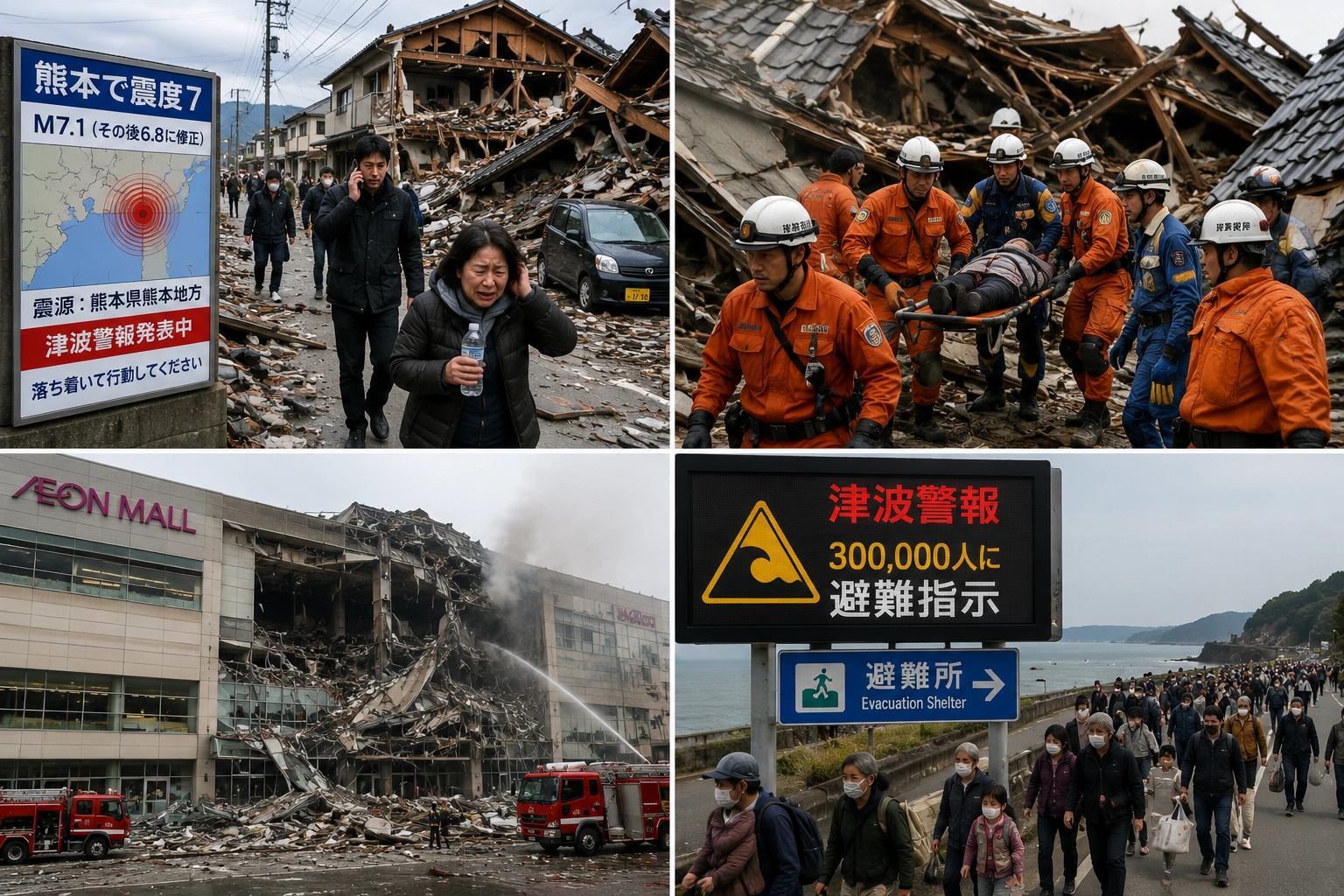
Key Points: Kumamoto Earthquake Kills
- Japan earthquake today struck Kumamoto Prefecture at magnitude 7.1, later revised to 6.8
- At least 13 people confirmed dead, with dozens still missing or trapped
- A shopping mall partially collapsed after an apparent gas explosion
- Tsunami warnings were issued, and 300,000 residents were told to evacuate
Southern Japan is reeling after one of the most powerful earthquakes to hit the region in years.
The quake struck Kumamoto Prefecture Tuesday at 4:27 p.m. local time, registering shindo 7, the highest level on Japan’s seismic intensity scale.
Here’s a detail worth understanding about the magnitude itself. The Japan Meteorological Agency initially measured it at 7.1, though the US Geological Survey later revised that figure down to 6.8.
Prime Minister Sanae Takaichi confirmed Wednesday morning that at least 13 people have died, with many others injured or still unaccounted for.
The most harrowing scene unfolded at an Aeon Mall in Kashima, where the second floor partially collapsed following what officials believe was a gas explosion.
NHK reported that 20 to 30 mall employees couldn’t initially be reached after the collapse, as rescue crews worked through the night searching the rubble.
A second major incident struck simultaneously at the Nippon Paper Industries plant in Yatsushiro, where a factory chimney collapsed during the quake.
At least 11 workers were reportedly trapped inside that facility, with two later confirmed dead as search efforts continued.
Here’s the geological context behind why this region keeps experiencing severe earthquakes. Kumamoto sits along the Japan Median Tectonic Line, where multiple active fault systems intersect.
This specific earthquake ruptured both the Hinagu Fault and the Futagawa Fault, with a 27-kilometer stretch sliding roughly 3.5 meters during the event.
Authorities issued tsunami warnings immediately following the quake, urging roughly 300,000 residents across Kumamoto Prefecture to move toward designated evacuation centers.
The infrastructure damage extends well beyond the mall and factory. Around 45,000 households currently have no power, according to Kyushu Electric Power.
There is some reassuring news amid the chaos. The Nuclear Regulation Authority confirmed no abnormalities at nearby nuclear plants, with three active reactors continuing to function normally throughout the disaster.
More than 150 public facilities across Kumamoto city have closed as a precaution, with many converted into temporary shelters for displaced residents.
With aftershocks continuing and search efforts ongoing at both collapse sites, officials are urging residents to stay alert as the true scale of this disaster continues to become clear.