Key points
- U.S. and allied strikes on Iran have sharply raised the risk of cyber retaliation from Iran aimed at private-sector targets — especially small and mid-sized companies with weaker cyber defenses.
- The U.S. cyber agencies have warned of an elevated and imminent Iranian cyber threat; companies in critical-infrastructure sectors (energy, water, healthcare, finance) should treat the risk as urgent.
- Iranian-linked groups can range from state actors with destructive tools to opportunistic proxies and hacktivists — meaning attacks can look like wipers, DDoS, supply-chain disruption or hack-and-leak campaigns.
- Many attacks are low-cost, high-impact tactics run by loose coalitions and even teen hackers in messaging apps — so any internet-exposed weakness can be exploited quickly.
- Immediate, practical steps (patching exposed systems, MFA, segmentation, tested backups, increased monitoring) materially reduce risk and are the priority for every U.S. company right now.
Lead — why this matters to American businesses right now
Cyber retaliation from Iran is not only a nation-state problem confined to diplomatic channels. In the weeks after U.S.–Israeli strikes, Iran and Iran-linked actors have signalled (and in some cases already launched) digital responses that focus on disrupting services, stealing or leaking sensitive corporate data, and degrading trust in essential systems. That places U.S. companies — from Fortune 500s to local utilities and healthcare providers — squarely in the crosshairs if they have internet-exposed weaknesses or third-party links to vulnerable suppliers.
The threat picture — three simple lines
- State actors: Iran has organized cyber units inside the IRGC and intelligence services capable of destructive intrusions when Tehran chooses.
- Proxies & affiliates: Regional and global proxy groups often execute operations the state wants to distance itself from; these groups can run wipers, DDoS, and hack-and-leak campaigns.
- Opportunists & hacktivists: Low-skill operators and teenagers in chatrooms can amplify effects by launching noisy but disruptive attacks — and by exploiting publicized geopolitical tensions to recruit.
Real-world examples (recent / illustrative)
- Website defacements and mass notifications have already been used as influence operations and to sow confusion during escalations.
- Threat intelligence firms are observing an uptick in DDoS, credential stuffing, and attempted intrusion on industrial control system (ICS) devices — classic entry points for broader disruption.
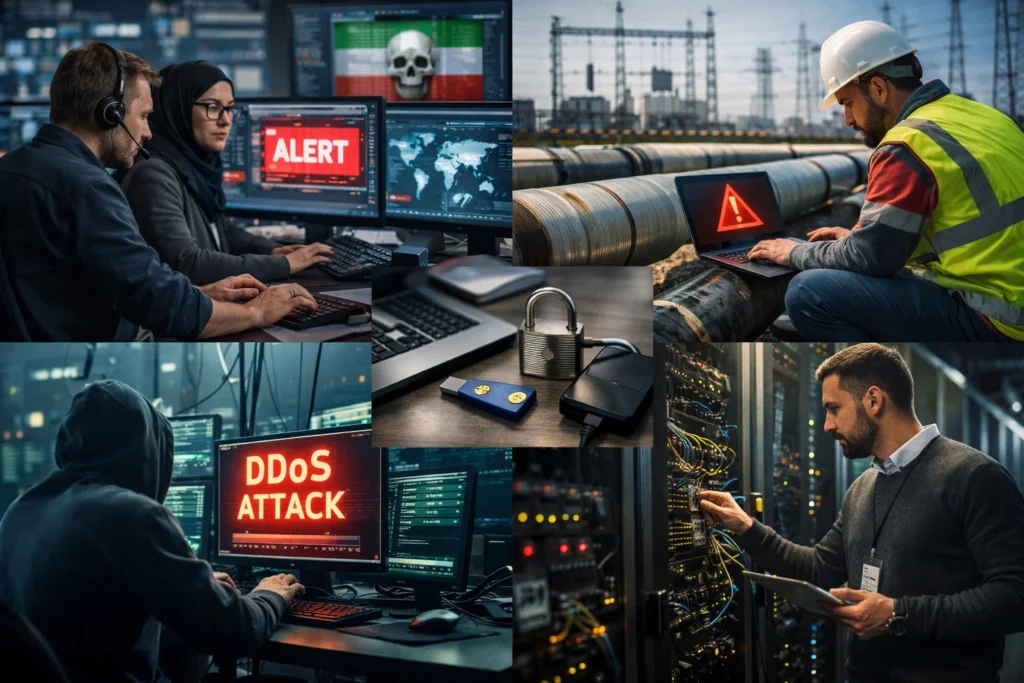
What U.S. companies should do — 7-point emergency checklist
These are practical, prioritized actions execs and CISOs can start today; none require classified access and all are proven risk reducers.
- Isolate and inventory — identify internet-exposed assets and OT/ICS endpoints; if any critical OT devices are internet-facing, isolate them immediately.
- Patch & reduce attack surface — apply critical patches, remove unused services, disable default accounts and close unnecessary ports. (Start with remote-access, VPNs, RDP/SSH.)
- Enforce MFA & password hygiene — require MFA for all admin and remote access; rotate high-privilege credentials.
- Increase monitoring & log retention — forward logs to a centralized SIEM, enable IDS/IPS rules for known Iran-linked TTPs, and raise alert thresholds.
- Test backups & recovery — verify immutable backups offline; run a tabletop Ransomware / Wiper recovery drill this week.
- Lock down supply-chain access — vet third-party vendors for cyber posture; require attestations and limit privileged API keys or service accounts.
- Engage government partners — sign up for CISA and FBI automated alerts, report suspicious access attempts, and follow any sector-specific playbooks.
How attacks are likely to look (so you know what to watch for)
- DDoS and service disruption: short, intense outages that mask other intrusions.
- Wiper malware: destructive payloads that render systems unusable (fast to deploy, hard to recover from without offline backups).
- Credential theft → ransomware: opportunistic groups monetize access via affiliates, hitting SMBs who lack mature defenses.
- Hack-and-leak: data theft followed by targeted disclosures to harm reputation or extract concessions.
Boardroom brief — questions executives should ask their CISO now
- Which assets are internet-exposed and what is the plan to isolate or harden them within 48 hours?
- Can we demonstrate tested, offline recovery for our top 10 business-critical systems?
- Do we have an up-to-date vendor map showing privileged access paths and exposure?
- Are we subscribed to federal threat feeds (CISA, FBI) and prepared to act on high-confidence advisories?
Policy & legal context (short)
U.S. agencies (CISA, FBI and partners) routinely publish advisories and playbooks during geopolitical escalations. Companies that follow official mitigations and report intrusions promptly can receive technical assistance, information sharing, and — in some cases — prioritized support. Noncompliance or delayed reporting can amplify business risk and complicate regulatory obligations for critical-sector operators.
Reader engagement & interactive elements (for your site / newsletter)
- Poll: “How worried is your organization about Iran-linked cyber retaliation?” (Not worried / Moderately worried / Taking urgent steps)
- Live checklist widget: A downloadable 1-page “48-hour cyber hardening” checklist (printable & e-mail capture).
- Incident playbook card: Tappable cards that walk users through “If you see these signs → do this.”
- Expert Q&A: A rapid form to submit top incident questions; rotate answers weekly from a CISO panel.
Bottom line
Cyber retaliation from Iran is a near-term operational threat for any U.S. company with internet-exposed assets, OT connections, or vulnerable third-party suppliers. The attackers operate at multiple levels — state teams, proxy groups and opportunistic hackers — which makes the problem both technical and organizational. The pragmatic response is immediate hardening: inventory, isolation, MFA, patched systems, tested backups, and active monitoring — coupled with fast information-sharing with U.S. cyber agencies. Acting now reduces both the likelihood of being hit and the damage if you are.