
Hongqi Bridge Collapse: This TrenBuzz explainer pulls together verified reporting and official signals about the dramatic partial collapse of the Hongqi Bridge in Sichuan province, China. Read this to understand the timeline, what videos show, why engineers suspect landslide/terrain failure, the safety and policy questions it raises, and what to expect from official investigations.
Key facts below are drawn from major outlets and local statements — the five most important load-bearing items are cited directly.
Quick take — the very short version
A newly completed section of the Hongqi Bridge in southwest China partially collapsed on 11 November 2025, after local authorities had already closed the bridge because of visible cracks and unstable slopes. The failure — captured on viral video — was linked to a landslide that undermined the approach and roadbed. Authorities reported no casualties.
1 — Where and what exactly collapsed
The Hongqi Bridge is part of a national highway (G317) in Maerkang/Barkam area of Sichuan province, a mountainous corridor that connects parts of central China with Tibet.
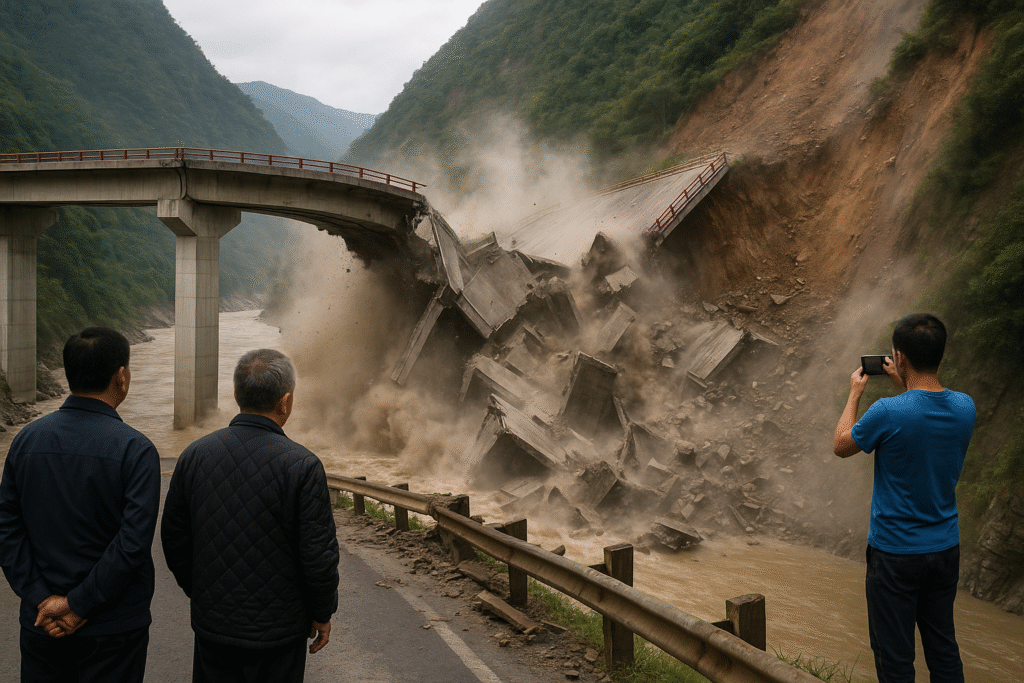
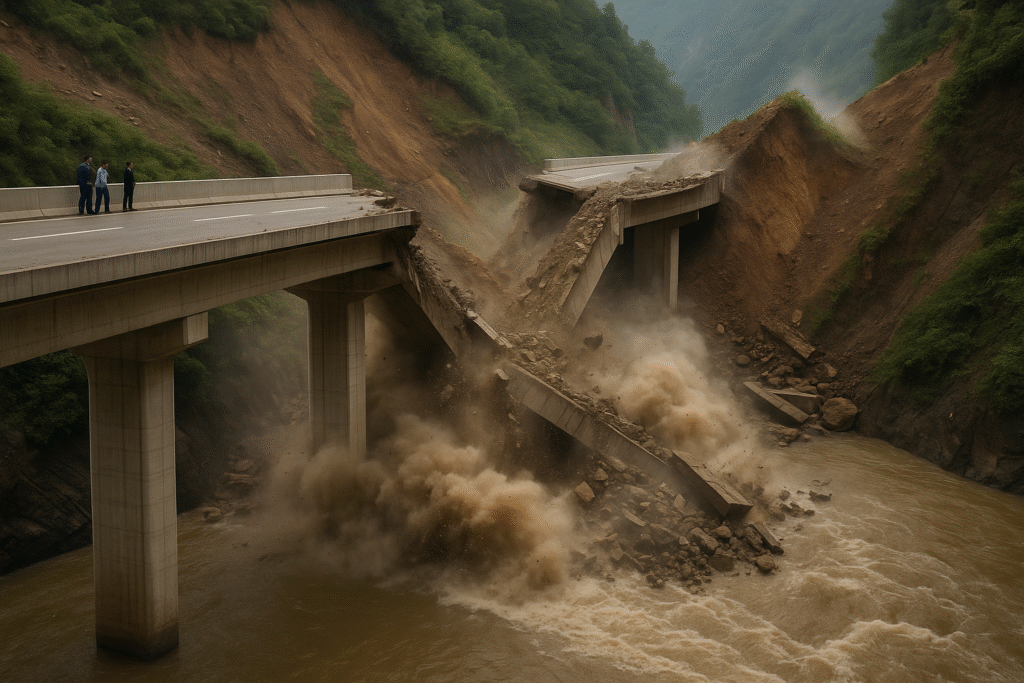
A section of the 758-metre bridge and its approach roadbed gave way and plunged into the river valley after slope instability worsened, sending up a large dust cloud and chunks of concrete.
2 — The collapse was caught on video (what the footage shows)
Multiple clips circulating on social platforms show a dramatic, nearly instantaneous buckling as the slope beside the bridge gives way and sections tumble into the gorge below.
The footage has been verified and widely replayed by major outlets; it shows the speed of the failure and the volume of concrete and debris entering the river.
3 — Timeline: warning signs came before the fall
Local authorities closed the bridge the day before the collapse after inspecting cracks in slopes and road damage nearby.
On Nov. 11, with slope conditions worsening, landslides triggered the collapse of the approach and adjacent roadbed. That prior closure likely prevented vehicles or pedestrians from being on the structure at the moment it failed.
4 — Casualties and immediate rescue posture
Official statements reported no casualties at the time of collapse, and local transport and public security bureaus moved quickly to cordon the site and assess hazards.
Because the bridge had been closed, authorities and first responders were able to focus on stabilizing the slopes and planning an engineering response rather than an emergency rescue of trapped motorists.
5 — Why engineers are pointing to landslides and terrain instability
Sichuan’s mountainous terrain is inherently geologically active and vulnerable to slope failures, especially after heavy rains, seismic activity, or excavation work.
Reports from local transportation bureaus pointed to slope deformation and ground shifts as the proximate trigger; the collapse appears to have been an approach / embankment failure rather than a classic mid-span suspension fracture.
6 — The bridge was new — why that matters
The Hongqi Bridge had been completed only months earlier as part of a major infrastructure project and was touted locally as a regional transport milestone.
A failure so soon after completion raises immediate questions about site geotechnical studies, slope stabilization measures, construction sequencing, and whether earlier warning signs were fully addressed during final inspection.
7 — What local authorities say and what investigators will check
Authorities announced the bridge closure and have opened inquiries; investigators will likely review geotechnical surveys, construction records, slope-stabilization plans, drainage controls, and any recent earthworks near the approach.
Expect multi-agency teams — transport bureaus, engineering oversight, and geological survey units — to examine whether design, construction or maintenance shortcomings contributed, or whether an exceptional landslide beyond reasonable design assumptions caused the failure.
8 — Broader pattern: why this collapse alarms observers
China has invested heavily in rapid infrastructure expansion in inland and mountainous regions — roads, dams, tunnels and bridges built fast to boost connectivity and growth.
When new projects fail early, it raises questions about the tradeoffs between speed and thorough geotechnical preparation, especially in fragile terrain where slope risk is high. The Hongqi collapse joins other recent incidents that prompted scrutiny of construction oversight.
9 — Environmental and hydrological angles to watch
Slope failures in steep mountain corridors often interact with seasonal rainfall, river scour, and upstream hydropower activity that can change groundwater and slope stress.
Investigators will look at recent weather, reservoir levels near hydropower operations, and whether groundwater seepage or erosion undermined the embankment supporting the approach span. Those details will inform whether this was a preventable engineering oversight or an extreme natural event.
10 — The safety takeaways for planners and the public
Short term: expect extended closures of the G317 route, structural inspections of nearby infrastructure, and emergency slope stabilization to prevent further collapses.
Longer term: planners and funders may re-examine geotechnical standards, inspection regimes, and how early warning systems (slope monitors, remote sensing) are deployed in high-risk mountain corridors. This incident will likely prompt policy reviews about building pace vs resilience.
11 — What to expect next from official investigators
Authorities will release staged updates: an initial factual incident report, followed by engineering assessments, and eventually a formal root-cause report after geotechnical analysis and records review.
Where accountability is found — whether design errors, construction shortcuts, or inadequate slope protection — officials may pursue administrative or contractual remedies and adjust future standards for similar projects.
Timeline snapshot (concise)
• Months earlier: Hongqi Bridge completed and opened as part of G317 highway improvements.
• Nov 10, 2025: Local authorities observed cracks and slope deformation; the bridge was closed to traffic.
• Nov 11, 2025: Worsening conditions produced landslides that undermined the approach and collapsed a portion of the bridge; viral video circulated and no casualties were reported.
How reporters verified the videos and facts
Major outlets confirmed video authenticity by cross-checking timestamps, local government notices and footage from multiple independent social accounts.
Those verifications — matched with official closure notices and local bureau comments — are the basis for the initial news accounts and for responsibly reporting the event without speculation.
Community and economic impacts to watch
Beyond immediate repair costs, closures on a national highway can disrupt local commerce, tourism, and supply routes to remote areas.
If repair requires a lengthy detour or reconstruction of approach embankments, economic and social impacts could last months — particularly where alternate routes are long or weather-dependent.
TrenBuzz disclaimer
This article summarizes verified reporting and initial official statements about the Hongqi Bridge collapse current as of November 12, 2025. It is not an engineering report. For official findings, wait for the investigation and root-cause analysis from Chinese transport and geological authorities.