


By TrenBuzz — Special report
Key points
- The U.S. has surged military signaling and assets around the Middle East while publicly threatening punitive action on Iran — a posture met with mixed regional cooperation that nonetheless tightens pressure on Tehran and reshapes great-power calculations.
- Washington’s dramatic operation to seize Nicolás Maduro and the follow-on interdictions of Venezuela-linked tankers have disrupted Russian access to Venezuelan oil and its “shadow fleet,” striking at a key economic lifeline for Moscow.
- At the same time, the administration’s uneven messaging on Ukraine — high-profile diplomacy mixed with conflicting public signals — has created leverage that could push Moscow toward accommodation or dangerous escalation depending on how Putin reads U.S. resolve.
- Taken together, these maneuvers are compressing the strategic space available to Vladimir Putin: economic squeeze, regional isolation in certain theaters, and diplomatic pressure that complicates Moscow’s calculations. But risks of miscalculation and unintended escalation are real.
How Trump foreign policy is boxing in Putin — the short version
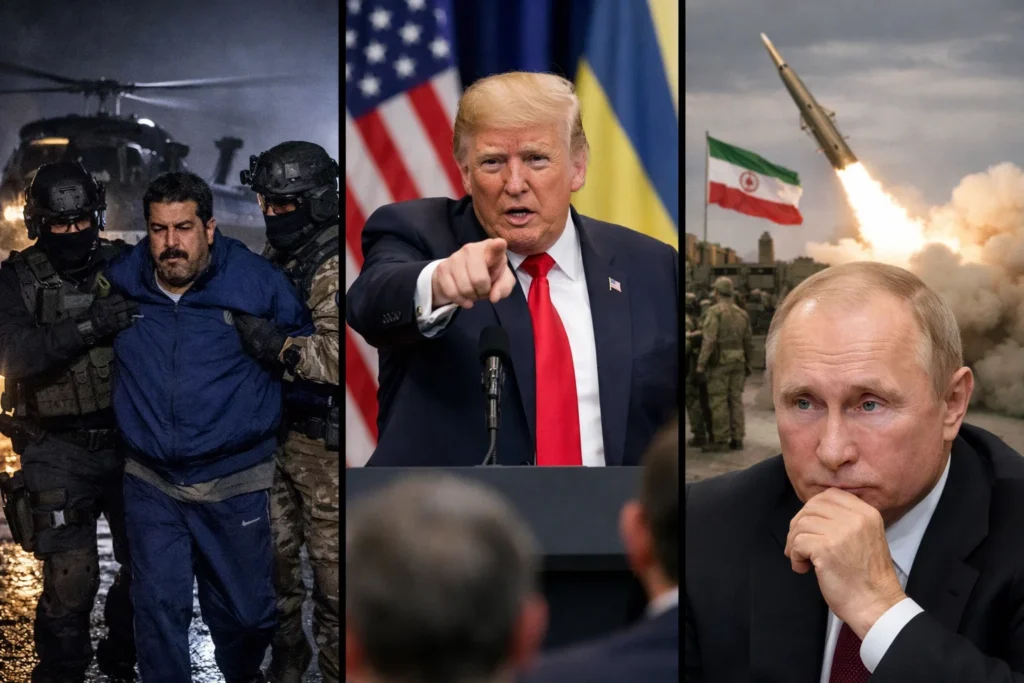
Three big moves this month — hardline threats toward Iran, a covert operation that captured Venezuela’s Nicolás Maduro, and a string of high-profile but sometimes contradictory U.S. signals on Ukraine — are not independent flashes of policy. They form a pattern. Together they squeeze the levers Putin relies on: energy revenues, diplomatic wiggle room and geopolitical backstops. The result is strategic pressure on Moscow — but also a thinner margin for error worldwide.
The three pressure points, explained
1) Iran: posture and limits
The U.S. has moved carrier groups, flown allied aircraft, and publicly warned of military options should Iran escalate or carry out severe repression of protesters. That posture is designed to deter Tehran and reassure partners, but several Gulf states have signalled limits: some major Gulf capitals say they will not host strikes, complicating coalition options and making any operation more unilateral and therefore riskier. The result: heightened deterrence with operational constraints — a pressure lever that alters how Russia views regional alignments and arms flows.
2) Venezuela: cutting off Russia’s oil lifeline
The U.S. capture of Maduro and follow-up interdictions of tankers tied to Venezuela have real economic bite. Analysts warn these actions undercut Russian crude access and revenue channels — especially the “shadow fleet” that once helped Moscow move oil to willing buyers. By seizing cargoes and putting Russian-flagged or Russian-linked vessels at legal risk, Washington is hitting Moscow where it matters: energy finance and the covert maritime logistics that back Russia’s ability to sustain long campaigns. That matters to Putin because oil money funds both domestic priorities and military effort.
3) Ukraine: mixed messages, hardened leverage
At Davos and in other fora the White House has performed a diplomatic balancing act: publicly urging an end to the war while signaling readiness to secure enforceable guarantees for Kyiv. That mixture — private pressure on Kyiv to compromise, public pressure on Moscow to end hostilities — creates a tight window for diplomacy. Putin now faces a moment where a negotiated deal might preserve some gains but would also lock in limits on Russia’s freedom to project power; alternatively, pushing ahead risks further isolation and economic pain. How Moscow reads Washington’s combination of carrots and sticks will shape the next move.

Why this is squeezing Putin
Putin’s strategic margin depends on three things: energy revenues to finance the state and military; durable diplomatic support (or at least neutrality) from partners like Iran or Venezuela; and the ability to exploit divisions among U.S. allies. The recent U.S. push attacks all three:
- Economic pressure: Venezuelan oil interdictions and tighter scrutiny of shadow shipping raise the cost and risk of Russia finding alternative markets — an erosion of a vital revenue channel.
- Diplomatic tightrope: U.S. moves force countries that might otherwise offer Moscow convenient political cover (or covert logistical help) to weigh risks of open alignment with Russia, particularly where U.S. enforcement and legal actions are visible.
- Exploiting ambiguity: Washington’s mixed signals on Ukraine — diplomacy plus pressure — create an environment where Moscow cannot assume an unlimited window to consolidate territorial gains without eventual costs. That uncertainty compresses Kremlin options.
Put differently: the U.S. campaign amplifies Putin’s trade-offs. He can double down and risk deeper isolation and economic pain, or he can seek a negotiated pause that cements some gains but constrains future expansion. Both are unattractive — and that is the pinch point.
Putin’s playbook — and the risks
How might the Kremlin respond?
- Escalate militarily in Ukraine to pressure Kyiv before any deal can be sealed — but that risks provoking further sanctions, military aid increases for Ukraine, and international unification against Russia.
- Seek new energy and trade partnerships (e.g., deeper ties with China or non-Western buyers) — possible, but costly and slow; the Maduro interdictions and shipping risks make these options noisier.
- Exploit diplomatic fissures by courting countries unhappy with U.S. policy — a long game that can blunt pressure but not instantly replace lost revenues or diplomatic capital.
- Use asymmetric measures (cyber, economic coercion, proxy actions) — risk of blowback and escalation remains high.
Each option carries trade-offs. The Kremlin’s most dangerous response would be miscalculation: interpreting mixed U.S. messages as weakness and acting in a way that triggers a more unified Western backlash. Conversely, an overcautious retreat could be politicized domestically as weakness — another bind for Moscow.
Where this could go next — three scenarios
- Diplomatic settlement: A deal on Ukraine that combines territorial concessions with robust, verifiable security guarantees and a phased normalization — Putin preserves some gains but sacrifices long-term freedom of action. This is the outcome the U.S. signal seeks to make more attractive to Moscow.
- Painful stalemate: Moscow ducks a deal, Western pressure ramps up, and Russia trudges into a prolonged squeeze: slower growth, constrained oil revenues and creeping isolation. This is slow-motion attrition.
- Escalatory spiral: Misread signals or a deliberate push by Moscow to change facts on the ground prompt a harsh allied response, which could widen the conflict and generate severe geopolitical and economic shocks. Risk of unintended consequences is highest here.
Practical takeaways — what policymakers, markets and citizens should watch
- Oil flows and tanker seizures: Shipping movements, insurance premiums and interdiction headlines will signal how effective pressure on Russia’s energy lifelines is.
- Allied cooperation vs. fragmentation: How Gulf states, European allies and others respond to U.S. Iran posture and Russia-related moves will determine coalition durability.
- Text of any Ukraine deal and enforcement clauses: Verification, sequencing and enforcement mechanisms (observers, sanctions triggers) will determine whether a settlement actually restrains Russian power.
Bottom line
The combination of aggressive pressure points — Iran warnings, the Maduro operation and targeted maritime enforcement, plus careful but mixed diplomacy on Ukraine — is compressing Putin’s strategic room for maneuver. That is the objective effect of the policy choices: to make costly the option of continued expansion while leaving a diplomatic off-ramp. But policymakers must manage the danger that mixed signals and unilateral moves could produce miscalculation. Tightening the vise on a rival works best when allied coordination is strong, legal foundations are clear, and back-channel diplomacy reduces surprises on the ground.