
Table of contents
- Quick summary
- The events, in sequence (what we know)
- Pyongyang’s public condemnation of U.S. action in Venezuela
- Military specifics: what was launched and where it flew
- Regional reaction and U.S. posture
- What analysts say: motivations and messaging
- Risks going forward: escalation, diplomacy, and sanctions
- What to watch next (timelines & likely documents)
- Reader poll — how worried are you about regional spillover?
- Closing note & disclaimer
1 — Quick summary (North Korea fires ballistic missiles)
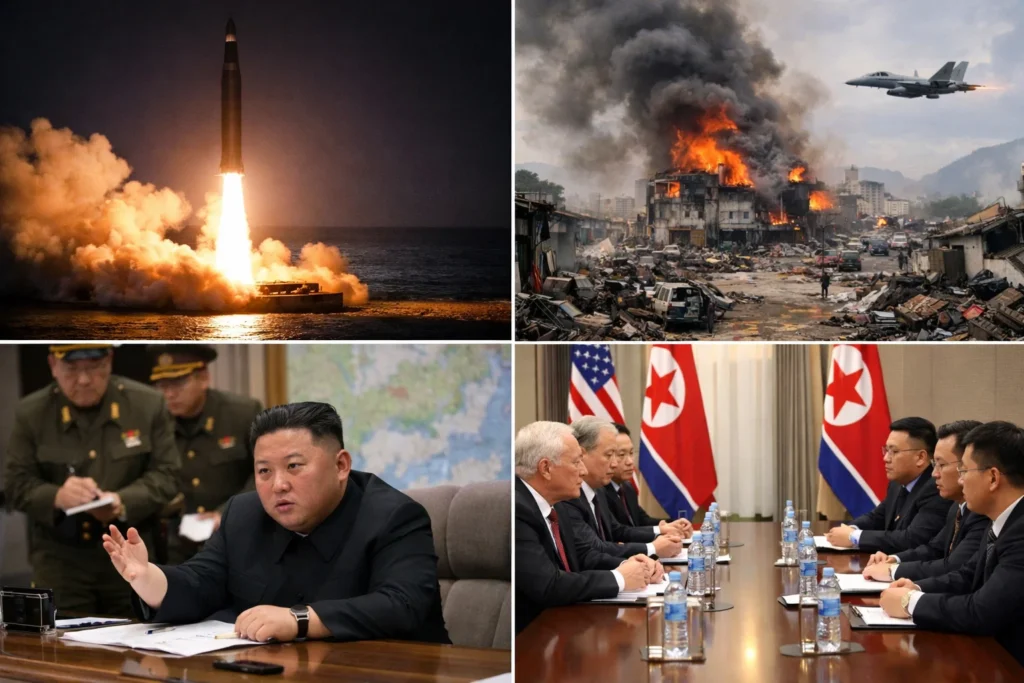
North Korea launched ballistic missiles into waters east of the Korean Peninsula on January 3–4, 2026, in its first missile activity of the year.
Pyongyang’s state media simultaneously condemned recent U.S. military strikes on Venezuela and framed the intervention as a breach of sovereignty.
2 — The events, in sequence (what we know)
South Korea’s Joint Chiefs and allied monitoring systems detected multiple ballistic missiles launched from the Pyongyang area that splashed down in the sea between the peninsula and Japan.
The launch came within hours or days of U.S. strikes on Venezuelan targets and the capture and removal of President Nicolás Maduro, actions that have produced a global diplomatic backlash.
3 — Pyongyang’s public condemnation of U.S. action in Venezuela
KCNA and North Korean foreign ministry statements described the U.S. strikes and Maduro’s capture as “the most serious form of encroachment of sovereignty,” urging international protest.
Pyongyang framed the operation as evidence of U.S. “rogue” behavior and used the incident to justify heightened rhetoric and military readiness.
4 — Military specifics: what was launched and where it flew
South Korean and Japanese tracking reported missiles launched from near Pyongyang that traveled several hundred to roughly 900 kilometers before splashing into the East Sea.
Seoul and Tokyo lodged formal condemnations, and U.S. Indo-Pacific Command said the launches posed no immediate threat to U.S. forces but would be closely monitored.
5 — Regional reaction and U.S. posture
South Korea and Japan publicly condemned the launches as violations of U.N. Security Council resolutions and destabilizing to regional peace.
Many governments — including Brazil and other Latin American actors — also denounced the U.S. strikes in Venezuela, producing a complex, multi-regional diplomatic crisis.
6 — What analysts say: motivations and messaging
Experts interpret the timing as purposeful signaling: North Korea appears to be asserting deterrence and aligning rhetorically with states decrying U.S. unilateral action.
Analysts note Pyongyang often uses missile tests to register displeasure abroad, to rally domestic support, and to remind partners and rivals of its strategic capabilities.
7 — Risks going forward: escalation, diplomacy, and sanctions
Short-term risks include further missile or conventional demonstrations intended to test allied readiness and to complicate diplomatic efforts.
Long-term risks include potential additional sanctions, increased military patrols from U.S. carriers, and greater strain on channels for de-confliction in Northeast Asia.
8 — What to watch next (timelines & likely documents)
Watch for: (a) formal U.S., South Korean, and Japanese intelligence updates about the missile types and trajectories;
(b) any North Korean follow-on statements or military parades; and (c) statements from the U.N. Security Council or emergency regional consultations.
After learning about the missile launches and the U.S.-Venezuela operation, how worried are you about international spillover?
10 — Closing note
This episode binds at least two theaters of contention — Latin America and Northeast Asia — into a single diplomatic shockwave.
As nations respond, the key indicators will be whether Pyongyang repeats missile activity, how allies recalibrate posture, and whether multilateral forums can de-escalate the new tensions.
Disclaimer: This article synthesizes official statements and reporting available as of early January 2026. It is for informational purposes only and does not substitute for official governmental, legal, or intelligence assessments.