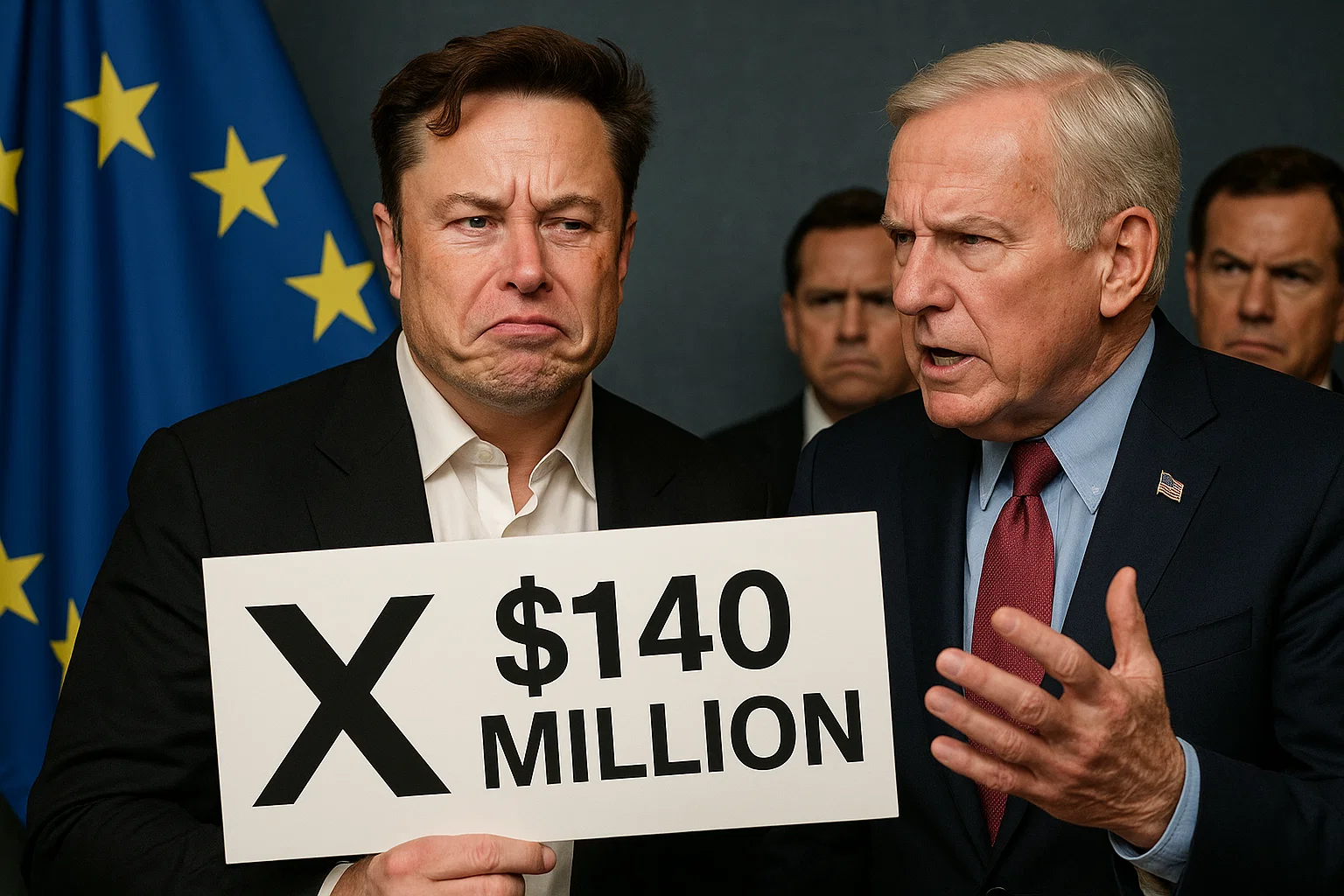
The European Commission has fined Elon Musk’s social platform X €120 million (about $140 million) for breaching the Digital Services Act.
Regulators said the penalty is the bloc’s first major enforcement under the DSA.
This explainer walks through what the fine covers, why it matters for platform regulation, how Washington reacted, and practical next steps for users, advertisers and researchers.
What the EU said — the official case in a nutshell
X Hit with $140M Fine: Brussels found X failed to meet DSA transparency obligations on several fronts.
Investigators cited the platform’s “deceptive” design of the paid verification (blue check), insufficient ad-repository transparency, and limits on researcher access to public data.
The Commission’s decision follows a multi-year probe and is legally significant because the DSA allows fines up to 6% of global turnover for the worst breaches.
For X, the €120m penalty is substantial — both symbolic and financially meaningful — as a first-of-its-kind sanction.
Why the blue check and ad transparency mattered
Regulators argued X’s paid-verification changes could mislead users about authenticity and trust signals.
Separately, the ad-repository shortcomings limited public visibility into who was paying for political and issue advertising across the EU.
Transparency rules are central to the DSA’s aim: to reduce manipulation, make platform design accountable, and allow independent researchers to assess online risks.
When platforms obscure verification signals or ad buyers, regulators see a direct risk to democratic information flows.
What X (and Elon Musk) said in response
Elon Musk blasted the fine on X, calling the penalty “crazy” and characterising the EU action as overreach.
Company spokespeople signalled they will review the decision and consider their legal options while noting they will continue compliance efforts where feasible.
Musk’s reaction revived a broader line of political criticism that the EU’s rules amount to censorship or undue control over speech.
That framing has fed swift pushback from some U.S. officials and pro-free-speech advocates.

How the U.S. reacted — a diplomatic layer appears
Top Trump administration officials condemned the EU’s action as unfair to American tech firms and framed the fine as an attack on U.S. free-speech norms.
The political back-and-forth raises the stakes: what started as regulatory enforcement now echoes in transatlantic policy tensions.
Expect continued vocal support for X from certain U.S. political quarters, which could complicate EU–U.S. cooperation on platform rules.
At the same time, Brussels has defended the penalty as lawful and necessary under the DSA’s transparency standards.
What the ruling requires X to do next
The Commission’s decision gives X a window to fix the cited compliance gaps — regulators often attach corrective requirements alongside fines.
Reports indicate X has roughly 60–90 days to implement remedies or face possible further sanctions under the DSA.
That timetable means product and policy teams at X must move quickly to redesign features, expand ad transparency, and broaden researcher access.
If X complies promptly, the fine may be the headline; failure to act could trigger escalated penalties or operational restrictions.
What this means for users, advertisers and researchers
Users may see changes to verification badges and clearer labelling for paid status or algorithmic nudges.
Advertisers will need to expect more stringent reporting requirements in the EU ad repository and higher scrutiny of political or issue ads.
Academic and policy researchers should get improved data access windows — a direct DSA goal — which could restore some independent study of platform effects.
Platforms that make ad data and public-data access robustly available also reduce reputational and regulatory risk in major markets.
Corporate & market fallout — short-term and long-term
In the short run, X faces a reputational hit and potential compliance costs as it redesigns services to satisfy Brussels.
Longer term, the decision signals to all large platforms that the DSA will be enforced and that transparency shortfalls carry real financial consequences.
Investors and advertisers increasingly price regulatory risk into platform valuations; this ruling will be factored into risk models across the sector.
Competitors may adjust product policies or emphasise compliance as a market differentiator in Europe.
Could this spark wider legal or diplomatic fights?
Yes — expect X to explore legal appeals and political supporters in Washington to push back diplomatically.
The case is likely to be referenced in future transatlantic talks about digital-rule alignment and platform governance.
If similar DSA enforcement accelerates, platforms with large EU user bases will have to re-engineer global products to meet divergent regional standards.
That could increase costs and complexity, and in some cases push companies to localise features by market to comply.
Quick checklist — what to watch next
- Official EU press release and the full decision text for specific remedial orders.
- X’s compliance roadmap and product changes for verification, ad transparency and researcher access.
- Any domestic U.S. political responses or diplomatic statements that could escalate the dispute.
Do you think the EU was right to fine X about $140M under the DSA?
Final take — measured, not partisan
The X hit with $140M fine headline is more than a story about one company; it’s a test of the DSA’s teeth and a marker for how democracies will govern giant platforms.
Practical impact will depend on X’s technical fixes, legal challenges, and whether Brussels or Washington escalate the political dimension.
Disclaimer: This article summarises reporting current as of the publish date and is for informational purposes only.
For official legal texts and corporate statements consult the European Commission and X’s press releases.