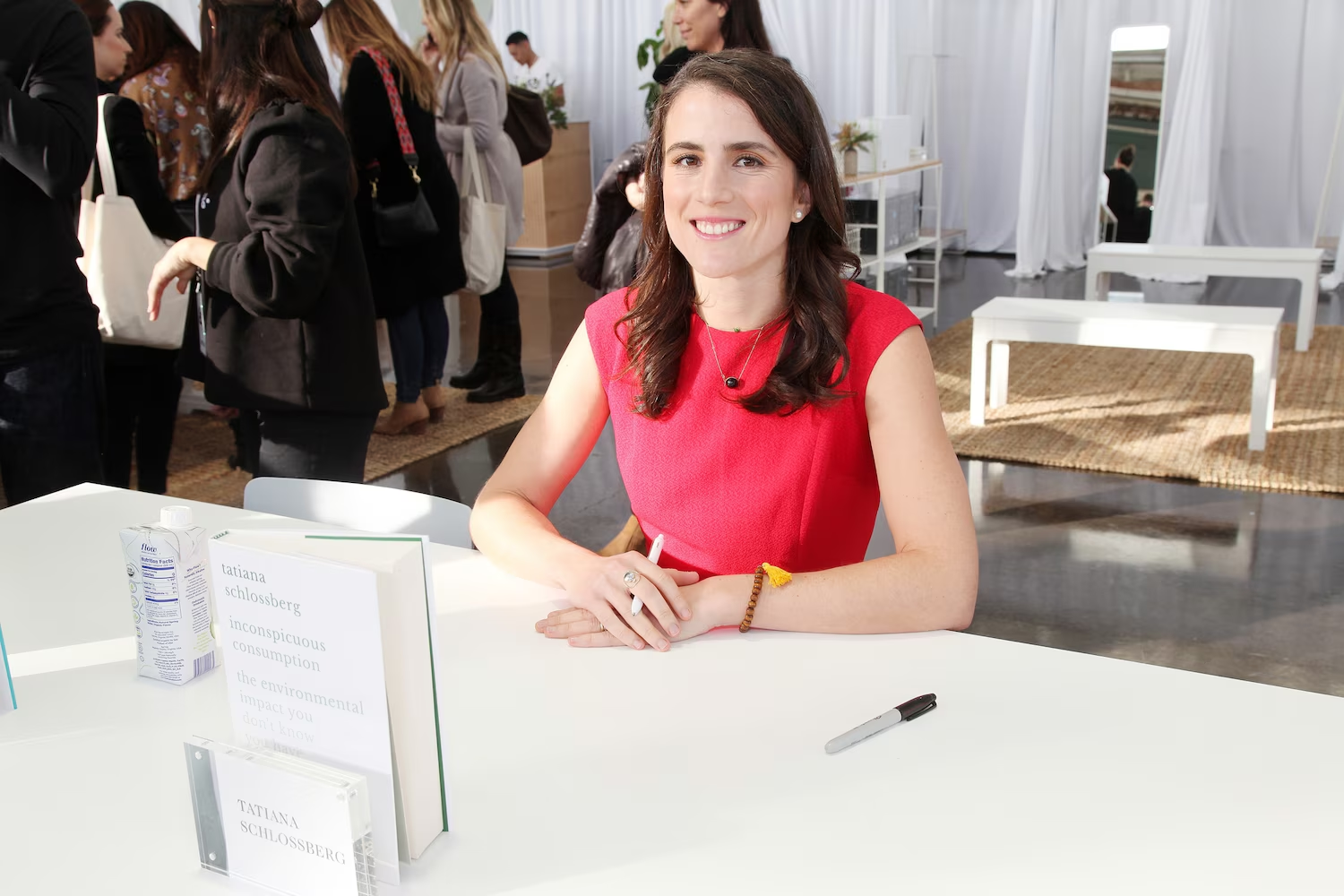
Tatiana Schlossberg illness ‘A Battle with her Blood’ by TrenBuzz — an in-depth, compassionate explainer that walks readers through the facts, the family background, the medical basics, and the public reaction to Tatiana Schlossberg’s announcement.
1) Who is Tatiana Schlossberg — the family and the public figure (Tatiana Schlossberg illness)
Tatiana Schlossberg is the daughter of Caroline Kennedy, U.S. ambassador and author, and designer-writer Edwin Schlossberg.
She is part of the Kennedy family lineage that includes President John F. Kennedy and Jacqueline “Jackie” Kennedy.
A former climate and environment reporter, Tatiana built a public voice through journalism and humane storytelling before sharing this private medical journey.
Her husband, Dr. George Moran, and her sisters — including Rose Schlossberg — are central to the family circle she describes in her essay.
2) What Tatiana said in her New Yorker essay — the core revelations
In “A Battle With My Blood,” Tatiana wrote candidly about the shock of diagnosis and the clinical details that followed her childbirth in May 2024.
She described very high white-cell counts, emergency hospitalization, chemotherapy, stem-cell transplants and participation in experimental trials.
Most striking, she said doctors found a rare genetic change called Inversion 3, an abnormality usually seen in older adults that made standard therapies unlikely to cure her.
Oncologists, she reported, told her in January that prognosis was measured in months, not years — an intimate, devastating update she chose to share publicly.
3) The diagnosis: what is acute myeloid leukemia (AML) — short, plain-language primer
Acute myeloid leukemia (AML) is a cancer of the blood and bone marrow that progresses quickly without treatment.
AML arises when immature white blood cells proliferate and crowd out normal blood production, causing infection, bleeding and organ problems.
Treatment often includes chemotherapy, targeted therapies, and stem-cell (bone marrow) transplants; outcomes depend on age, genetics and response to therapy.
Some genetic subtypes — like the rare inversion Tatiana described — can be especially aggressive and less responsive to conventional approaches.
4) Timeline and medical steps Tatiana described
Tatiana wrote that the first abnormal signal was an unusually high white-cell count noticed shortly after giving birth on May 25, 2024.
She then underwent intense inpatient and outpatient treatments, including two stem-cell transplants and experimental CAR-T participation and other trials.
Her account underscores how rapidly AML can move from seeming health to intensive hospital care.
She framed the medical narrative through family moments — the people who held her hand, who cared for her children, and who helped her make treatment decisions.
5) Why the essay triggered headlines: policy, family and public critique
Beyond the medical details, Tatiana used the platform to criticize her cousin, Robert F. Kennedy Jr., for positions and actions she said have weakened medical-science infrastructure.
Her essay alleges that policy choices — particularly cuts to research funding and skepticism toward medical science — have real consequences for patients seeking advanced therapies.
That line of critique connected a personal tragedy to wider public-policy debates about research dollars, vaccines, mRNA technology and the role of federal support for biomedical innovation.
Because the Kennedys are a high-profile family, Tatiana’s words amplified national discussion about health policy and government funding choices.
6) Family responses and public reaction so far
Tatiana’s siblings and relatives — including brother Jack Schlossberg and sister Rose Schlossberg — publicly expressed support; family members were noted as present in her essay.
Public reaction has been a mix of sympathy, praise for her candor, and debate over her policy criticisms of a family member in public office.
News organizations across the U.S. covered the essay and summarized her medical timeline; coverage emphasized both the personal courage of the piece and its political reverberations.
Readers and commentators are discussing not just the diagnosis but the policy implications Tatiana raised about research funding and medical innovation.
7) How to read the medical details responsibly — a caution for readers
Medical terms and prognosis are emotionally charged; Tatiana’s essay is a personal narrative, not a clinical guideline.
If you or someone you love faces AML or any serious diagnosis, consult qualified medical professionals — oncologists, hematologists and licensed care teams — for individual advice.
Public discussion of policy and funding is important, but it cannot replace personalized medical counseling; clinical decisions rest on tests, history and expert judgment.
TrenBuzz’s role here is to summarize facts, point to verified reporting, and remind readers to seek qualified medical guidance for health decisions.
8) What this moment means for the Kennedy family legacy and public memory
The Kennedys have long occupied a symbolic place in American memory — from JFK to Jackie Kennedy to Caroline Kennedy’s public service.
Tatiana’s candid essay is part of that family’s public record: another moment that blends private grief and public life in ways that capture national attention.
For historians and the public, her reflections — on memory, parenting and the fragility of life — add a new, intimate chapter to how the family’s story is told.
For many Americans, the essay opened conversations about grief, scientific investments and the personal costs of national policy.
Practical resources for readers who want to help or learn more
If you’re moved to support Tatiana’s family or those facing AML, consider reputable patient-advocacy groups, cancer-support networks and local service organizations.
For authoritative medical information about AML, consult professional bodies, cancer centers, and hospital oncology pages — and always verify through your medical team.
Journalists covering the story should rely on Tatiana’s New Yorker essay as the primary source for her account and use official family statements for confirmations.
Common questions answered (short)
Is Tatiana Schlossberg related to JFK?
Yes — she is a granddaughter of President John F. Kennedy and Jacqueline Kennedy, and the daughter of Caroline Kennedy and Edwin Schlossberg.
What type of cancer does she have?
She revealed she has acute myeloid leukemia (AML) with a rare “Inversion 3” mutation, which her doctors said is aggressive and difficult to cure.
Did she name specific people in power?
In her essay, Tatiana criticized her cousin Robert F. Kennedy Jr. for positions and actions she argues have weakened medical research and public-health capacity.
After reading Tatiana Schlossberg’s essay, what matters most to you?
Final thoughts — a human note
Tatiana Schlossberg’s essay is a difficult and brave public act: it asks readers to sit with private grief, complex medical science, and uncomfortable policy questions.
As the Kennedy family processes this new chapter, many Americans will respond with sorrow and curiosity — and with renewed attention to how research and policy shape lives.
Disclaimer
This article summarizes reporting available as of November 2025 and Tatiana Schlossberg’s own account in The New Yorker. It is informational and not medical advice.
If you or a loved one face AML or other health concerns, consult professional medical providers and accredited clinical resources for diagnosis and treatment guidance.