Published by TrenBuzz.com | May 7, 2026
Key Points at a Glance – How the US and China Are Quietly Building AI Rules
- The US and China are pursuing AI guardrails — narrow agreements to prevent their tech rivalry from causing a catastrophic miscalculation.
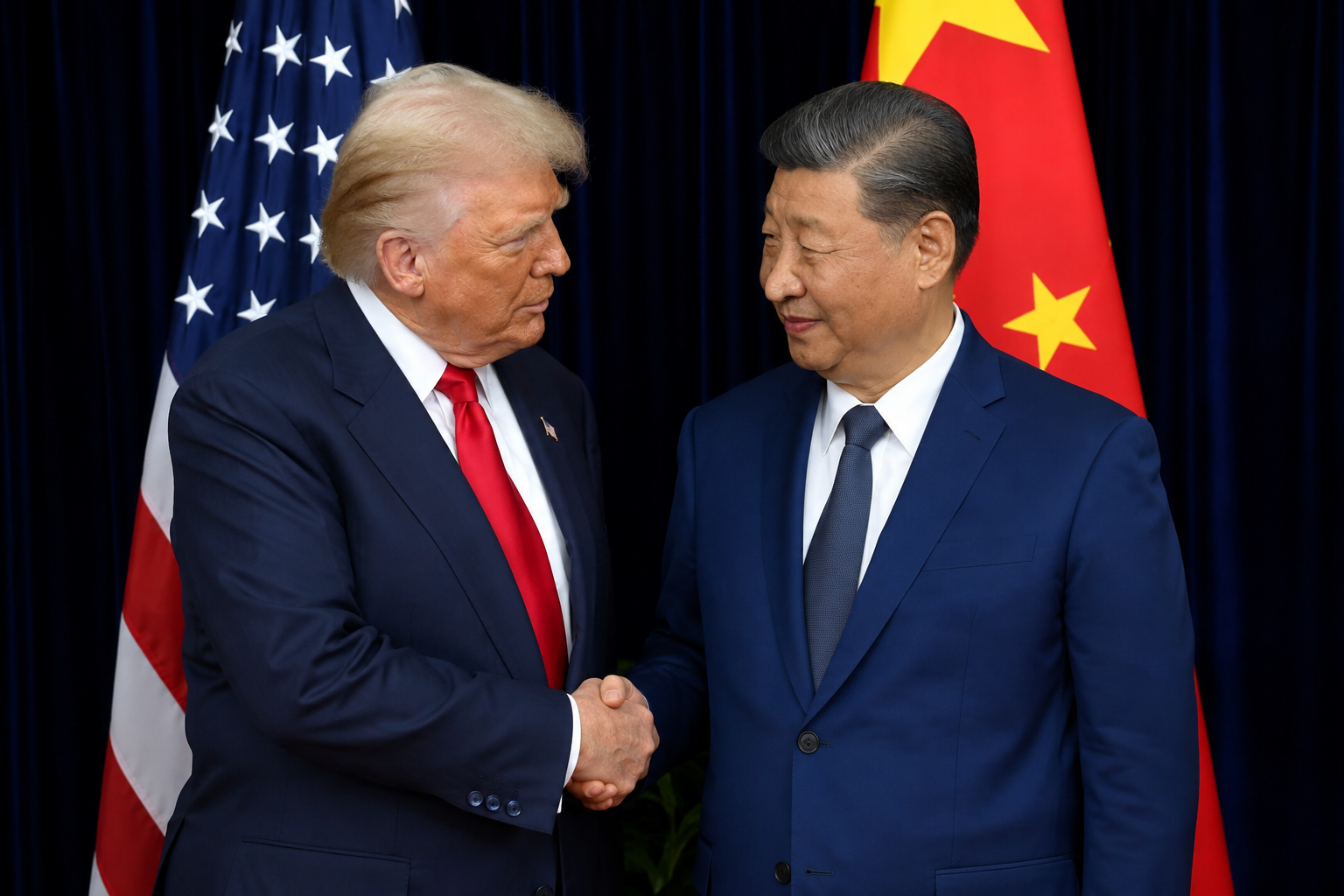
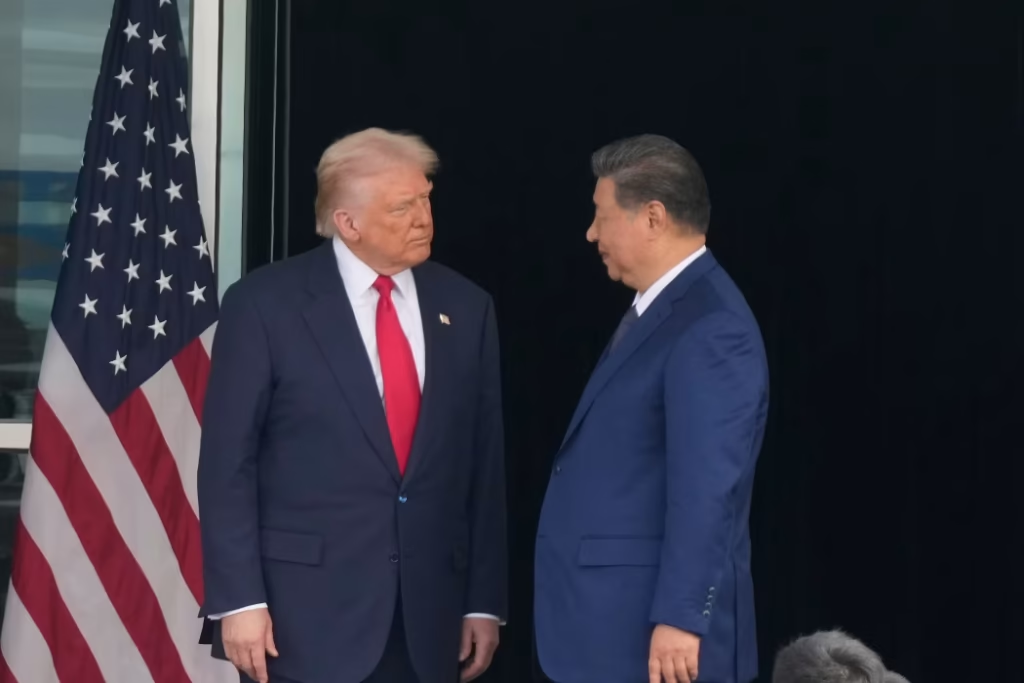
- Trump and Xi Jinping are set to meet in Beijing on May 14 — AI governance is a central agenda item.
- The White House OSTP accused China of “industrial-scale” AI technology theft just three weeks before the summit.
- Former Treasury Secretary Hank Paulson warned: “the meeting won’t take place if we’re back into war” — tying the Iran ceasefire directly to AI diplomacy.
- The Busan trade truce — set to expire in November 2026 — creates a narrow window for AI cooperation before political space closes.
- Experts are proposing Cold War-style protocols: shared testing standards, incident hotlines, verification tools — not model-sharing or joint development.
- China’s Global AI Governance Action Plan presents itself as a multilateral alternative to Washington’s bilateral-first approach.
- Both sides agree AI governs near-term military planning — making unmanaged AI incidents a direct war risk.
- Neither country wants to share model weights, proprietary data, or military AI applications — the focus is on preventing accidents, not enabling collaboration.
The United States and China are engaged in the most intense technological competition in history. They are also, quietly and carefully, trying to make sure that competition doesn’t accidentally start a war.
AI is both a driver of rivalry and a source of systemic risk for global markets and societies. When Donald Trump and Xi Jinping agreed at the recent APEC summit to set a floor under spiraling China-US trade relations, they also agreed to consider cooperation on artificial intelligence in the year ahead. With Trump and Xi planning an exchange of visits in 2026, now is the time for a “smart agenda” to identify which elements of AI make sense for Washington to discuss with its top strategic rival.
What “Guardrails” Actually Means — Not Cooperation, Not Conflict
Shared protocols, evaluation methods, and verification tools are among the most promising and least risky starting points for cooperation between geopolitical rivals on AI. Safety frameworks and best practices give both sides a shared vocabulary for responsible development. Testing and evaluation methods help them understand whether advanced systems behave safely and reliably outside the lab — and can help ensure that fatal accidents do not recur. None of this requires sharing model weights, proprietary data, or anything close to military applications.
The key word is “floor.” Not a treaty. Not a partnership. A bare minimum of shared rules to prevent worst-case scenarios.
The Cold War Analogy — Why History Says This Can Work
History suggests that when rivals manage dangerous technologies, they usually start with tightly bound, low-risk measures. During the Cold War, Washington and Moscow built narrow agreements on nuclear testing, incident reporting, and crisis hotlines long before there was anything like trust. They traded limited technical information, set up verification rituals, and created habits of communication that helped both sides avoid worst-case misunderstandings and accidents. None of that ended the arms race. But it made the arms race less likely to end the world.
The White House Accusation — AI Theft Ahead of the Summit
The White House Office of Science and Technology Policy accused China of “industrial-scale” AI technology theft just three weeks before the Trump-Xi summit. “The US has evidence that foreign entities, primarily in China, are running industrial-scale distillation campaigns to steal American AI. We will be taking action to protect American innovation,” OSTP Director Michael Kratsios wrote.
The memo added that these distillation campaigns “allow those actors to deliberately strip security protocols from the resulting models and undo mechanisms that ensure those AI models are ideologically neutral and truth-seeking.” The accusation drops while both governments are simultaneously trying to establish those same AI guardrails in Geneva — a contradiction that defines the entire relationship.
The Iran-AI Connection — Paulson’s Warning
Former Treasury Secretary Hank Paulson tied the AI summit directly to the Iran war. “The meeting won’t take place if we’re back into war,” Paulson told Fox Business. “What we know is both want stability. Expect the Chinese to welcome Trump with all the pomp and ceremony, and then expect an emphasis on stability.” He called for mechanisms that prevent trade from spinning out of control, and specifically for AI guardrails so “we each understand the other’s red lines, we can compete, and we don’t get into a war.”
The Ticking Clock — November 2026 Is the Deadline
The window for building these guardrails is narrow: the Busan trade truce expires in November 2026, and with it, much of the political space that makes even limited cooperation possible. The goal is not financial integration or policy alignment — rather, the focus is on pragmatic guardrails that recognize a basic reality: unmanaged AI incidents would harm both economies, and the global system, in ways neither side can afford.
The United States and China will not only need to manage their own strategic rivalry but also take steps to guard against AI misuse by rogue actors. This shared vulnerability should compel both powers to act in parallel. A flexible, multilayered approach is needed — one that includes multilateral coalitions, monitoring regimes, and targeted bilateral efforts to establish safeguards before a crisis makes all of it impossible.
The race for AI supremacy is real. The dangers of that race going unmanaged are equally real. And on May 14, 2026, in Beijing, two presidents will sit down to try and build enough of a floor to survive the race they’re both determined to win.
Disclaimer: This article is for general informational and educational purposes only. All quotes, policy details, and expert assessments referenced are based on publicly available sources including the Wall Street Journal, World Economic Forum, The Diplomat, Brookings Institution, and Fox Business as of May 6–7, 2026. The Trump-Xi summit is confirmed for May 14, 2026 — agenda details may evolve. TrenBuzz.com does not represent any government, technology company, or intelligence body. Readers are encouraged to follow credible news and official government sources for real-time updates.