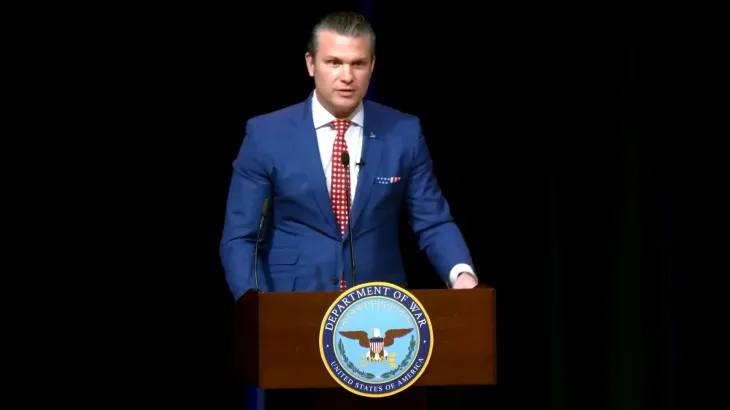
Defense Secretary Pete Hegseth led a Pentagon worship service using a prayer nearly identical to Samuel L. Jackson’s iconic Pulp Fiction monologue — a speech Quentin Tarantino invented and falsely attributed to Ezekiel 25:17. Here’s everything that actually happened.
By TrenBuzz Staff | Washington, D.C. | April 16, 2026 | 5 min read
Key Points
- Defense Secretary Pete Hegseth led a Pentagon prayer service on April 15, 2026, reciting a prayer nearly word-for-word from Quentin Tarantino’s 1994 film Pulp Fiction.
- The prayer is called “CSAR 25:17” and was given to Hegseth by the lead mission planner of the “Sandy 1” combat rescue team that recovered a downed U.S. airman from Iran on April 3.
- Hegseth said the prayer was “meant to reflect Ezekiel 25:17” — but the actual biblical verse is a single sentence that bears almost no resemblance to what he recited.
- The Pulp Fiction version of Ezekiel 25:17 was itself invented by Tarantino and co-writer Roger Avary, adapted from a 1973 Japanese martial arts film.
- The video went viral on social media, sparking a fierce debate about whether Hegseth knowingly or unknowingly quoted a Hollywood hitman’s death speech at a Pentagon religious service.
- The Pentagon defended Hegseth, saying he never claimed to be quoting scripture directly.
- The incident came the same day House Democrats filed articles of impeachment against Hegseth.
It started as a solemn Pentagon prayer service. It ended as one of the most unexpectedly viral moments of 2026.
On April 15, Defense Secretary Pete Hegseth stood before Pentagon staff during his monthly Christian worship gathering and read aloud what he described as a combat prayer used by Air Force rescue crews ahead of missions in Iran. The words were powerful, dramatic — and immediately recognizable to anyone who has seen Pulp Fiction.
The prayer Hegseth recited was almost a direct echo of the iconic monologue delivered by Samuel L. Jackson’s hitman character Jules Winnfield in Quentin Tarantino’s 1994 Oscar-winning film — a speech that the character falsely attributes to Ezekiel 25:17.
What Pete Hegseth Actually Said at the Pentagon
Hegseth opened the prayer by explaining its backstory. He told the audience the prayer had been used by the “Sandy 1” Combat Search and Rescue (CSAR) teams — A-10 attack aircraft crews — ahead of a real mission that rescued a downed U.S. Air Force pilot from inside Iran on April 3, 2026.
“They call it CSAR 25:17, which I think is meant to reflect Ezekiel 25:17,” Hegseth said. Then he asked the room to pray with him and read the following: “The path of the downed aviator is beset on all sides by the inequities of the selfish and the tyranny of evil men. Blessed is he who in the name of camaraderie and duty shepherds the lost through the valley of darkness, for he is truly his brother’s keeper and the finder of lost children. And I will strike down upon thee with great vengeance and furious anger those who attempt to capture and destroy my brother. And you will know my call sign is Sandy 1 when I lay my vengeance upon thee. Amen.”
The prayer was livestreamed by the Pentagon’s own media channel, Defense Now — and within hours, social media lit up with one question: Did Pete Hegseth just quote Pulp Fiction?
Ezekiel 25:17 — The Bible, the Movie, and the Mix-Up
Here is where the story gets layered. The real Ezekiel 25:17 in the King James Bible is a brief, sharp declaration of divine vengeance against the Philistines: “And I will execute great vengeance upon them with furious rebukes; and they shall know that I am the Lord, when I shall lay my vengeance upon them.” One sentence. No aviators. No valley of darkness.
The sweeping, cinematic version of Ezekiel 25:17 most people know — “The path of the righteous man is beset on all sides…” — was written by Quentin Tarantino and co-writer Roger Avary for Pulp Fiction. They in turn adapted it from a 1973 Japanese martial arts film called Bodyguard Kiba, which had falsely attributed a similar speech to Ezekiel.
Tarantino’s version has Jules say it before executing a man in cold blood. The CSAR version Hegseth recited swaps out “the righteous man” for “the downed aviator” and “Sandy 1” for “the Lord” — but the cadence, structure, and language are unmistakably Tarantino’s.
“Pete Hegseth quoted a fake Pulp Fiction Bible verse during a Pentagon sermon.”— Viral Reddit post, 22,000+ upvotes, April 16, 2026
Did Hegseth Know? The Pentagon’s Defense
Pentagon spokesman Sean Parnell moved quickly to defend Hegseth on X, insisting the Secretary never claimed he was quoting the actual Bible. “Anyone saying the Secretary misquoted Ezekiel 25:17 is peddling fake news and ignorant of reality,” Parnell wrote, adding that “both the CSAR prayer and the dialogue in Pulp Fiction were reflections of the verse Ezekiel 25:17.”
Fact-checkers at Snopes confirmed that Hegseth did explicitly introduce the prayer as “CSAR 25:17” — a military adaptation — rather than presenting it as actual scripture. Still, the episode raised broader questions about whether military culture has quietly absorbed a Hollywood hitman’s monologue as a genuine spiritual text without anyone noticing.
The timing added another layer: the prayer service happened the same day House Democrats filed articles of impeachment against Hegseth, making April 15 one of the most eventful days yet for the Secretary of War.
Why This Moment Says Something Bigger
The Hegseth Pulp Fiction prayer story is funny on the surface — but it points to something genuinely interesting. Pop culture, military tradition, scripture, and political theater have collided in a single two-minute video clip from a government worship service. The fact that soldiers were reportedly reciting a Tarantino-derived speech before combat missions in Iran is, on its own, a remarkable cultural artifact.
Whether Hegseth knew the origins of the prayer or not, Quentin Tarantino — who has never served in the military — may have accidentally written one of the most memorable pre-mission prayers in U.S. military history. That is something no one involved in making Pulp Fiction in 1994 could have imagined.
The internet, at least, has already moved on to comparing Hegseth to Jules Winnfield and wondering which Tarantino speech he might recite next.
Disclaimer: This article is published for informational and news reporting purposes only. All content is based on publicly available sources, verified reports, and official statements as of April 16, 2026. TrenBuzz.com does not make any religious, political, or editorial judgment about the individuals or organizations mentioned. References to Pulp Fiction are made in a strictly factual and journalistic context.