Key Points: Social Security 2100 Act
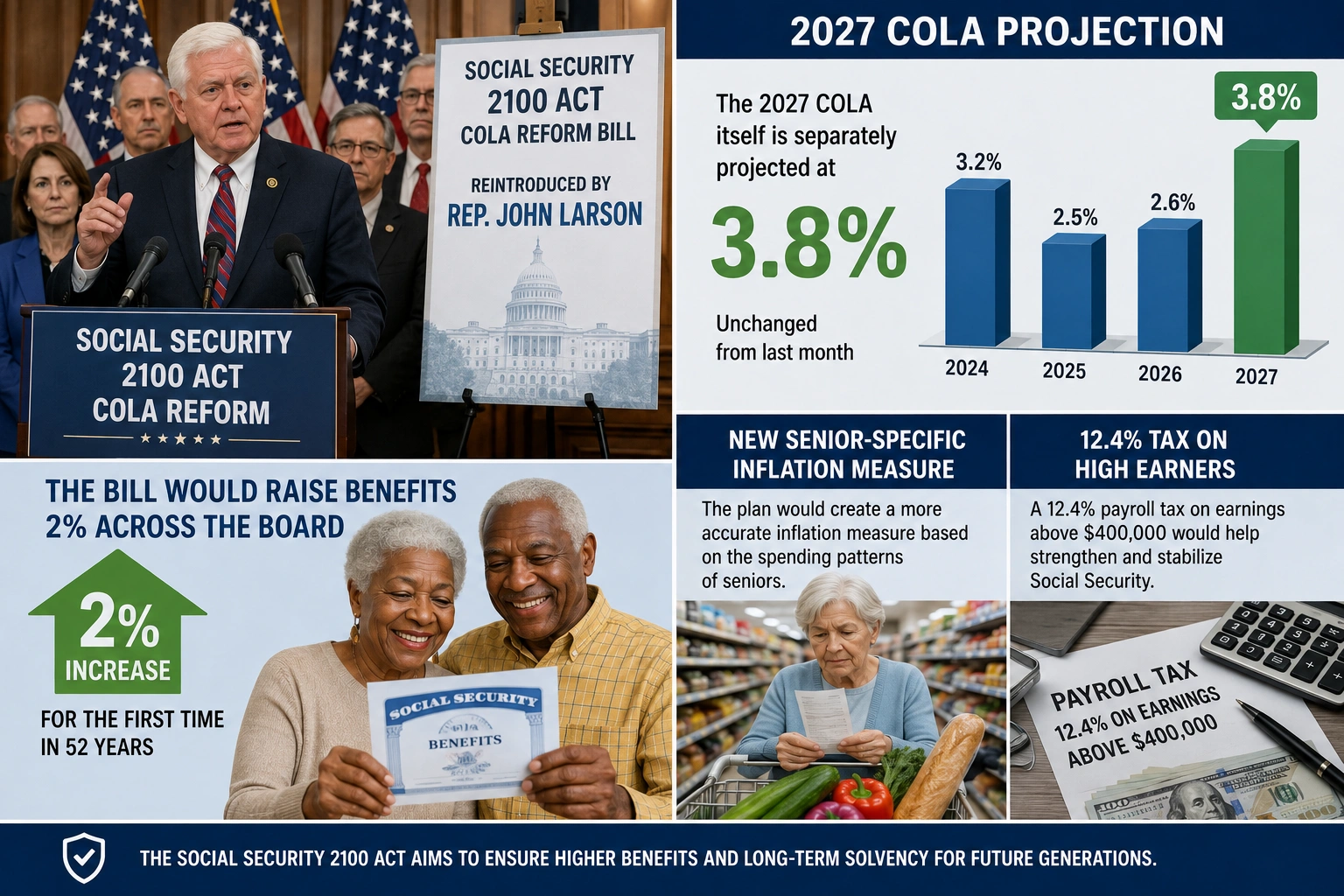
- Social Security 2100 Act COLA reform bill was just reintroduced by Rep. John Larson
- The 2027 COLA itself is separately projected at 3.8%, unchanged from last month
- The bill would raise benefits 2% across the board for the first time in 52 years
- A new senior specific inflation measure and 12.4% tax on high earners anchor the plan
Two separate Social Security stories are colliding on Capitol Hill this week, one about your actual 2027 raise, and one about a bill trying to fix the formula behind it entirely.
What The Social Security 2100 Act Actually Does
Rep. John Larson reintroduced the Social Security 2100 Act, H.R. 9519, this week, referring it to multiple House committees for review.
Here’s the headline provision. The bill would raise benefits by 2% across the board for every Social Security beneficiary, something that hasn’t happened in 52 years.
It would also switch how COLAs get calculated, adding the Consumer Price Index for the Elderly, known as CPI-E, which tracks spending patterns specific to Americans 62 and older.
That distinction matters because current COLA calculations use CPI-W instead, a formula built around younger, working-age consumers rather than retirees’ actual costs.
Why Advocates Call This The Gold Standard
The bill would establish a new minimum benefit too, set at 125% of the federal poverty line for workers with at least 30 qualifying years of work history.
Here’s what that means in real dollars. The 2026 poverty line for a single person sits at $15,650 annually, or $1,304 monthly, a benchmark roughly 5.6 million seniors currently fall below.
Shannon Benton of The Senior Citizens League called the bill “the gold standard for Social Security reform,” even while acknowledging it faces long odds of actually passing this Congress.
Here’s how the bill plans to pay for these improvements. It would impose a 12.4% investment tax specifically on high earners making $400,000 or more annually.
How This Connects To Your Actual 2027 Raise
Separately, and more immediately relevant to most retirees, TSCL’s latest COLA forecast for 2027 held steady at 3.8%, unchanged from last month’s projection.
That would push the average monthly benefit from $1,937.53 to $2,011.15, an increase of roughly $73.62 for typical beneficiaries.
Here’s an important distinction worth understanding. This 3.8% figure reflects the existing COLA formula, not the CPI-E change the 2100 Act proposes.
If the 2100 Act eventually passed, future COLAs from 2027 through 2036 would shift toward that senior-specific inflation measure, potentially delivering larger increases in years when healthcare costs outpace general inflation.
With the official 2027 COLA announcement still not expected until mid-October, and the broader reform bill facing a genuinely difficult path through Congress, retirees are watching two very different timelines unfold simultaneously.